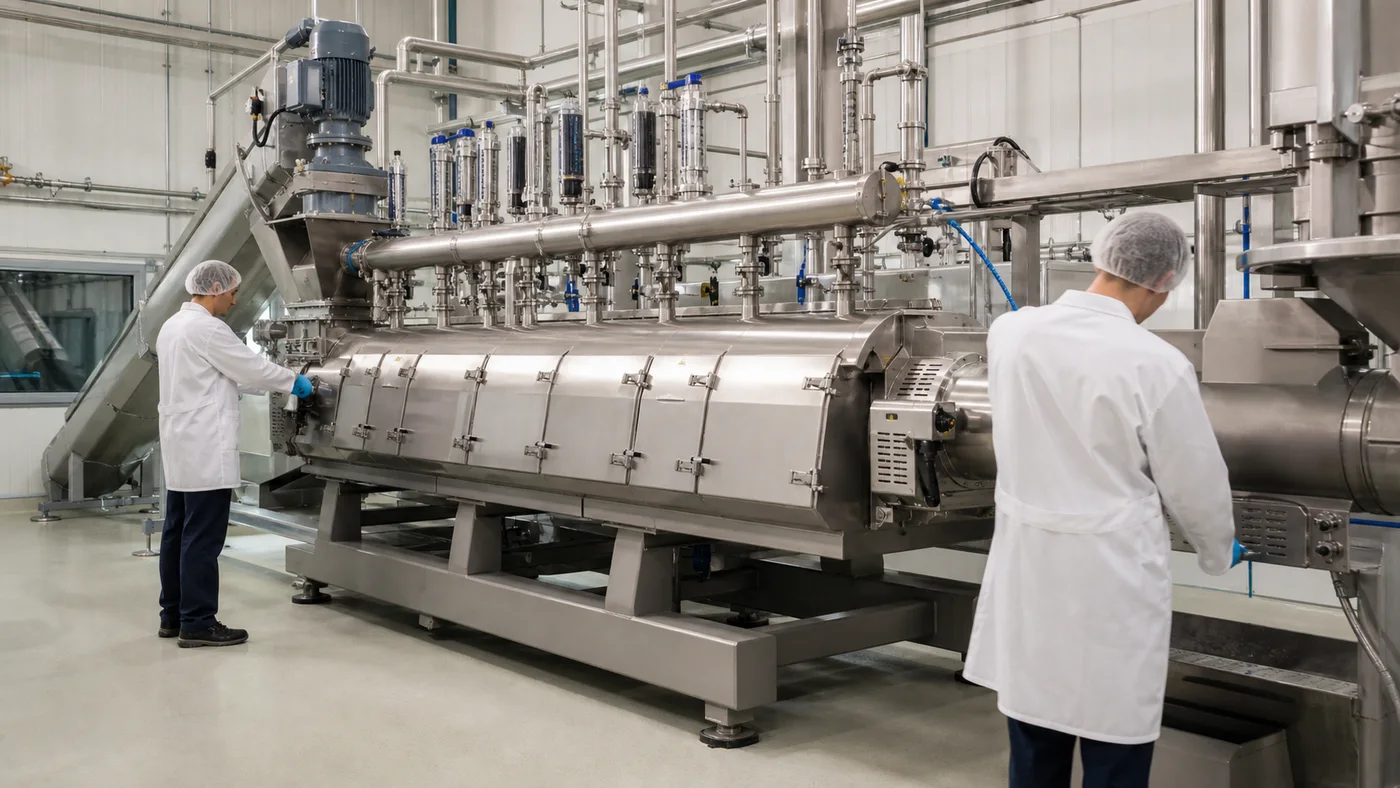
Preconditioning prepares dry pet food meal for extrusion by wetting, heating, and mixing it before it enters the extruder. The equipment is often positioned directly upstream of the barrel, but its effect extends across the line: it influences material flow, hydration, thermal history, extruder torque, pressure stability, expansion, density, energy use, and the load placed on drying and coating.
A preconditioner is therefore not just a steam inlet above a paddle mixer. It is a controlled processing zone with a defined recipe, mass balance, residence-time range, sanitary condition, and interface to the extruder. This guide explains how to plan that zone as part of a complete pet food factory system.
Define the purpose for each product family
Start with the products to be made, not a nominal machine capacity. For each recipe family, list the ground meal composition, starch sources, protein and fibre range, fresh-meat or slurry additions where applicable, initial moisture, bulk density, particle distribution, target product form, expected rate, and product-quality measures. These conditions determine how readily the material absorbs water and steam, how it moves through a conditioner, and how much work remains for the extruder.
Typical objectives include more uniform hydration, controlled temperature rise, partial cooking before the extruder, stable feeding, reduced mechanical load, and a wider operating window for defined products. The correct combination of moisture, temperature, and time differs by formula and product route. It must be established through trials and validated against downstream performance, not copied from a different line.
The starting meal must also be consistent. Variations in the grinding system and particle-size distribution can change water absorption, bulk density, and the amount of dry core remaining after a given residence time. A conditioner cannot reliably correct an unstable upstream grind or an incorrect batch formulation.
Understand the three core inputs: moisture, heat, and time
Conditioning uses liquid water, steam, and mechanical mixing to create a warm, moist material before extrusion. Water provides moisture; steam contributes both moisture and thermal energy; mixing distributes these additions; and retention time allows absorption and heat transfer to progress. These variables are coupled. Raising steam pressure or flow may change temperature and water addition together, while changing meal feed rate alters the residence time available for both.
Bühler describes conditioning as holding dry material in a warm, moist environment before extrusion so wetting, heating, and mixing support moisture penetration. It also notes that starch gelatinization and protein denaturation can begin during this stage. Read the official conditioning overview. These principles are useful, but do not create a universal setpoint for every pet food formula.
Define a mass and energy balance for each guaranteed product. Record dry-meal rate, incoming moisture and temperature, liquid-water additions, steam conditions, product temperature leaving the conditioner, expected moisture at the extruder feed, and all relevant losses or recirculation. Every equipment package, control recipe, and acceptance test should use the same basis.
Separate liquid-water addition from steam addition
Steam is a useful heat-transfer medium, but it is not always the best way to add all of the required moisture. Depending on pressure and condensate condition, a steam flow rate contributes a limited quantity of water with a significant amount of energy. If a formula requires additional moisture without a proportional temperature increase, controlled liquid-water dosing may be required.
Keep the two delivery systems distinguishable in the process design and records. Specify water quality, temperature, filtration, storage, pump accuracy, flow measurement, injection location, nozzle condition, and line sanitation. For steam, specify pressure, dryness or quality expectation, condensate management, pressure reduction, control valve sizing, insulation, steam traps, and safety. A simple steam-flow estimate does not prove the moisture delivered to the material.
Check the point of injection. Water added as large droplets onto a static meal surface can create wet clumps; poorly distributed steam can condense in a local zone or on equipment surfaces. The location, nozzle pattern, material movement, and liquid timing must be evaluated together.
Choose conditioner architecture for the required retention
Single- and twin-shaft conditioners use paddles or other mixing elements to lift and turn the meal while water and steam are introduced. Multi-stage arrangements can separate intensive initial mixing from a longer retention stage. The appropriate choice depends on product portfolio, target residence-time distribution, required addition range, footprint, sanitation expectations, and the stability needed at the extruder inlet.
Geometric volume is not usable retention volume. Effective residence time depends on actual fill level, bulk density, throughput, shaft configuration, paddle angle, internal geometry, and discharge behaviour. A simple calculation based on empty vessel volume can materially overstate the time available to the product.
Ask suppliers to state their assumed product density, fill level, throughput, and the method used to establish retention. ANDRITZ identifies heat, moisture, and time as conditioning variables and describes controlled steam and liquid addition, adjustable paddles, and retention as equipment considerations. Its conditioner overview is a useful comparison reference; the final design must still be proven with the project's materials.
Control residence time and avoid hidden short-circuiting
Nominal residence time is not enough. Material can move more quickly along one path, sit in a stagnant corner, or remain on an internal surface through a product changeover. These effects change the actual thermal and moisture history of portions of the product and can create carryover.
Review the flow path from inlet to discharge. Define the expected fill range, paddle arrangement, weir or discharge configuration, start-up and shutdown sequence, and how low-level operation behaves. If a long retention stage is used, establish whether it delivers a near first-in, first-out result or a broad distribution. That information matters for quality, traceability, sanitation, and the interpretation of process samples.
During commissioning, a suitable tracer or agreed test approach can demonstrate the actual material flow. The test must be planned with the site quality and safety teams; it should not introduce an uncontrolled ingredient into production. Confirm the result at minimum, normal, and maximum practical rates.
Match mixing intensity to the material
The conditioner must distribute water and steam without leaving dry cores, wet balls, or unmixed pockets. Higher mechanical action may improve dispersion for a difficult formula, but it can also affect fragile material, heat generation, deposits, and residence-time behaviour. The correct paddle geometry and shaft speed are formula- and equipment-specific.
Define what the mixer must achieve: distribution of additions, wetting rate, absence of visible lumps, stable discharge, and acceptable product temperature. Do not specify maximum motor power or shaft speed as a quality proxy. Measure the conditioned material and the downstream response instead.
Conditioning also begins before the machine. A stable batch from the main mixing system makes hydration more predictable. Poorly mixed meal, variable micro-additions, or inconsistent pre-extrusion liquid addition can be mistaken for a conditioner problem.
Design the inlet and extruder transfer as one system
Meal should arrive at the conditioner at a controlled rate without bridging, pulsation, or uncontrolled air entrainment. The conditioner discharge should transfer the conditioned material to the extruder without allowing it to cool, segregate, dry out, or accumulate. A surge bin or long conveyor between the two units can change the state that was created in the conditioner.
Use a positive, controllable transfer device where the process requires it. Define capacity, enclosure, cleanout, product temperature, transition time, level control, and the response to an extruder trip. When the extruder stops, the conditioner and upstream feed must respond in a way that avoids an unknown mass of over-conditioned material remaining in the line.
The pet food extrusion guide explains why feed consistency, energy input, and die conditions belong in the same process discussion. Extruder torque, pressure, motor load, and product density are useful downstream signals, but they must be interpreted alongside actual conditioner feed rate, temperature, and moisture data.
Measure the state of the conditioned meal
Setpoints are not results. A preconditioning control system should distinguish requested water and steam additions from measured flows, and both from the actual condition of the product. Useful measures may include meal rate, water flow, steam flow or valve position with steam pressure, product temperature, moisture by a validated method, shaft speed, motor load, vessel level, and downstream feed rate.
No single instrument proves hydration. A rapid moisture measurement must be checked against a defined reference method and used with consistent sample preparation. A surface probe temperature can respond differently from the bulk material. Sensors should be installed where they represent the product state and can support an operator decision.
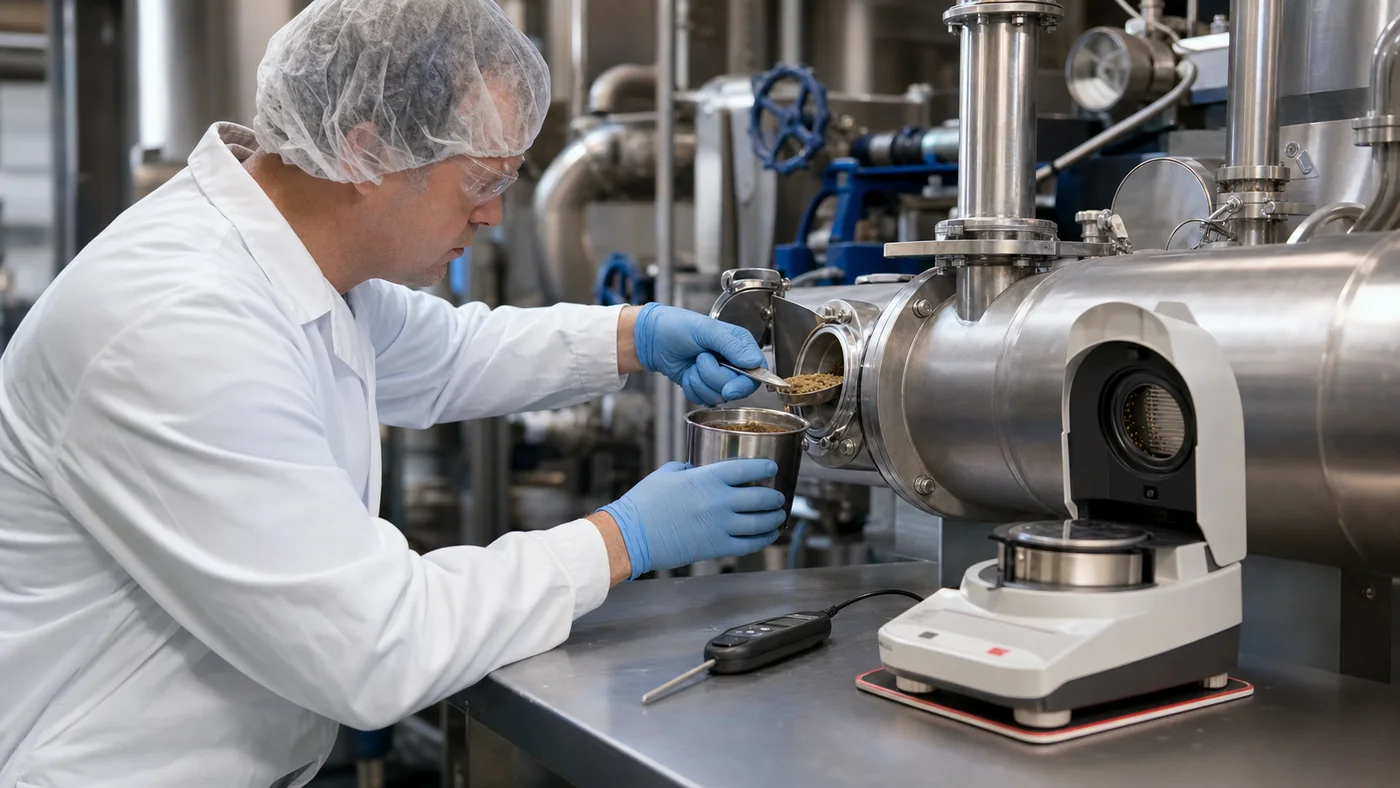
Use a representative sampling plan
Take samples at a controlled point close to the extruder feed, after the conditioner has reached stable operation. Record recipe version, dry-meal rate, ingredient lots where relevant, water and steam data, conditioner level and speed, time, sample location, temperature, and extruder status. Keep separate samples where the aim is to observe changes across time or line conditions.
Compare measured moisture and temperature with the operating window for that product, then compare the result with extruder torque, pressure, product expansion, density, cut quality, and dryer load. A result that looks correct in the conditioner but causes unstable extrusion is not a finished process validation.
Do not create a universal moisture or temperature target in a public article or equipment request. The approved operating range belongs to the actual formula, product specification, manufacturing controls, and customer or market requirements.
Plan steam and water utilities from the real duty
Conditioning performance depends on utility stability. Steam pressure, flow capacity, condensate removal, water pressure, water temperature, and electrical power for drives and pumps must remain within the required envelope during line operation. A shared plant steam header may experience load changes from other users; that should be included in the utility balance rather than discovered after installation.
Specify pressure reduction and control valves for the required flow range, not only the maximum header pressure. Insulate steam lines, avoid low points that collect condensate, provide drainage and maintenance access, and protect operators from hot surfaces. Water systems need cleanable tanks or lines where required, appropriate filtration, backflow protection, and a sanitation approach that matches the site risk assessment.
The factory's utility-planning guide provides the broader load-schedule method. Conditioning demand needs to be reconciled with the extruder, dryer, cleaning, and other process loads on the same utility systems.
Keep process validation separate from food-safety claims
Heat, moisture, and retention can influence the microbiological and physical condition of meal, but a preconditioner should not be represented as delivering a universal safety result. Any pathogen-reduction, lethality, or other food-safety claim must be established by the site's documented hazard analysis, validated process, monitoring plan, and applicable regulations. Product temperature alone does not establish that a required control has been achieved.
Where conditioning is part of a preventive-control strategy, define the controlled parameters, validated operating range, sensor location, monitoring frequency, corrective action, product disposition, verification, calibration, and record review. Where it is not a preventive control, it should still be managed as a process step that influences consistency and downstream performance. This distinction keeps engineering targets, quality specifications, and legal responsibilities clear.
During trials, record the conditions that support the result without overstating them: formula identity, meal moisture, water and steam addition, product temperature, retention evidence, extruder behaviour, and finished-product observations. The process owner should then decide which observations are development data, which become routine quality checks, and which, if any, are part of the formal food-safety plan.
Design hygienic access and changeover before installation
Warm, moist material can adhere to paddles, shafts, vessel walls, inlet and outlet transitions, sampling ports, and injection nozzles. Those surfaces need access for inspection, cleaning, and maintenance. If an operator cannot see or reach a residue point safely, cleaning instructions alone will not make the system hygienic.
Map all product-contact surfaces, dead legs, drains, joints, seals, spray points, and locations where condensation can occur. Define dry or wet cleaning as appropriate, including disassembly, cleaning agent, rinse or dry-out needs, inspection criteria, verification, restart checks, and records. Wet cleaning introduces its own drainage and drying controls; it should not be added casually to a line designed around dry operation.
Sequence products according to the site's hazard and cross-contact review. Use controlled flush material only where it is defined, identified, and reconciled. The conditioning system must use the same batch identity as receiving, mixing, extrusion, and packaging so an investigation can follow material through the complete route.
Protect operators and control process deviations
Preconditioning combines rotating shafts, hot steam, pressurised piping, wet floors, electrical drives, and sometimes manual access for sampling or cleaning. The design should include guards, interlocked covers, lockout/tagout points, controlled vessel opening, pressure relief where appropriate, non-slip floors, drainage, insulation, lighting, and access platforms that do not require operators to climb over moving equipment.
Define the actions for high product temperature, loss of steam pressure, low water flow, out-of-range moisture, high drive load, failed level sensor, opened cover, loss of downstream extruder feed, or extended stoppage. Some deviations may require a controlled stop and product hold; others may allow an approved correction. The action should be set by the site's process, quality, and safety teams before commercial production.
Commission using real products and agreed acceptance measures
Factory acceptance testing should verify materials of construction, mechanical operation, drive rotation, guards, injection hardware, instrumentation, controls, access, and documentation. It is useful for catching mechanical and control defects, but it cannot fully establish performance with the factory's formula.
Site commissioning should use agreed representative products and evaluate start-up, normal operation, low and high practical rates, water and steam additions, residence-time behaviour, product temperature, moisture method, transfer to extrusion, extruder stability, alarms, cleanout, changeover, and sustained rate. Agree in advance on the sample plan, analytical method, acceptance window, repeat testing, and responsibility for a failed result.
The capacity and line-balancing guide can then be used to test the complete factory constraint. A conditioner that meets a standalone trial rate may still be limited by water supply, steam availability, the extruder feeder, downstream drying, or packing.
Information to include in a preconditioning-system RFQ
- product families, formula ranges, dry-meal properties, inlet moisture and temperature, and the reason for the conditioning target;
- minimum, normal, and maximum dry-meal rate, final mass basis, campaigns, and expected future products;
- required water and steam addition range, water quality, steam conditions, temperature, filtration, metering, and sanitation requirements;
- requested retention range, assumed density and fill level, mixing requirement, discharge behaviour, and proof method;
- conditioned-meal temperature and moisture measurement method, sample point, traceability, and product-release relationship;
- interfaces with upstream mixing, grinding, extruder feeder, utilities, building loads, drainage, access, and cleanout;
- materials, injection nozzles, seals, insulation, guards, safety interlocks, maintenance access, and sanitation or changeover plan;
- control narrative, recipe management, alarms, records, calibration, FAT, SAT, training, manuals, and agreed performance tests.
Select a verified preconditioning system, not a steam-injection accessory
A reliable pet food preconditioning system combines a stable dry-meal feed, controlled water and steam addition, adequate mixing and retention, hygienic access, a short controlled path to the extruder, meaningful measurements, and representative commissioning. The goal is repeatable material condition at the extruder inlet across the agreed product range.
PetFactorySystem.com can develop the conditioning mass balance, steam and water concept, equipment specification, layout interfaces, hygienic design, control requirements, and acceptance protocol for a dry pet food line. To begin a technical review, share the planned products, formula route, capacity range, factory location, and applicable quality requirements.
Review the related factory system
Compare the production route, equipment package, layout assumptions, capacity target, and operating requirements before confirming a factory plan.