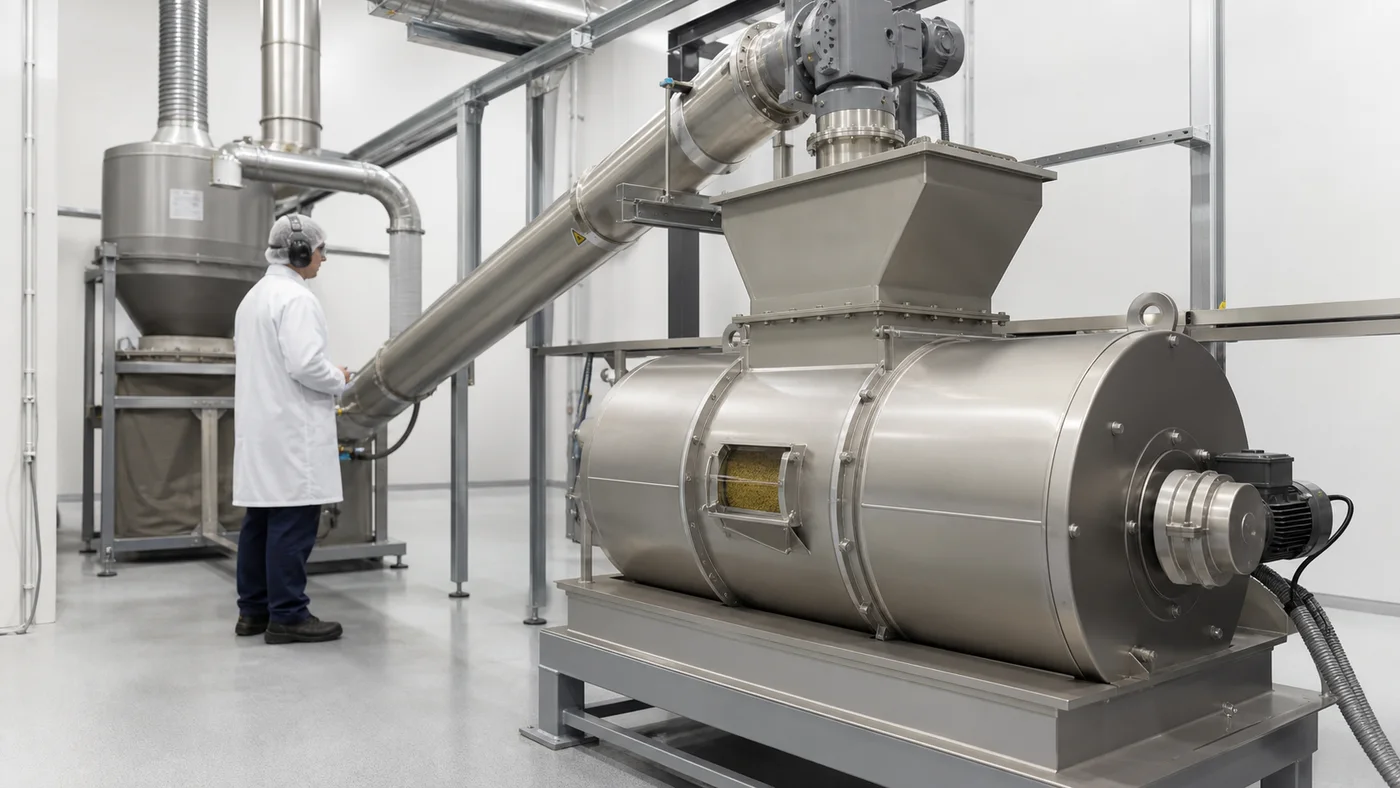
Grinding is where stored grain meals, cereal ingredients, and other suitable dry raw materials are prepared for the next stage of a dry pet food process. It is not simply a matter of making material smaller. The grinding system must deliver a repeatable particle-size distribution, stable flow, controlled temperature, manageable dust, protected equipment, and a product that behaves consistently in batching, mixing, conditioning, and extrusion.
A mill selected only by motor size or advertised tonnes per hour can become a source of variability. The same screen can produce different results when ingredient hardness, moisture, oil level, feed rate, hammer condition, aspiration, or recirculated fines change. This guide explains how to define the complete grinding package inside a pet food factory system, rather than treating the mill as an isolated machine.
Start with the product portfolio and raw materials
Define what the factory will grind at launch and what it may grind during the planned operating life. List each material, its initial particle size, moisture, hardness, bulk density, fat level, fibre level, abrasive contaminants, tendency to bridge, heat sensitivity, foreign-material risk, storage condition, and expected annual or campaign volume. Grain, meals, fibre sources, vegetable proteins, and functional ingredients do not behave alike in a mill.
Then define why each ingredient is ground. The objective may be to improve mixing behaviour, support a stable extrusion feed, achieve a chosen kibble texture or density, reduce visible coarse particles, or make a particular premix route possible. It should not be an arbitrary micron figure borrowed from another formula. The target distribution needs to be proven with the actual recipe family and downstream process.
The raw-material supply-chain plan should identify which ingredients arrive already suitable for use, which require screening or grinding, and which should not pass through the main mill. That decision affects receiving, bin allocation, traceability, dust zoning, cleaning, and the amount of wear material entering the process.
Specify particle-size distribution, not only a screen hole
A screen aperture is an equipment setting, not a final particle-size specification. Final distribution is influenced by the mill design, hammer tip speed, screen open area, screen wear, ingredient properties, feed rate, air flow, and the time particles remain in the grinding chamber. Two mills using nominally similar screens can give different distributions, fines content, temperature, and energy use.
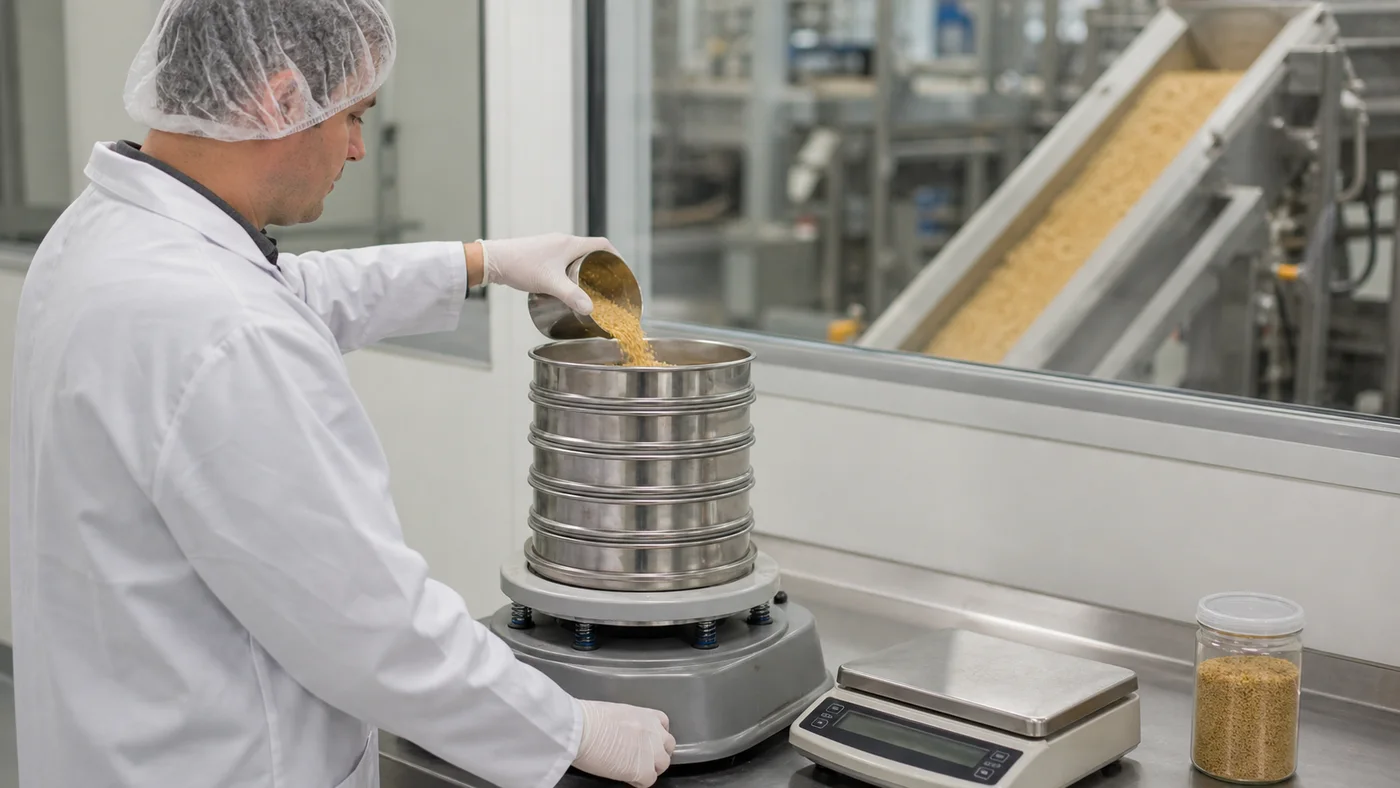
Describe the target with a defined test method. Depending on the material, that can include a sieve stack, laser-diffraction method, or another validated procedure. Record the sample preparation, sample mass, sieve sizes or instrument configuration, shaking time, calculation method, and how often the reference method is checked. A simple average particle size alone can hide a broad distribution with too many fines and too many coarse particles.
Use practical acceptance measures such as median size, stated percentile limits, or the proportion retained on defined sieves only after the product team has agreed what each measure means for the product. The correct tolerance is product- and method-specific. It should account for analytical variation as well as normal process variation.
Connect grinding to extrusion performance
Particle size affects the surface area and the way dry meal hydrates, mixes, and accepts mechanical and thermal energy. Very coarse material can create inconsistent conditioning or visible inclusions; an excessive fine fraction can change bulk density, dust loading, water demand, and the behaviour of the feed in hoppers and screws. The appropriate window comes from the complete process, not from the grinder alone.
During pet food extrusion, the meal must feed consistently and respond predictably to water, steam, and shear. A change in particle distribution can therefore show up as a change in die pressure, motor load, expansion, density, cutter behaviour, or dryer loading. When those downstream variables drift, the investigation should include the incoming grind result rather than only changing extruder settings.
Run development and commissioning trials with representative formulas. Compare not only a single laboratory result but the relationship between distribution, mixer performance, conditioner response, extruder stability, finished kibble dimensions, density, texture, and product yield. Keep formula versions and process records together so the selected particle-size window can be reproduced.
Choose hammer, roller, or fine-grinding technology by application
Hammer mills reduce size through impact as material passes through a rotating hammer field and exits through a screen. They are widely used because they can handle many dry ingredients and can change nominal fineness through screen selection and operating conditions. Horizontal hammer mills are available for feed and pet food applications across coarse and fine grinding duties; Bühler notes that the actual range depends on the material and process, which is why a supplier's capacity figure should be tied to a defined test material and screen. See the official hammer-mill overview.
Roller mills reduce size through compression and shear between rolls. They can be useful where a narrower distribution, lower fines, or a particular cereal-processing route is desired. They may be less flexible for sudden changes in raw-material condition and need their own roll-gap, feed, magnet, and maintenance controls. Fine-grinding hammer mills, pulverizers, or classifier-based systems may be appropriate for materials or particle targets outside a standard hammer mill's stable operating range.
No type is universally better. Compare representative throughput, distribution, fines, product temperature, energy, wear, noise, access, cleaning, contaminant handling, building height, maintenance time, and total installed system cost. A small upstream difference can change downstream capacity and quality more than the purchase price of the mill itself.
Build the full grinding system around the mill
A dependable system includes receiving or day-bin discharge, magnets and screens where required, controlled feed, the mill, aspiration and filtering, discharge conveyance, a surge bin or direct transfer, controls, sampling points, safety devices, and maintenance access. Each interface needs a defined capacity and material path.
Use controlled, even feeding. A mill that alternates between starvation and flooding will not produce a stable result. Define the feeder type, speed range, level control, interlocks, and the response to upstream bridging. Include a means to protect the mill from tramp metal, stones, and oversize material before it reaches the rotor. A magnet alone does not remove all foreign material; the receiving and pre-cleaning concept must match the actual supply risk.
Screening can also be used before or after grinding. Bühler describes upstream sieving as a way to reduce hammer-mill power demand and multi-stage screening as a way to obtain fractions without changing mill screens. Its sieve-system overview is a useful example of why screening should be evaluated as part of the process flow, not added only after a quality issue occurs.
Size capacity with the actual material and duty cycle
Grinding capacity depends on the material, starting size, required distribution, screen condition, air system, mill configuration, feed consistency, and operating hours. A rating measured on dry corn with one screen cannot be assumed for a higher-fibre, higher-moisture, or more abrasive formulation ingredient.
Calculate sustained need from the recipe, planned output, grinding fraction, storage strategy, and campaign schedule. The mill does not necessarily need to run continuously with the extruder; it may charge a ground-meal bin during a defined window. If so, size the bin, mill rate, conveying, and changeover allowance together. Include start-up, shutdown, screen changes, planned cleaning, routine inspection, and the capacity loss expected as hammers and screens wear.
The line-capacity and balancing guide provides the right principle: use a common mass basis and validate sustained output across connected equipment. A high nominal mill rate cannot compensate for a downstream bin, mixer, or extruder that limits the actual production campaign.
Control aspiration without changing the product
Aspiration carries air and fine material away from the grinding chamber, supports throughput, controls dust, and helps prevent uncontrolled pressure in the system. It is not an optional accessory. Fan performance, duct diameter, air velocity, filter resistance, clean-air return, rotary valves, leakage, and the point where collected material returns all affect the final process.
Too little air can increase residence time, temperature, accumulation, and unstable discharge. Excessive or poorly balanced air can draw a disproportionate amount of fines from the product stream, increase filter load, or make material accounting difficult. Establish the intended air balance during commissioning and monitor values that operators can use to detect filter blinding, a broken connection, or an open inspection door.
Dust recovered from the filter should not automatically be returned without a documented material identity, batch boundary, safety review, and reconciliation approach. Returning an unknown or accumulated fraction to a later batch can create traceability and formulation problems.
Measure temperature and protect ingredient quality
Grinding adds mechanical energy, and product temperature can rise with fine grinding, restricted screens, poor aspiration, worn parts, high feed rate, or long material residence. The temperature limit should be established from the ingredient and formula, not guessed from a general rule. Heat-sensitive materials, fats, flavours, and some functional ingredients may require a different route, shorter residence, cooling, or addition after the main grinding step.
Install temperature monitoring where it can identify meaningful process change: for example, the grinding chamber, bearing housings, product discharge, or aspiration air, depending on the equipment and hazard review. An alarm needs a defined action, such as controlled stop, product hold, inspection, or maintenance. Recording a temperature without linking it to a response does not protect the batch.
Consider the effect of storage time after grinding. Freshly ground meal can have a different temperature, flow pattern, and dust behaviour from material that has cooled in a bin. The next processing stage should receive material in a defined condition.
Verify the distribution with representative samples
Take samples at the point that represents what enters the mixer or conditioner, not only from an easy-to-reach bin. A sample from immediately below the mill may not reveal segregation or fines loss that happens in the conveyor, pneumatic line, surge bin, or transfer chute.
Define a plan that includes sample location, time, batch or campaign identity, sample mass, container, cooling or sealing where necessary, method, and acceptance calculation. Take separate samples across time and, where relevant, across flow paths. Do not composite everything before analysis if the purpose is to detect variation.
Interpret sieve results in context
Sieve analysis separates a prepared sample into defined size fractions. The result can show median behaviour and the amount retained above or below practical limits, but it must be read with the method details. Wet, oily, electrostatic, or fibrous materials may not pass through sieves in the same way as dry free-flowing meal. Sieve condition, shaking time, sample mass, and cleaning influence repeatability.
Set the laboratory or at-line method against a recognised reference method and keep the same approach through development, commissioning, and routine monitoring. When the method changes, compare old and new results before changing a product specification. Otherwise an apparent process shift may simply be a measurement shift.
Trend the full distribution alongside screen changes, feed rate, product temperature, mill power, differential pressure, and downstream extruder data. One failed sample should trigger confirmation and process review, not an unsupported assumption that the screen alone caused the result.
Plan for screen, hammer, and rotor wear
Wear changes mill performance gradually. Rounded hammer edges, damaged screens, enlarged apertures, worn pins, imbalance, bearing condition, and buildup can alter capacity, particle distribution, power draw, vibration, and product temperature before a visible breakdown occurs. Define inspection intervals and measurable replacement criteria rather than relying on emergency repair.
Keep a wear-parts strategy matched to the material. Abrasive ingredients and foreign-material incidents can shorten life considerably. Record the part type, position, rotation or reversal history where applicable, installation date, operating hours, and the distribution result before and after significant changes. This makes it possible to establish realistic spares and maintenance intervals.
Maintenance design matters. Access doors, rotor locking, screen removal, lifting points, dust containment, lighting, and safe work space determine whether inspections are completed properly. Supplier literature often highlights fast screen and hammer changes; confirm this with the actual plant layout, operator access, and lockout procedure rather than a brochure time claim.
Manage sanitation, cross-contact, and material recovery
Grinding creates surfaces where material can remain: in the feeder, magnet drawer, mill chamber, screen, discharge, air ducts, filter hopper, rotary valve, conveying line, and ground-meal bin. Those hold-up points must be mapped for formula changeovers, customer segregation, animal-protein controls, allergen considerations where applicable, and any export-market requirements.
Define the sequence of products, flush material, cleanout method, access points, inspection standard, residue verification, and recordkeeping before the line is built. Dry cleaning may be appropriate for many dry pet food routes; if wet cleaning is planned, it also requires drainage, drying, restart, and contamination-control design. The right protocol comes from the facility hazard analysis and the actual materials, not a generic cleaning schedule.
Use the same ingredient and batch identities across receiving, grinding, mixing, extrusion, and finished-product records. That traceability is essential when a particle-size, foreign-material, or changeover issue needs investigation.
Design dust and explosion safety into the layout
Fine organic dust can create occupational, housekeeping, fire, and, depending on the material and conditions, combustible-dust hazards. The required safeguards depend on the site, materials, jurisdiction, dust test data, equipment arrangement, and applicable standards. The project should include a documented hazard assessment rather than applying a generic configuration.
Consider enclosure, housekeeping access, dust collection, grounding and bonding, spark or bearing-temperature monitoring where appropriate, explosion protection or isolation where required, relief routing, safe electrical classification, and emergency response. Separately, protect operators from rotating equipment, stored energy, noise, hot surfaces, and unexpected start-up through guards, interlocks, lockout/tagout points, and operating procedures.
Locate the mill, filters, ducts, bins, and maintenance doors so that safety equipment can be inspected and serviced. A technically correct protection device that cannot be reached or tested is not a dependable plant control.
Use controls that make the process diagnosable
A grinding control system should record the conditions that influence the result: ingredient identity, source bin, feed rate, mill motor load, feeder setting, screen or recipe reference, aspiration pressure or flow indicators, temperature, filter status, discharge level, alarms, and the batch or campaign boundary. These records help distinguish a raw-material change from a mechanical or air-system change.
Define the logic for an empty upstream bin, low downstream level, high mill load, high temperature, filter differential-pressure alarm, loss of air flow, opened access door, magnetic separator inspection, and emergency stop. Interlocks should protect equipment and product without creating uncontrolled accumulation in a chute or bin.
Recipe permissions, calibration records, sensor checks, manual-operation rules, and recovery after a trip should be documented. A smooth restart after an interruption is part of consistent production, especially where an unknown quantity of material may remain in the mill or line.
Test the grinding system during FAT and SAT
Factory acceptance testing should verify materials of construction, rotor, drive, guards, access interlocks, feeder controls, instrumentation, documentation, and dry mechanical operation. It can identify assembly and control issues, but it cannot prove the project particle distribution with a convenient substitute material.
Site acceptance and commissioning should use agreed representative ingredients and cover normal and boundary feed rates, intended screens or mill settings, aspiration balance, temperature, product distribution, conveying, changeover, alarms, cleanout, and sustained operation. Agree beforehand on the sampling method, laboratory, acceptance measures, repeat tests, and response if a result fails.
Compare the installed result against the project process balance, not just a standalone mill test. The system is successful when it supplies the mixer and extruder with the required material condition at the planned factory rate.
Information to include in a pet food grinding-system RFQ
- ingredient list, starting sizes, moisture, bulk density, hardness, oil, fibre, abrasiveness, and foreign-material risk;
- required particle-size distribution, test method, sample plan, acceptable variation, and downstream process reason for the target;
- minimum, normal, and maximum rates, campaign schedule, operating hours, and declared capacity basis;
- feeders, magnets, screens, pre-cleaning, mill type, rotor and screen configuration, aspiration, filters, and discharge path;
- temperature monitoring, product and bearing limits, alarm actions, and required cooling or material hold time;
- wear parts, access, maintenance clearances, lifting, inspection, vibration, and spare-parts requirements;
- sanitation, changeover, cross-contact, recovery, material identity, and traceability requirements;
- site dust hazard assessment, guards, interlocks, grounding, dust collection, fire or explosion safeguards, and local compliance responsibilities;
- utilities, building loads, noise expectations, controls, data records, FAT, SAT, training, manuals, and performance documentation.
Select a verified grinding system, not just a mill
A reliable pet food grinding system starts with representative ingredients and a product-driven particle-size target. It combines protected receiving, stable feeding, the right mill technology, balanced aspiration, controlled transfer, defined sampling, planned maintenance, sanitation, safety, and records that connect raw material to finished product. The final proof is repeatable performance with real formulations over the agreed operating range.
PetFactorySystem.com can develop the grinding process balance, equipment specification, aspiration and conveying concept, particle-size verification plan, layout interfaces, safety requirements, and acceptance protocol for a dry pet food line. To begin a technical review, share the planned ingredients, capacity, product range, factory location, and applicable quality requirements.
Review the related factory system
Compare the production route, equipment package, layout assumptions, capacity target, and operating requirements before confirming a factory plan.