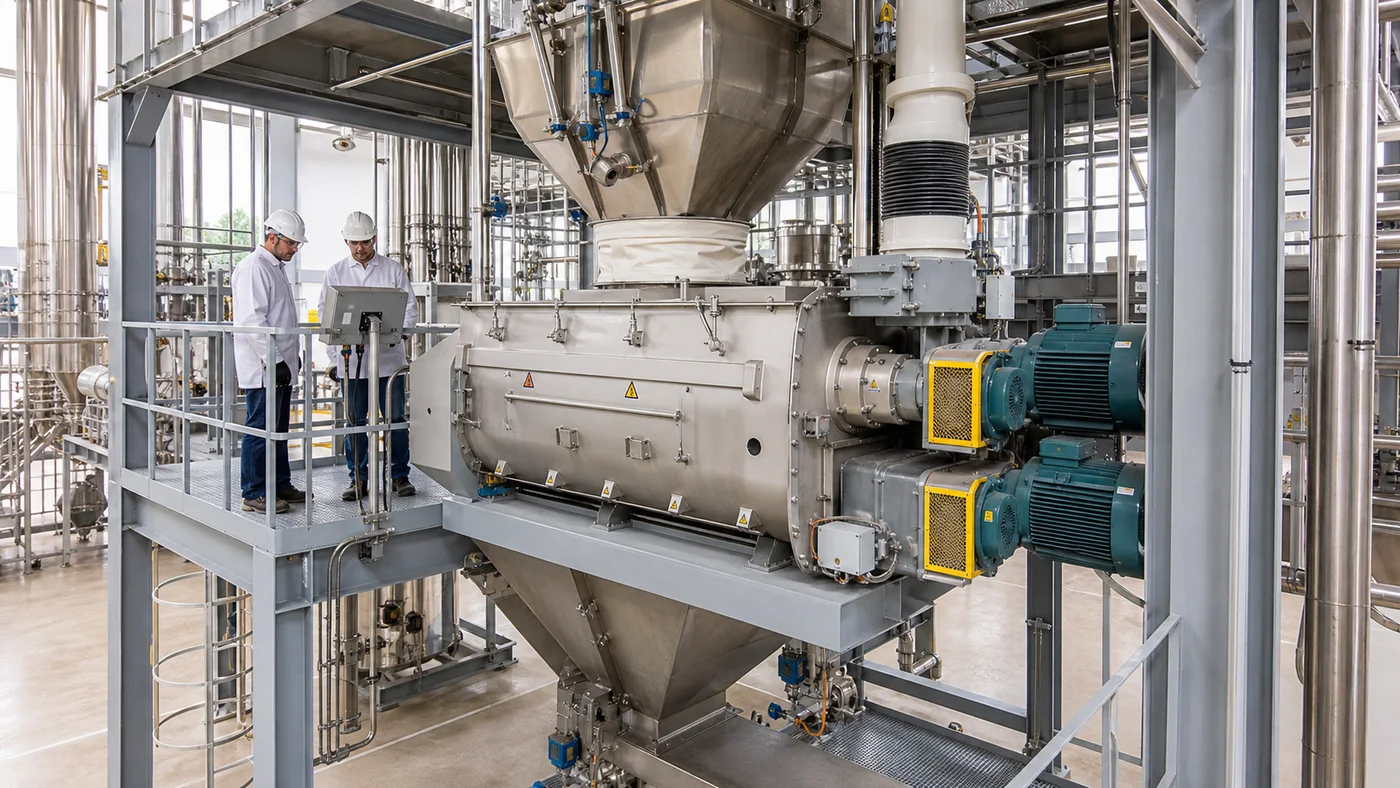
A pet food mixer is not selected only by vessel volume or the shortest advertised mixing time. Its job is to distribute major ingredients, micro-ingredients, premixes, and permitted liquids reproducibly across every production batch while fitting the capacity, hygiene, traceability, maintenance, and product-change requirements of the complete factory.
The mixer also cannot correct every upstream problem. An inaccurate scale, segregated premix, unstable grinding result, poorly timed liquid spray, overfilled vessel, worn paddles, leaking discharge gate, or uncontrolled transfer after the mixer can all produce inconsistent finished food even when the mixer itself is mechanically sound.
This guide explains how to define and verify a dry-meal batch mixing system for extruded pet food. It covers the main mixer and its interfaces with weighing, micro-dosing, liquid addition, discharge, conveyance, controls, cleaning, and quality testing within a complete pet food factory system.
Define what the mixer must distribute
Start with a recipe matrix rather than an equipment model. List major ground ingredients, low-inclusion nutrients, premixes, palatants or process aids added before extrusion, and any water, oil, slurry, or other liquid intended for the main mixer. For every material, document inclusion range, particle-size distribution, bulk density, flowability, moisture, tendency to cake, electrostatic behavior, fragility, temperature limits, and storage or handling restrictions.
Identify the smallest addition that must be distributed through the largest production batch. A claim that a mixer can handle a ratio such as 1:10,000 does not prove that the plant can weigh, transfer, disperse, sample, and analyze that ingredient accurately. The whole system must preserve the intended amount from the ingredient container to the extruder feed.
Separate the initial guaranteed recipes from possible future products. Grain-free formulas, high-fiber diets, high fresh-meat routes, small premium batches, and formulas with more liquids may impose different fill, power, cleaning, and discharge requirements.
Map the complete batch from dosing to extrusion
Define where each ingredient is weighed, how it reaches the mixer, when it enters, where liquids are added, how long dry and wet mixing continue, where the batch is discharged, and how the mixed meal reaches the next process. Include manual additions, returns, flush material, rework, temporary holding, sampling, and the response to an interrupted batch.
The raw-material receiving, storage, and batching plan should use the same ingredient identities and batch boundaries. If the warehouse, batching system, mixer control, and production records use different names or lot definitions, traceability becomes difficult during a deviation.
Mark every location where segregation or residue can occur: weigh hoppers, long drops, bucket elevators, pneumatic lines, screw conveyors, diverter valves, mixer corners, discharge gates, surge bins, and extruder feed bins. Uniformity must survive this entire path.
Calculate usable batch size from bulk density and fill range
Mixer volume does not equal batch weight. Batch weight depends on the usable operating volume and the bulk density of the actual recipe. A low-density formula can fill the mixer before reaching the expected weight, while a dense formula can create a much heavier mechanical load at the same volume.
For each product family, calculate minimum, normal, and maximum batch weight within the equipment supplier's validated fill range. Do not assume that one performance result at full load applies to a partial batch. Different mixer designs have different turndown capability, and the minimum batch needs its own uniformity test.
Overfilling can create material above the active mixing zone and produce poorly mixed pockets. Underfilling can prevent the agitators from moving the entire bed as intended. Increasing time may not correct either condition.
Compare paddle, ribbon, and vertical mixers by application
Horizontal paddle mixers use paddles to create multi-directional movement and are common in high-throughput feed and pet food plants. Twin-shaft designs can provide rapid movement and a broad operating range when correctly sized. Ribbon mixers create axial and radial movement with inner and outer ribbons and can be appropriate for many dry blends. Vertical screw mixers offer a compact footprint and lower installed complexity for some lower-capacity applications but may require longer cycles.
No mixer type is universally superior. Compare the actual guaranteed fill range, dry and wet mixing time, sensitivity to particle damage, liquid capability, discharge time, residue, access, shaft seals, installed height, power, maintenance, and verified performance with representative products.
The ANDRITZ paddle mixer overview, for example, shows how one commercial design addresses mixing quality, liquid nozzles, outlet sealing, hygiene, and integrated pre-bin and surge-bin arrangements. These features illustrate evaluation points; supplier-specific results should not be treated as a universal guarantee for another mixer or recipe.
Size capacity from the complete cycle
Hourly mixer output equals usable batch weight divided by complete batch-cycle time, not dry mixing time alone. The cycle normally includes:
- weigh hopper filling and final scale stabilization;
- transfer into the mixer and ingredient loading sequence;
- dry mixing before liquids where required;
- liquid dosing, spray time, and wet mixing;
- discharge-gate opening, emptying, and closure confirmation;
- interlocks, data recording, and any settling time before the next batch.
The weigh hopper, mixer, surge hopper, and downstream conveyor can overlap parts of their cycles only when capacity, controls, and batch separation allow it. The pet food line capacity and balancing guide provides the method for testing sustained output rather than adding nominal machine ratings.
Make weighing accuracy part of mixer performance
A mixer can distribute only what enters it. Define scale capacity, minimum practical load, resolution, accuracy, repeatability, stabilization, calibration, and allowable batching tolerance for major, minor, and micro ingredients. One large scale may not control both tonne-level materials and very small additions adequately.
Check the complete dosing path for dribble, material in flight, leakage, sticking, bridging, and residual material. A display that reaches the target weight does not prove the full measured amount entered the mixer. Reconciliation and loss-in-weight checks can help identify unexplained differences.
Manual additions need controlled identity, quantity, sequence, authorization, barcode or equivalent verification where appropriate, and confirmation that the material was actually added to the correct batch.
Use premixing when direct micro-addition is not reliable
Very low inclusion materials may have too few particles or too large a concentration difference for dependable direct distribution. A controlled premix can increase the mass and particle count presented to the main mixer. Geometric dilution or another validated premixing procedure may be used, depending on material properties and process design.
Premixing is not simply adding carrier. The premix equipment, batch size, loading sequence, mixing time, discharge, container, storage time, identification, sampling, and addition to the main batch all require control. A uniform premix can still segregate during transport or fail if only part of its container enters the main mixer.
Evaluate whether sensitive ingredients should be added as a purchased premix, produced in a dedicated controlled room, or dosed through an automated micro-ingredient system.
Control particle size, density, shape, and cohesion
Powders with similar physical properties generally mix and remain mixed more easily than materials with large differences in particle size, density, shape, or surface behavior. Fine dense mineral particles can move differently from coarse fibrous meal. Fatty or hygroscopic ingredients may form agglomerates. Electrostatic powders can adhere to walls, filters, and flexible connections.
Grinding specifications should therefore support both extrusion and mixing. Excessive fines can increase dust and cohesion, while a very broad particle-size distribution can promote segregation. Screen selection, hammer condition, aspiration, and ingredient moisture influence the material entering the mixer.
Do not judge uniformity only inside the mixer. Drop height, vibration, free fall, air transport, and repeated transfers can separate particles after discharge.
Develop the ingredient loading sequence by trial
Loading sequence affects how quickly and completely ingredients disperse. A common starting approach places part of the major carrier materials into the mixer, introduces minor and micro ingredients where they can be captured and distributed, adds remaining major ingredients, and applies liquids only after an appropriate dry-mixing period. The best sequence is recipe- and mixer-specific.
Avoid dropping a small quantity of fine material onto a static surface where it can remain as a concentrated layer. Also avoid burying a cohesive minor ingredient beneath all major ingredients without evidence that the agitators can disperse it.
Specify when the mixer starts relative to filling and when the official mixing clock begins. “Two minutes mixing” is ambiguous if one operator starts timing at first ingredient entry and another starts after the last ingredient arrives.
Separate dry mixing, liquid addition, and wet mixing
Where liquids are added, the batch recipe should distinguish dry-mix time, spray time, and post-spray wet-mix time. Total cycle time alone cannot show whether dry ingredients were uniformly distributed before liquid addition or whether the liquid had enough time to spread.
Too little mixing may leave concentration differences. Excessive mixing does not guarantee continuous improvement and can increase particle damage, heat, energy, coating of equipment surfaces, or re-segregation in some systems. Establish an operating window using representative trials at several times, not one chosen setpoint.
Engineer liquid addition for droplet distribution
Liquid performance depends on viscosity, temperature, pressure, nozzle type, droplet size, spray pattern, nozzle position, flow range, number of nozzles, and the moving powder surface presented to the spray. A pump flow reading does not prove even distribution across the batch.
Large droplets or poor atomization can create wet lumps and deposits. Fine mist can be carried into aspiration or coat unintended surfaces. Heated fats need controlled temperature through tanks, lines, valves, and nozzles without overheating or long stagnant sections.
Provide anti-drip measures, line purge or recovery where appropriate, accessible nozzles, filtration, pressure monitoring, and a method to confirm delivered mass. Define what happens when a nozzle blocks or liquid flow stops during a batch.
Prevent the dust system from removing formula
Mixer aspiration controls displaced air and dust during filling, but excessive airflow can selectively remove fine ingredients. Filters, return arrangements, air velocity, pressure, and cleaning pulses should be designed so the dust-control system does not change the recipe.
Collected material should not be returned automatically unless identity, batch ownership, safety, and quantity are controlled. Cross-batch dust return can undermine both uniformity and traceability.
Define a valid marker for uniformity testing
Mixing uniformity is commonly evaluated by measuring a selected marker in multiple samples and calculating its coefficient of variation: standard deviation divided by the mean, multiplied by 100. The result is meaningful only when the marker, sample, and analytical method are suitable.
The marker should originate from a defined ingredient source, be present at a measurable concentration, have enough particles in the sample mass, remain stable during the test, and use an analytical method with adequate precision. Salt, amino acids, minerals, approved tracers, or other components may be used depending on the product and purpose.
Do not select a marker simply because it is easy to test. A marker that segregates differently from the critical micro-ingredient may overstate or understate actual performance. Analytical variation also contributes to the observed CV, especially when the mean concentration is low.
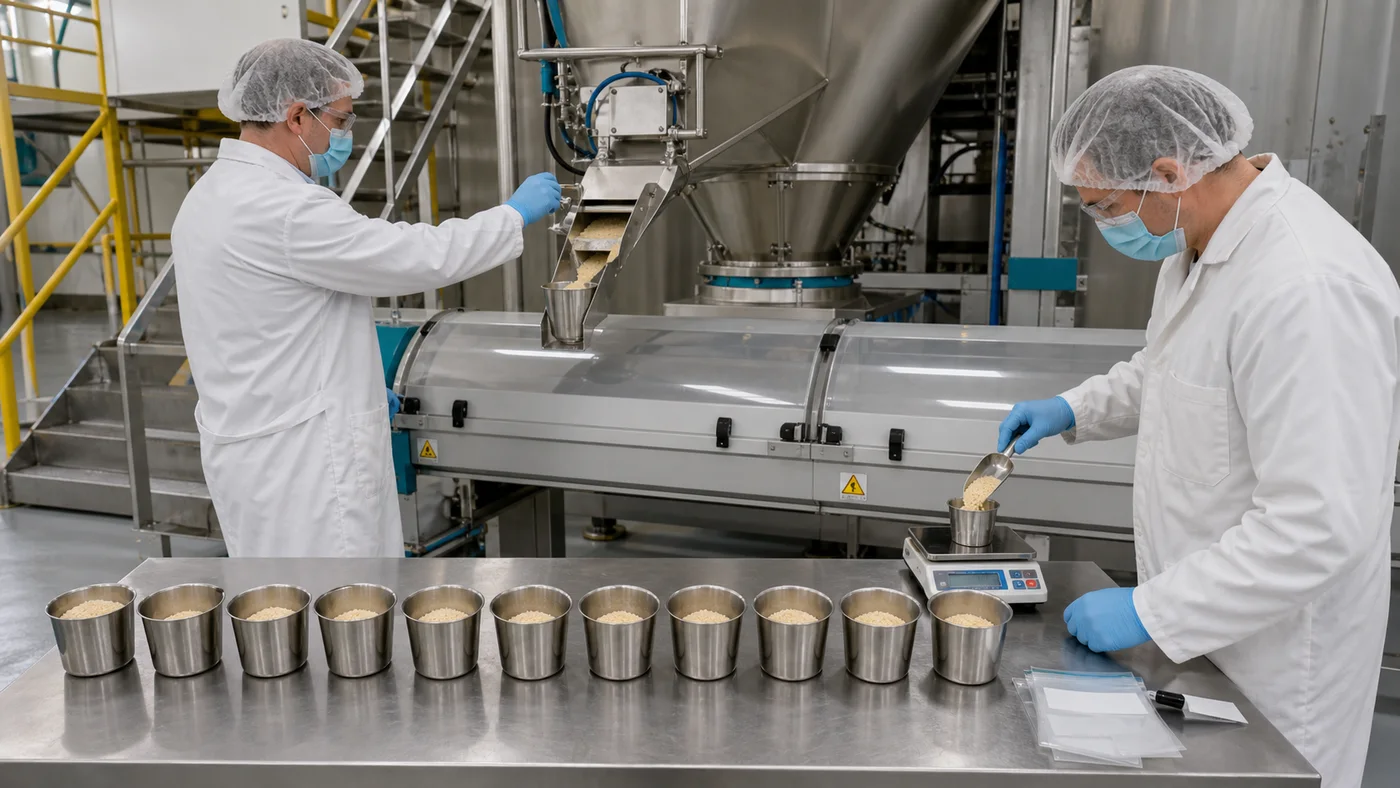
Build a representative sampling plan
Kansas State University's Testing Mixer Performance guide describes a widely used feed-industry approach based on ten samples from one batch, taken from different mixer locations or at equally spaced intervals near discharge. It also explains marker selection and CV calculation. This is a useful technical method, but the final protocol must match the facility's products, market, regulatory framework, and customer requirements.
Samples collected during discharge should remain separate until analysis. One composite sample can conceal the beginning-to-end variation that the test is intended to find. Define the sampling point, interval, sample mass, container, handling, grinding or preparation, laboratory method, chain of custody, and calculation before the test.
Test minimum, normal, and maximum batch sizes, representative difficult formulas, different liquid levels, and repeated batches. A single successful batch is not a complete validation of the operating range.
Interpret CV with the method and risk in view
A CV below 10% is often used as an industry reference for feed mixing, and the Kansas State guide categorizes lower CV results more favorably. Some equipment suppliers report results below 5% under defined test conditions. Neither figure should be copied into a project specification without the marker, concentration, sample count, method, product, batch size, and sampling location.
A 2025 open-access study comparing feed mixing systems found that mixer type, mixing time, marker selection, and transfer after the mixer affected measured uniformity, and one tested marker did not achieve CV below 10% in any treatment. The study of horizontal, vertical, and transfer mixing systems supports evaluating the process as a system rather than treating one CV threshold as proof for every ingredient.
Set acceptance criteria through product risk, regulatory and customer requirements, analytical capability, manufacturing capability, and validation evidence. Review individual results and discharge trends as well as the final CV.
Check segregation after mixer discharge
A uniform batch can segregate in the surge hopper, screw conveyor, bucket elevator, pneumatic transfer, extruder feed bin, or packaging operation. Differences in particle size and density, long free-fall distances, vibration, air currents, and funnel flow can separate ingredients.
During commissioning, compare samples near mixer discharge with samples at the point where the next process receives the meal. When several mixer batches are combined in one bin, retain traceability to the individual batches and check whether first-out and last-out material remain comparable.
Design transfers for controlled speed, limited drop, suitable bin geometry, and complete emptying. Do not assume that extra conveyance always improves mixing; it may either mix or segregate depending on the materials and equipment.
Control residue and carryover between batches
Residual powder can remain on paddles, ribbons, shafts, seals, liquid nozzles, ledges, gate edges, flexible connections, screw flights, filters, and surge-bin walls. The next batch can receive an uncontrolled amount of the previous formula.
Measure residue after normal discharge and identify where it accumulates. Evaluate carryover with a challenge batch followed by a controlled blank or different product, then sample the complete path. The result should inform production sequencing, flushing, physical cleaning, rework restrictions, and release decisions.
Cross-contact requirements depend on ingredient, species, product claims, customer standards, and market rules. Avoid assuming that a sequencing plan alone controls every high-risk material.
Specify fast, complete, and controlled discharge
A wide bottom gate can shorten discharge, but the seal, actuation, opening profile, surge-hopper capacity, and downstream conveyor must work together. Slow or restricted discharge increases cycle time and can separate material. A leaking gate can contaminate the previous or next batch and distort weighing reconciliation.
Specify gate position feedback, closed confirmation before filling, open confirmation during discharge, seal inspection access, fail-safe behavior, and a method to detect incomplete emptying. The surge hopper should hold the full batch without backing material into the mixer.
Design hygienic access and cleaning before purchase
Review the inside trough, agitators, shaft penetrations, seals, nozzles, roof, inlets, discharge gate, and any hollow or overlapping sections. Access doors should allow inspection and cleaning without unsafe entry or excessive dismantling. Product-contact materials, welds, surface condition, gaskets, and lubricants should suit the process and market.
Choose dry cleaning, controlled wet cleaning, or another validated method based on the soil, ingredients, zoning, construction, drainage, and drying capability. Introducing water into a dry powder area without adequate containment and dry-out can create new hazards.
The factory hygiene and sanitation plan should define cleaning tools, disassembly, inspection, release, chemical control, verification, and the time included in the production schedule. For facilities manufacturing animal food for the U.S. market, FDA Guidance for Industry #235 provides recommendations on the animal-food CGMP requirements and related training and recordkeeping.
Address personnel, mechanical, and combustible-dust safety
Mixers contain powerful moving parts and stored energy. Provide interlocked access doors, guarded drives and couplings, lockout points, safe platforms, lifting provisions, and procedures for clearing blockages or entering equipment where permitted. Access-door interlocks should be safety-rated as required by the risk assessment and local law.
Dry meal and micro-ingredient dust may create respiratory, fire, or combustible-dust risks depending on material properties and jurisdiction. Dust collection, electrical classification, grounding and bonding, ignition-source control, explosion protection, housekeeping, and emergency response require competent project-specific assessment.
Connect mixer controls to batch genealogy
The control system should verify recipe version, ingredient identity, target and actual weights, manual additions, mixer availability, gate status, dry-mix time, liquid delivery, wet-mix time, discharge completion, alarms, deviations, and destination. The batch record should show actual events and timestamps, not only planned setpoints.
Interlocks should prevent filling an open mixer, discharging to an unavailable or wrong destination, starting liquid spray before the required stage, or releasing a batch with unresolved dosing errors. Authorized overrides need identity, reason, time, and review.
The factory automation and traceability design should connect mixer batch IDs with ingredient lots, extruder production, finished-product lots, quality results, holds, and rework.
Plan maintenance around mixing quality
Paddle or ribbon wear, incorrect clearances, bent components, shaft movement, seal leakage, gate wear, deposits, damaged nozzles, and drive problems can change mixing or carryover performance. Define inspection points and acceptance limits rather than relying only on breakdown maintenance.
Trend motor current, cycle time, discharge time, residue, uniformity results, seal condition, and liquid-flow performance. Revalidate or verify mixing after major repair, rotor adjustment, control change, ingredient change, or persistent quality drift.
Test the mixer and the system during FAT and SAT
Factory acceptance testing should verify dimensions, materials, motor and gearbox data, rotation, gates, access interlocks, seals, nozzles, controls, emptying, and documentation. A dry run with a convenient test material can check mechanics but may not represent the plant's recipes.
Site acceptance and commissioning should use representative ingredients and cover agreed batch weights, recipes, liquid levels, cycle times, discharge, residue, and uniformity. Confirm that the weighing, transfer, mixer, surge bin, and downstream path operate together at sustained rate.
Agree in advance on marker, sample locations, sample count, method, laboratory, acceptance criteria, repeat tests, and responsibility if results fail. Testing rules written after the trial invite disagreement.
Information to include in a pet food mixer RFQ
- recipe families, ingredient properties, particle-size and bulk-density ranges;
- smallest and largest inclusions, micro-ingredient and premix strategy;
- minimum, normal, and maximum batch weights and required batches per hour;
- dry ingredients, liquid types, liquid percentage, viscosity, temperature, and dosing accuracy;
- required dry-mix, spray, wet-mix, discharge, and total cycle performance;
- uniformity marker, sampling protocol, analytical method, and acceptance criteria;
- allowable residue, carryover test, cleaning method, and product-change requirements;
- materials, seals, hygienic access, dust aspiration, safety, and maintenance clearances;
- weigh-hopper and surge-hopper interfaces, building height, loads, and removal route;
- control architecture, recipe permissions, records, alarms, interfaces, and cybersecurity responsibilities;
- FAT, SAT, training, spare parts, manuals, performance guarantees, and remedies.
Documents required before equipment release
Align the recipe matrix, ingredient data, batch calculations, process flow, cycle-time chart, scale schedule, equipment data sheet, general arrangement, building loads, motor list, liquid-flow diagram, aspiration plan, control narrative, instrument list, hygienic review, safety review, cleaning procedure, uniformity protocol, carryover protocol, commissioning plan, and acceptance criteria.
Confirm that all suppliers use the same batch size, density, liquid level, and capacity basis. A mixer, scale, surge hopper, and conveyor designed from different assumptions will not form a reliable production system.
Select a verified mixing system, not an isolated vessel
A dependable pet food mixing system combines accurate weighing, suitable premixing, controlled loading, an appropriate mixer, uniform liquid addition, complete discharge, limited residue, protected transfer, traceable controls, representative sampling, and planned maintenance. The final proof is repeatable performance with the factory's real products across the agreed operating range.
PetFactorySystem.com can develop the recipe matrix, batch balance, mixing equipment specification, micro-dosing and liquid-addition concept, layout, controls, sanitation requirements, and acceptance protocol for a new dry pet food line. To prepare an initial review, send the planned recipes, batch range, capacity, smallest additions, liquid requirements, factory location, and applicable quality standards.
Review the related factory system
Compare the production route, equipment package, layout assumptions, capacity target, and operating requirements before confirming a factory plan.