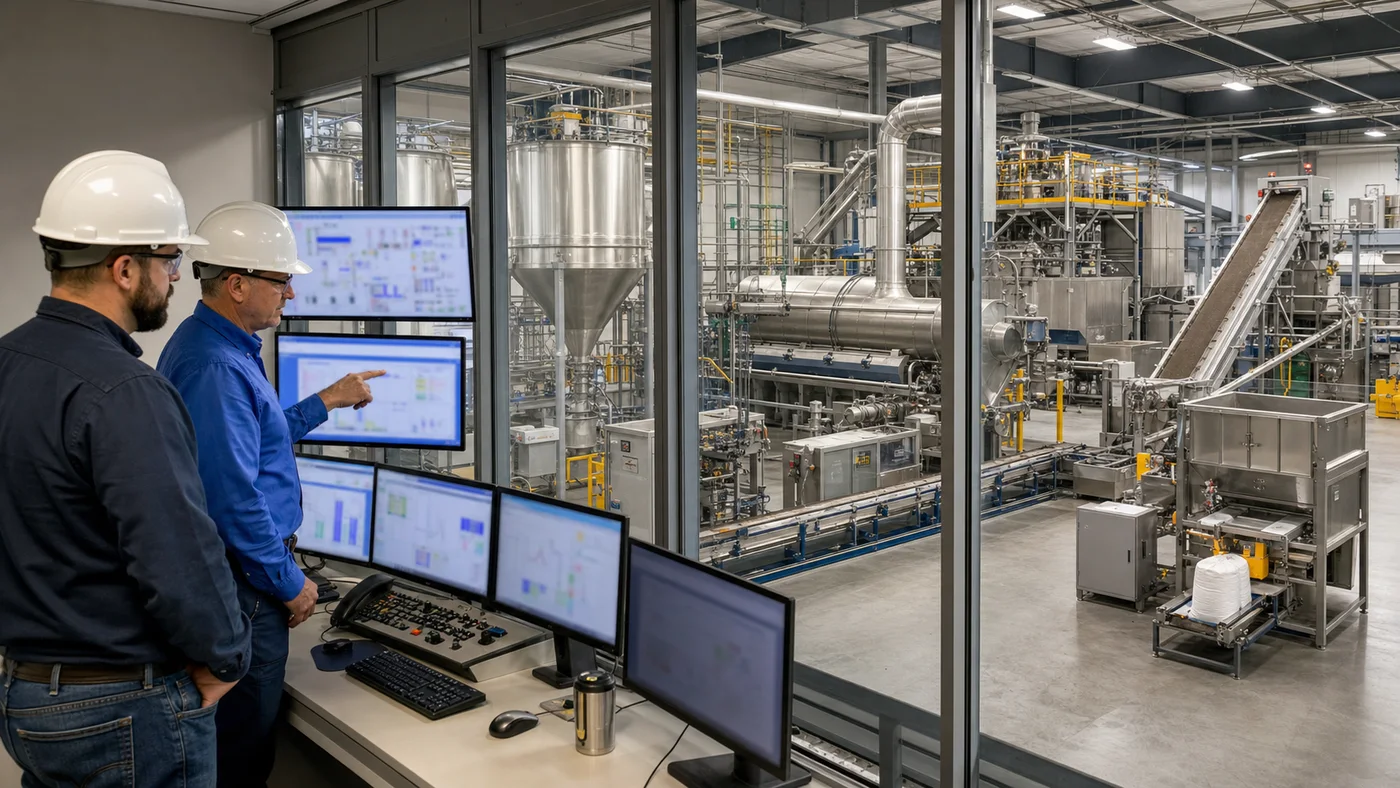
A pet food production line should not be sized by choosing the largest extruder in a supplier catalogue. The useful capacity of a factory is the amount of saleable product that the complete system can produce repeatedly, at the required quality, during the available operating calendar. Grinding, batching, mixing, preconditioning, extrusion, drying, coating, cooling, screening, buffering, packing, utilities, operators, cleaning, and quality release all affect that result.
This is why a line described as “three tonnes per hour” may deliver much less finished product across a month. The stated figure may refer to one machine, one formula, one die, ideal raw materials, or wet product before drying. It may exclude start-up, shutdown, product changeover, cleaning, blocked conveyors, packing changeovers, quality holds, and planned maintenance.
This guide explains a capacity-planning method for a dry dog or cat food factory. It complements the pet food factory system by showing how a target sales volume becomes a balanced production-line requirement instead of a collection of unrelated machine ratings.
Define the capacity terms before comparing equipment
Project teams should agree on a small set of capacity definitions. Without them, two suppliers can quote different numbers while appearing to answer the same question.
- Nameplate capacity is the stated maximum or nominal rating of a machine under defined conditions. It is useful for comparison but is not automatically the factory output.
- Sustainable process rate is the rate a stage can hold for an agreed product and run period while meeting moisture, density, shape, coating, and other quality requirements.
- Scheduled hours are the hours assigned to production before losses.
- Effective production hours are scheduled hours after planned allowances for start-up, shutdown, changeover, sanitation, maintenance, breaks, and expected minor stops.
- Saleable output is finished product released for sale after process loss, fines, start-up waste, rework, samples, and rejected material are considered.
The most useful project guarantee is normally based on sustainable saleable output for defined products, not a short peak observed at one machine.
Start with annual demand, product mix, and operating calendar
Capacity planning begins with the commercial plan. Record annual saleable tonnes by product family, expected peak demand, number of production days, shifts per day, scheduled hours per shift, packaging formats, and the percentage of time assigned to each formula or kibble size. A factory making one stable formula in one bag size has a different capacity profile from a factory making twenty formulas in retail bags.
A basic planning equation is:
Required average saleable rate = annual saleable volume ÷ effective production hours.
Consider an illustrative project targeting 12,000 tonnes of saleable kibble per year. If it schedules 300 production days, two eight-hour shifts per day, it has 4,800 scheduled hours. If the early planning assumption allows 85% of those hours for effective production, the model has 4,080 effective hours. The required average saleable rate is approximately 2.94 tonnes per hour.
If the combined mass yield from ingredient intake to released product is assumed at 97%, the corresponding upstream dry-material requirement would be approximately 3.03 tonnes per hour. These figures are an example, not a quotation or performance promise. The project must replace every assumption with product tests, supplier data, and its own operating plan.
Build a mass balance, not one tonnes-per-hour column
The mass flow changes through a kibble process. Water and steam are added during preconditioning and extrusion. Moisture is removed in the dryer. Liquid fat and palatant may be added during coating. Fines can be screened out or returned under a controlled rework rule. Samples, start-up waste, dust collection, and off-specification material also affect the final balance.
For each process stage, record the flow basis: dry ingredients, conditioned mash, wet extrudate, dried kibble, coated product, or saleable packed product. A dryer rated on wet feed cannot be compared directly with a packing line rated on finished product unless moisture removal and coating addition are included.
The mass-balance sheet should show at least:
- incoming dry ingredients and liquid additions;
- target preconditioner and extruder moisture;
- dryer inlet and outlet moisture assumptions;
- coating addition rate;
- expected fines, start-up loss, rework, sampling, and rejection;
- finished bulk density and bag-weight range.
The FAO guidance on planning agro-processing capacity similarly recommends mapping each process stage and matching equipment throughputs to avoid bottlenecks. Its examples are not pet-food equipment specifications, but the underlying mass-flow method is relevant to line planning.
The line capacity is controlled by the bottleneck
The sustainable capacity of a serial process is limited by its slowest required stage under the selected operating conditions. Installing a five-tonne-per-hour extruder does not create a five-tonne-per-hour factory if the dryer can sustain only three tonnes per hour for the target moisture load, or if the packing room can handle only two tonnes per hour across the required bag mix.
The bottleneck can also move. A dense small kibble may limit extrusion. A high-moisture recipe may shift the limit to drying. A high coating percentage may increase retention and cooling requirements. Small bags may shift the bottleneck to weighing, sealing, case packing, or palletizing. A formula with difficult grinding characteristics can constrain the front end.
Capacity review should therefore use a product-by-product matrix rather than one general rate. The dry kibble production process should first be mapped stage by stage; the line-balance model then adds the sustainable rate and operating assumptions for every stage.
Match batch equipment with continuous equipment
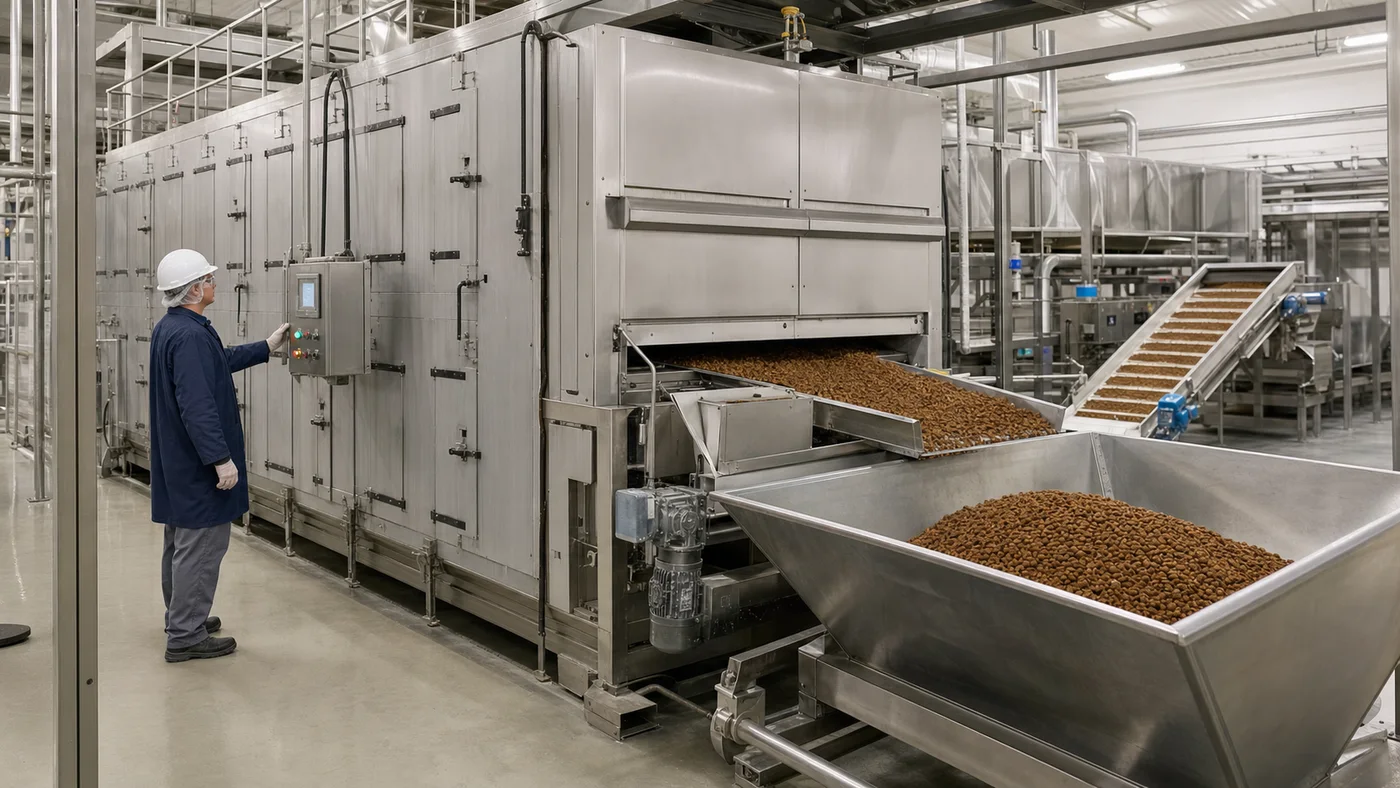
Pet food lines combine batch operations and continuous operations. Ingredient weighing and mixing are commonly batch-based, while conditioning, extrusion, drying, cooling, and some transfer stages operate continuously. Their capacities must be translated to the same time basis.
For a batch mixer, usable capacity is not simply the vessel volume. The effective hourly output depends on usable batch weight and complete cycle time:
Batch-stage output = usable batch weight × completed batches per hour.
The cycle includes filling, weighing confirmation, mixing, liquid addition, discharge, and any required checks. A 2,000-kilogram nominal mixer that completes only two full cycles per hour does not support the same flow as one completing four controlled cycles. Formula bulk density and safe fill level also change usable batch weight.
A surge bin between mixing and extrusion can help convert batch discharge into a stable continuous feed. It should be sized around the batch cycle, extruder demand, minimum and maximum level, residence time, segregation risk, and cleanout requirement. An oversized bin is not automatically better because long residence, difficult cleanout, and formula carryover may create new problems.
Check the real extrusion operating window
Extruder capacity changes with formula composition, particle size, preconditioning, moisture, steam availability, screw configuration, die open area, kibble diameter, density target, cooking requirement, and motor or torque limit. A supplier should state the product and operating assumptions behind a quoted rate.
For planning, ask for more than maximum mechanical feed rate. Request the sustainable range for representative formulas, the expected start-up and shutdown loss, product change time, die-change time, and the quality parameters that must remain in specification. The goal is not merely to push mass through the barrel. It is to produce stable kibble that the dryer and downstream system can handle.
Where a plant needs many product types, flexibility may be more valuable than selecting a machine only for one maximum rate. The equipment package should also allow practical access for wear checks and maintenance because declining screw, liner, die, or feeder condition can reduce throughput and consistency over time.
Dryer sizing must use evaporation load and residence time
The dryer is frequently capacity-critical in expanded kibble production because it must remove a defined quantity of water while maintaining product quality. Its duty depends on wet-feed rate, inlet moisture, target outlet moisture, product size, bed depth, air temperature, humidity, airflow distribution, and residence time. Two products with the same finished tonnes per hour may place different loads on the dryer.
A useful dryer review separates product flow from water evaporation. The supplier should show the assumed wet-feed moisture, finished moisture, evaporation load, residence time, number of zones, airflow basis, and expected product depth. The project should also check how start-up material, product transitions, and moisture corrections are handled.
Increasing temperature to chase output is not a valid universal solution. It can affect surface drying, internal moisture equalization, color, aroma, breakage, and energy use. Capacity must be demonstrated while the agreed product specification remains stable.
Coating, cooling, screening, and packing can become the limit
After drying, kibble may need cooling before or after coating depending on the process design. Coating capacity depends on feed control, liquid preparation, dosing accuracy, retention time, absorption target, and whether atmospheric or vacuum coating is used. Cooling must bring product to an appropriate condition for storage and packing without condensation.
Screening removes fines or oversize material but introduces a yield and rework decision. Transfer equipment must handle the product gently enough to avoid creating additional fines. Each elevator, conveyor, diverter, and bin should be checked for both volumetric and mass capacity because bulk density varies by product.
Packing capacity must be tested against the commercial bag mix. A line packing large bulk bags has a different output from a line running small retail bags with frequent film changes, coding checks, metal detection, checkweighing, case packing, and manual palletizing. The pet food packaging line planning guide covers these downstream decisions in detail.
Use buffers to decouple short stops, not hide chronic mismatch
Surge bins and buffer hoppers can keep one stage running during a brief downstream interruption. They are useful around batch-to-continuous transitions, dryer discharge, coating, and packing. However, a buffer only stores time. If the upstream stage continuously produces faster than the downstream stage can consume, the bin will fill and the line must stop.
Buffer sizing should be based on a defined interruption duration and flow difference. It should also include minimum operating level, high-level response, low-level response, product residence, segregation, cleanout access, dust control, load-cell accuracy where used, and the number of formulas sharing the bin.
The control logic matters as much as physical volume. Upstream rate reduction, controlled stop sequence, restart conditions, and alarm limits should be included in the automation narrative so that operators do not respond to every high level with an abrupt emergency stop.
Utilities must support simultaneous peak demand
A balanced equipment list can still underperform if utilities are undersized. Capacity calculations should include simultaneous electrical load, steam pressure and flow at the conditioner, dryer thermal duty, compressed-air peak demand, dust-collection airflow, cooling demand, water where required, and ventilation or heat rejection.
Average consumption alone is not sufficient. Starting a large motor, heating a dryer, operating pneumatic bagging devices, and running dust collection at the same time can create a different demand from a monthly utility average. Distribution losses and the distance between the utility plant and process equipment also matter.
These checks should be coordinated with the pet food factory utility planning guide. A project should not confirm line throughput until the boiler, transformer, compressor, air handling, and dust-control systems can support the required operating case.
Allow for product mix, changeovers, and quality release
Annual capacity is strongly affected by the number of SKUs and production campaign length. Short campaigns create more start-ups, cleanouts, formula transitions, packaging changes, and laboratory checks per tonne. A line producing long campaigns can have the same installed machines but higher effective annual output.
Build a production calendar by product family. Group compatible formulas and pack formats where quality and commercial requirements allow. Record expected campaign length, changeover time, cleaning level, start-up loss, packaging change time, and QC hold. This creates a more credible utilization factor than choosing a generic percentage.
Quality release can also constrain finished-goods flow. If product must remain in quarantine until moisture, bulk density, water activity, nutrient, packaging, or other checks are completed, the warehouse needs enough identified hold space and a clear release workflow.
Plan redundancy around business risk
Redundancy is not required equally at every stage. The project should identify equipment whose failure stops the whole factory, components with long replacement lead times, and systems that can be bypassed safely. Spare screens, dies, wear parts, pumps, dosing components, sensors, motors, and control hardware may protect capacity more economically than installing a complete second line.
Where future growth is expected, reserve floor area, structural loading, electrical capacity, steam capacity, dust-collection margin, control-panel space, and conveyor connection points. Expansion planning should identify which stage will become the next bottleneck when the first upgrade is made.
Define the capacity acceptance test before ordering
A capacity promise should state the test conditions. Before purchase, agree on representative raw materials and formula, product size and density, target moisture, coating level, pack format, run duration, sampling method, acceptable quality range, treatment of start-up material, permitted interruptions, and how saleable output will be calculated.
Factory acceptance testing may confirm machine construction and dry operation, but final process capacity normally requires site utilities, connected equipment, trained operators, and representative materials. Site acceptance and commissioning should include a sustained integrated run rather than a short peak-rate demonstration.
The pet food production line commissioning guide explains trial production, operator training, and first-batch release. Capacity validation should be part of that commissioning plan, with a mass balance and stop log for the test period.
Capacity-planning information to prepare
A useful supplier or engineering review should receive:
- annual saleable volume by product family and expected peak season;
- production days, shifts, scheduled hours, and maintenance strategy;
- representative formulas, ingredient characteristics, kibble sizes, and density targets;
- moisture assumptions before extrusion, at dryer inlet, and at dryer outlet;
- coating addition, fines and rework policy, and expected saleable yield;
- bag sizes, bags per minute, secondary packing, and palletizing method;
- changeover frequency, sanitation level, and QC release process;
- available steam, electrical, compressed-air, dust-control, and cooling capacity;
- future expansion target and acceptable single-point-failure risk.
PetFactorySystem.com can turn these inputs into a process mass balance, equipment capacity matrix, preliminary utility schedule, buffer philosophy, and acceptance-test basis. To review a planned dry pet food line, send the target products, annual volume, shift plan, country, and available building information.
Reference basis
General capacity-planning principles in this guide are consistent with FAO guidance on planning a feed-mill project and its agro-processing guidance on matching equipment throughput to avoid process bottlenecks. Final pet food equipment ratings and performance guarantees must be confirmed against the selected formulas, raw materials, utilities, equipment design, and agreed acceptance conditions.
Review the related factory system
Compare the production route, equipment package, layout assumptions, capacity target, and operating requirements before confirming a factory plan.