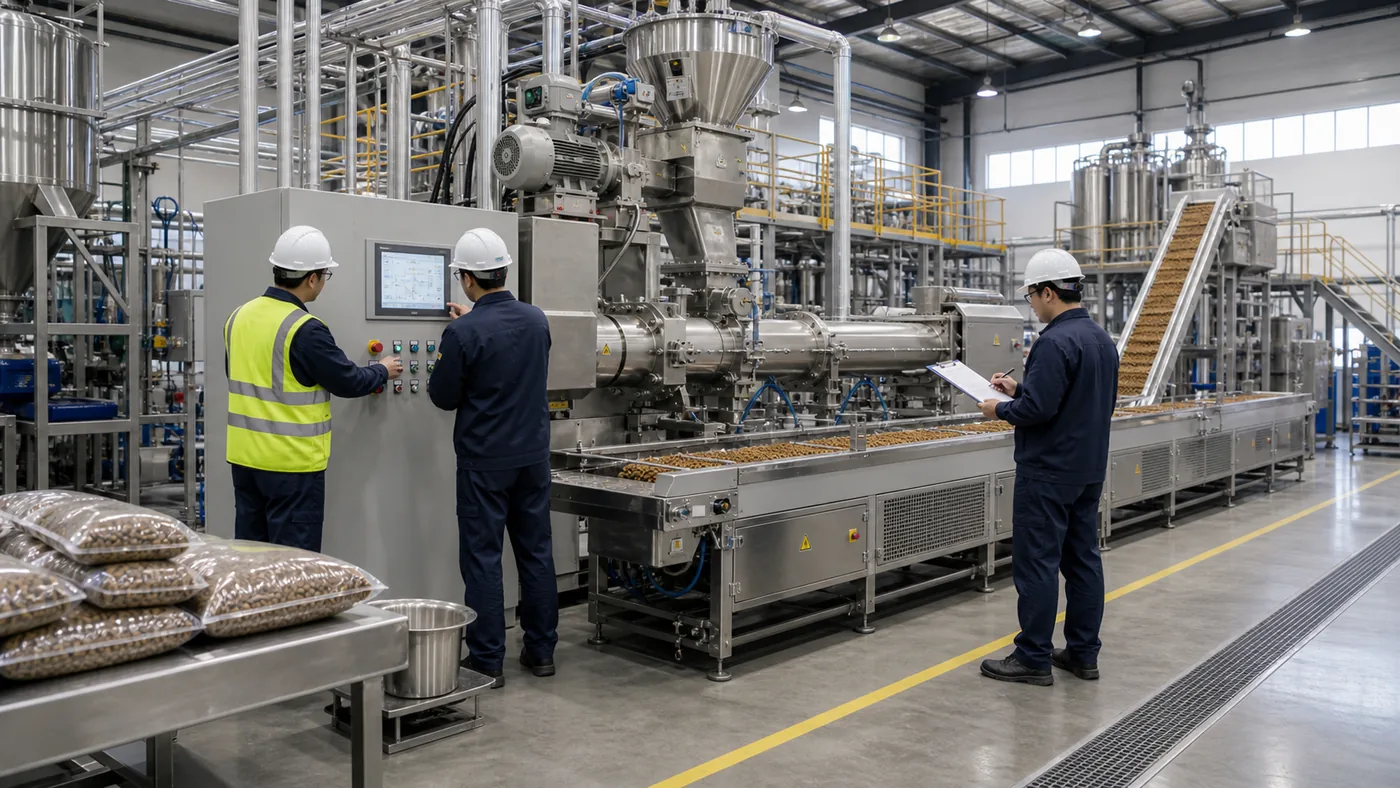
Commissioning is the stage where a pet food factory changes from installed equipment into a controlled production system. The machines may already be in place, the utilities may be connected, and the workshop may look ready, but the factory is not ready for commercial production until the line can run safely, repeatedly, and with traceable quality records.
For a dry pet food factory, commissioning normally includes mechanical inspection, electrical and control checks, utility verification, empty running, water or material test runs where appropriate, trial production, product quality review, operator training, sanitation routines, and the first commercial batch release. This stage is often underestimated because buyers focus heavily on equipment purchase and factory layout. In practice, commissioning quality can decide how quickly the plant moves from installation to stable output.
This guide is written for investors, brands, and factory planners preparing a new pet food production site. It connects with earlier planning work such as the factory setup process, the pet food factory system, and the equipment package selection stage. The goal is to help project teams understand what should be checked before operators start regular production.
Commissioning is not only a machine startup
A production line can rotate, heat, convey, cool, and pack without being fully commissioned. True commissioning means the whole system is checked as an operating factory. The raw material route, batching accuracy, conditioning stability, extrusion pressure, dryer temperature, cooling effect, coating uniformity, packing accuracy, coding, metal detection, finished goods handling, and recordkeeping all need to work together.
The commissioning team should include equipment engineers, factory management, production operators, quality staff, maintenance staff, and project decision makers. If only the equipment supplier attends, the line may run for a demonstration but operators may not understand how to adjust parameters, respond to alarms, handle cleaning, or record deviations. If only factory operators attend without technical support, small installation or control issues may be missed.
Pre-commissioning inspection before the first run
Before powering the line for normal running, the factory should complete a pre-commissioning inspection. This includes mechanical installation, anchor bolts, guards, access platforms, lubrication points, bearing direction, belt tension, conveyor alignment, sensor placement, emergency stops, electrical grounding, control cabinet wiring, motor rotation direction, and local safety interlocks.
Utility systems should also be checked before startup. Steam or thermal oil, compressed air, water, drainage, dust collection, ventilation, and power supply must match the actual line requirement. The earlier guide on pet food factory utility planning explains why utility capacity should be reviewed before equipment installation is finalized. During commissioning, the same utility assumptions must be tested under real running conditions.
A practical pre-commissioning checklist should define who checks each item, what evidence is recorded, and what condition blocks the next step. For example, a grinder should not enter normal trial production if the dust collector is not operating correctly. A dryer should not run at full load if temperature control, exhaust, or fire safety checks are incomplete.
Dry run and empty running checks
Empty running is used to confirm that equipment can operate without product. Operators should check vibration, abnormal sound, motor temperature, reducer temperature, belt tracking, conveyor transfer points, sensor response, local control, central control, emergency stop function, and startup or shutdown sequence. This step helps identify installation problems before raw material is introduced.
For a continuous pet food line, sequence is important. Upstream and downstream machines should start and stop in an order that prevents material blockage. Conveyors, elevators, rotary valves, fans, dryers, coolers, and packing machines should be tested as a connected process, not only as individual machines. Alarm logic and emergency stop recovery should also be tested carefully, because operators need to understand how the line returns to a safe state after an interruption.
Trial production with real material
After empty running, the factory can move into trial production with real material. The first trial should usually start below target capacity. The purpose is to stabilize material flow, observe equipment behavior, and collect process data. The team should not rush to maximum output before the formula, moisture, extrusion condition, dryer setting, cooling, coating, and packing flow are understood.
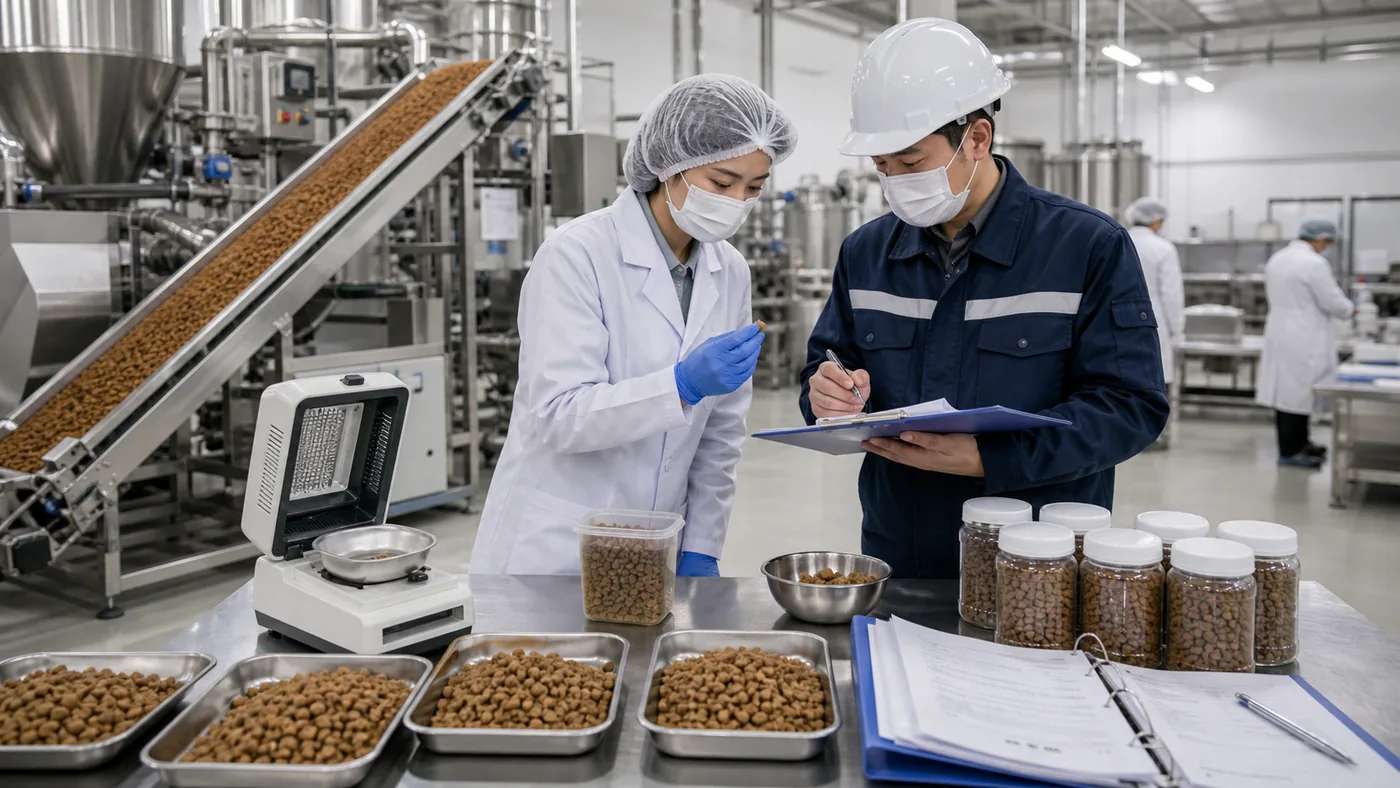
For dry kibble, the commissioning record should include raw material condition, grinding size, batching accuracy, water and steam addition, conditioner temperature, extruder load, screw speed, die condition, cutting result, dryer temperature zones, drying time, final moisture, cooling temperature, coating addition, product appearance, bulk density, palatability-related observations where available, and packing weight. These records become the first practical operating reference for the line.
Trial production is also where factory staff learn how the chosen equipment package behaves in the actual building. The equipment scope should now be translated into operating settings, cleaning routes, maintenance routines, and shift responsibilities.
Process parameter development
Commissioning should produce a practical parameter window, not a single number that only works once. A factory may need one setting for small kibble, another for larger dog food, and another for a different protein or starch structure. The first phase should identify which parameters are critical and how much adjustment range operators can use without damaging product quality or equipment stability.
Key parameters often include grinding size, mixing time, preconditioning temperature, moisture addition, extruder load, die pressure, cutter speed, dryer temperature, dryer residence time, cooler performance, coating temperature, and packing speed. Not every factory needs a complex control system on day one, but every factory needs a clear method for recording settings and linking them to batch results.
Quality checks during commissioning
Quality checks during commissioning are not limited to finished product appearance. The factory should review raw material identity, batch traceability, moisture control, shape consistency, breakage, fines level, bulk density, packing weight accuracy, coding accuracy, metal detection or inspection steps, retention samples, and basic sanitation records. The exact checklist depends on product type and local regulatory requirements.
Commissioning does not replace product registration, legal compliance, third-party testing, or customer-specific audit requirements. It is an internal factory startup process that helps the plant prove it can produce consistently before regular orders begin. If export or private label production is planned, documentation discipline should start during trial production rather than after the first customer complaint.
Operator training and handover
Operator training should happen while the line is being commissioned. Classroom training alone is not enough. Operators should practice startup, normal running, parameter adjustment, cleaning, inspection, basic troubleshooting, product changeover, shutdown, and abnormal situation response. Maintenance staff should understand lubrication, spare parts, wear parts, belt and chain checks, screen replacement, die and cutter inspection, sensor cleaning, and dust collector maintenance.
The handover package should include equipment manuals, electrical drawings, spare parts list, lubrication schedule, cleaning procedure, startup and shutdown sequence, trial production records, parameter sheets, quality checkpoints, and unresolved issue list. A project should not be considered complete only because the equipment supplier has left the site. It is complete when the factory team can operate, document, and improve the line with confidence.
First commercial batch release
The first commercial batch should be treated carefully. The factory should define who approves production release, which quality results are required, how retention samples are stored, how batch records are reviewed, and what action is taken if a result is outside the agreed range. This is also the time to test finished goods handling, palletizing, warehouse identification, and shipping documentation. The pet food packaging line planning guide covers these downstream details in more depth.
Many startup problems appear after several hours of continuous running rather than during a short demonstration. For that reason, early commercial production should include close monitoring of equipment temperature, motor load, dryer stability, packing accuracy, rejected packs, dust condition, and operator workload. The commissioning team should review the first production days and update standard operating procedures based on real factory data.
Common commissioning mistakes
Common mistakes include starting trial production before utilities are stable, running only individual machines instead of the full line, skipping operator training, using one successful short run as proof of readiness, failing to record process parameters, ignoring cleaning and changeover routes, and treating quality checks as a separate laboratory task instead of a production control system.
Another common mistake is not preparing enough raw material and packaging material for commissioning. Trial production consumes material. Some material may be used for adjustment, cleaning verification, rejected samples, or repeated startup. A realistic commissioning plan should budget time and material for learning, not only for perfect output.
What to prepare before commissioning starts
Before the supplier and factory team begin commissioning, the project owner should prepare the product route, trial formula, raw material list, target product size, target moisture range, packing format, quality checklist, trained operators, safety review, maintenance tools, spare parts, cleaning tools, and a clear escalation path for issues. The team should also decide which results are required before moving from trial production into commercial production.
PetFactorySystem.com can help buyers review the commissioning sequence together with the production route, equipment scope, utility plan, and launch schedule. If you are preparing a new pet food factory or checking whether an installed line is ready for trial production, you can send the project details and request a factory startup review.
Review the related factory system
Compare the production route, equipment package, layout assumptions, capacity target, and operating requirements before confirming a factory plan.