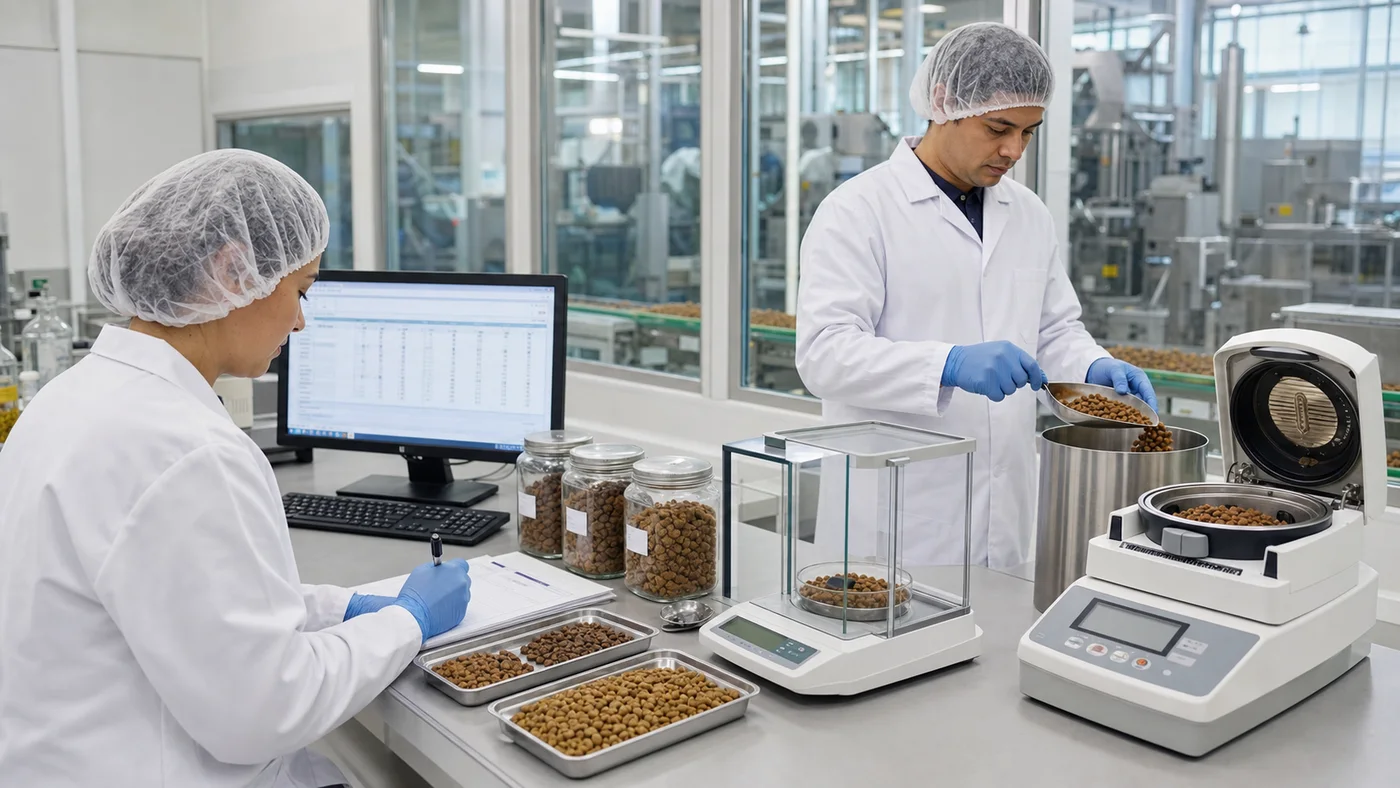
A pet food quality control laboratory should be designed around decisions, not around the longest possible equipment list. Its purpose is to provide reliable information for accepting ingredients, controlling production, investigating deviations, verifying finished-product specifications, and releasing or rejecting lots. A large instrument has little value if the sample is not representative, the method is unsuitable, or no one has defined what action follows the result.
The correct laboratory scope depends on the product portfolio, target countries, claims, ingredients, hazards, factory capacity, release time, staff competence, and access to qualified external laboratories. A dry kibble plant producing several stable formulas may need a different in-house capability from a supplement plant, freeze-dried line, or facility handling raw animal materials.
This guide supports early planning for a pet food factory system. It does not prescribe one universal test panel or replace the regulations, validated methods, accredited laboratory advice, veterinary nutrition expertise, or food-safety plan required for a specific project.
Define the laboratory's decisions before selecting instruments
Begin with a list of decisions the quality team must make and the maximum acceptable time for each decision. Typical examples include whether a delivery can enter storage, whether a heat process remains within its validated operating window, whether coated kibble meets physical targets, whether a deviation requires segregation, and whether a finished lot can be released.
Classify each proposed test by its purpose:
- Food-safety verification: supports a hazard analysis, preventive control, sanitation program, supplier control, or investigation.
- Regulatory and label conformity: assesses applicable composition, nutrient, contaminant, additive, or label requirements in the destination market.
- Process control: provides rapid information such as moisture, bulk density, particle size, or coating consistency while production can still be adjusted.
- Commercial quality: checks appearance, odor, dimensions, hardness, package integrity, palatability, or customer-agreed specifications.
This classification prevents a common mistake: buying a sophisticated analyzer for a slow, low-frequency test while leaving routine sampling, sample preparation, calibration, or data review under-resourced.
Build a specification and hazard matrix for every product family
The laboratory plan should start from approved specifications rather than generic test names. For each raw material, packaging material, intermediate, and finished product, record the characteristic, target or limit, unit, approved method, sampling point, frequency rationale, responsible laboratory, result time, and required response.
The matrix should distinguish formula targets from legal limits and label declarations. It should also distinguish a supplier certificate of analysis from the factory's own verification. A certificate can be part of supplier assurance, but its reliability must be evaluated through approval, performance history, risk-based verification, and contract terms.
For facilities serving the United States, FDA's Preventive Controls for Animal Food overview explains that product testing and environmental monitoring are possible verification activities when appropriate to the animal food, facility, preventive control, and its role in the food-safety system. This is not a blanket requirement to test every parameter in every batch. The facility's hazard analysis and applicable legal obligations determine the program.
Separate incoming, in-process, and finished-product controls
Incoming control can include identity confirmation, packaging condition, sensory inspection, moisture, supplier documents, and risk-based checks for nutrients, mycotoxins, microorganisms, chemical contaminants, or foreign material. The actual panel should follow ingredient risk and the approved-supplier program. High variability or poor supplier performance may justify tighter verification than a stable, well-controlled ingredient.
In-process control should focus on information that can change the current run: ground particle distribution, preconditioner or extrusion records, moisture, extrudate density, dryer profile, coating addition, kibble dimensions, fines, and package weight. Instrument readings do not replace validated process monitoring; they complement it.
Finished-product control can cover physical and sensory attributes, moisture or water activity, declared composition, selected nutrients, package integrity, coding, contaminants, and microbiological verification where justified. Release status should reflect all required records, not just a single laboratory result.
Coordinate these controls with the raw material receiving, storage, and batching plan so that sampled lots remain identifiable and cannot be used accidentally while on hold.
Design a representative sampling plan
Analytical precision cannot correct a biased sample. The plan must define the lot, sampling unit, selection method, number and location of increments, composite preparation, sample reduction, laboratory portion, retain quantity, container, seal, label, and chain of custody. Sampling from the easiest point only can miss segregation within a truck, silo, tote, or production run.
Sampling intensity should be based on the hazard, material variability, process, method, lot size, confidence required, supplier history, and governing rule. There is no responsible single number that applies to all ingredients and all contaminants. Microbiological sampling also requires special statistical interpretation because a negative result only means the target was not detected in the tested portions; it does not prove that an entire lot is free of the organism.
Use clean, suitable tools and containers, and control carryover between lots. Record who collected the sample, where and when it was collected, the lot identity, seal condition, requested tests, and any unusual observation. If a sample is transferred to an external laboratory, document packaging, temperature or environmental protection where relevant, dispatch time, and receipt.
Control sample preparation as carefully as analysis
Dry pet food and raw materials are often heterogeneous. Coarse pieces, fines, surface coating, meat inclusions, mineral premixes, and moisture gradients can create different results if the laboratory portion is not properly reduced and homogenized. Use a documented sample divider or reduction technique rather than taking a convenient scoop from the top.
Grinding can change moisture or create heat, and poorly cleaned mills can carry material into the next sample. Define particle-size requirements for the method, cleaning between samples, treatment of high-fat or sticky materials, order of preparation, and controls for cross-contact. For moisture-sensitive testing, minimize open exposure and analyze within the validated holding time.
Keep an untouched portion when an investigation, confirmation, or external retest may be required. Once the entire sample has been ground or opened repeatedly, it may no longer represent the original condition of the lot.
Plan laboratory zones around contamination and workflow
The laboratory should not be one undivided room. A practical layout can include sample reception and registration, sample subdivision and grinding, rapid physical testing, chemistry preparation, instrument space, controlled reagent storage, washing, waste handling, records, and retain-sample storage. Microbiological work, if conducted in-house, requires a separately assessed layout, containment, utilities, cleaning, waste treatment, and competent supervision.
Do not route dirty ingredient samples through finished-product work areas. Separate dusty preparation from sensitive balances and instruments. Provide stable benches, controlled temperature where methods require it, adequate electrical capacity, ventilation appropriate to the chemicals and equipment, clean water where needed, safe chemical storage, and access for calibration and maintenance.
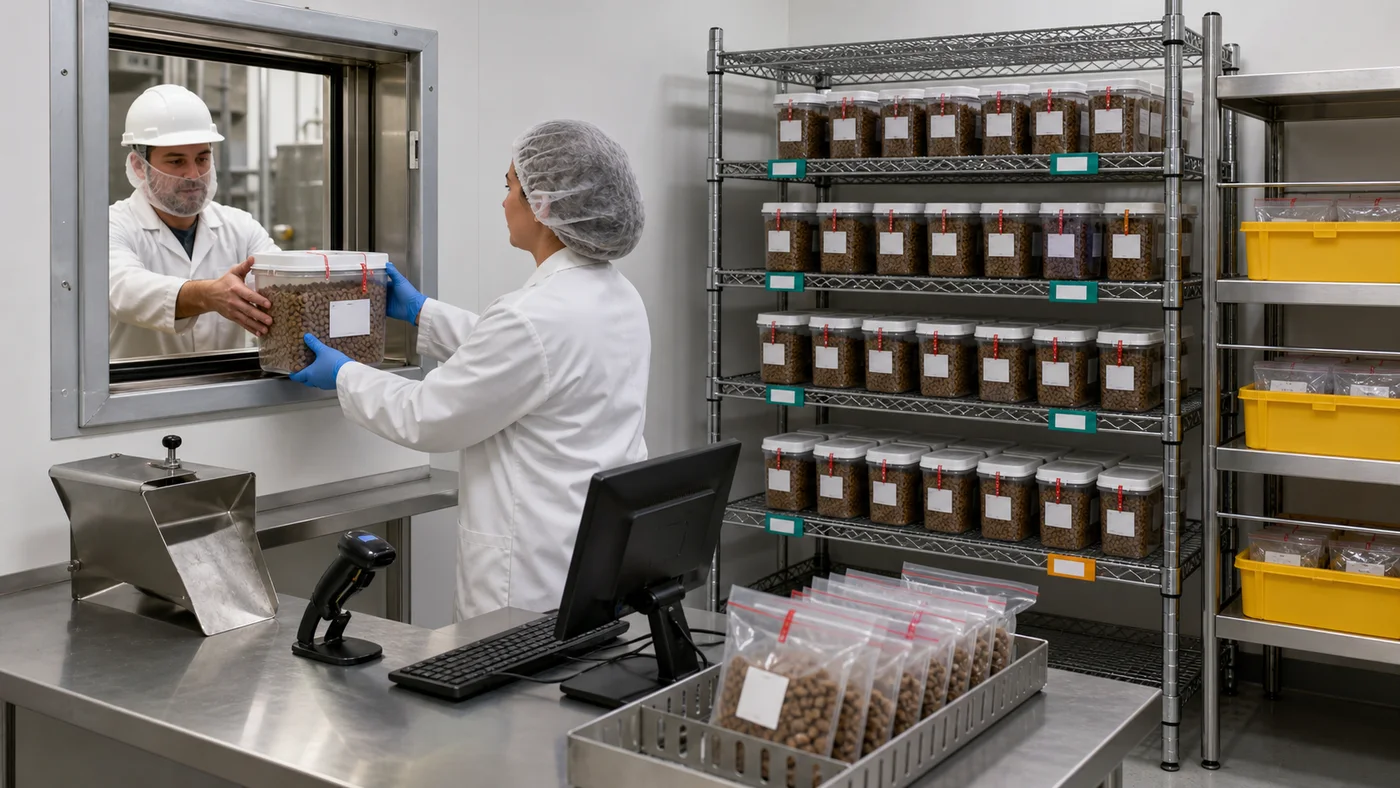
The laboratory location must also fit the wider factory layout and QC workflow. Short sample travel is useful, but an opening directly into a dusty production room can compromise the laboratory environment. A controlled handoff hatch or sample reception point is often more manageable.
Select a realistic in-house test package
A basic dry pet food laboratory may use calibrated balances, a sample divider, grinder, moisture analyzer or oven method, water-activity meter, sieves, bulk-density tools, calipers, package scales, seal or leak checks, and controlled sensory standards. The exact package depends on the approved methods and products.
Water activity and moisture content are related but not interchangeable. Moisture describes the amount of water; water activity reflects the availability of water under the test conditions and is relevant to stability and microbial considerations. Both instruments require an appropriate method, temperature control, calibration checks, and defined acceptance criteria.
Near-infrared instruments can support rapid screening for properties such as moisture, protein, or fat, but they require suitable calibration models, representative reference data, validation, maintenance, and ongoing performance checks. A displayed result should not automatically be treated as an official release value. Calibration transfer between different products, particle sizes, temperatures, or instrument models must be evaluated.
Choose carefully between in-house and external chemistry
Proximate analysis, minerals, amino acids, vitamins, fatty acids, additives, contaminants, and other analytes can require very different preparation, instruments, technical competence, reference materials, and quality controls. Installing every capability in-house can create a laboratory that is expensive to maintain but produces too few samples to sustain competence.
Keep a method in-house when its turnaround time materially affects production, sample volume is sufficient, trained staff and quality controls can be maintained, and the result is reliable for its intended decision. Use an external laboratory when testing is complex, infrequent, regulatory, claim-related, confirmation-critical, or dependent on specialized instrumentation.
When selecting an external laboratory, review its scope, method, matrix experience, reporting limit, measurement uncertainty where relevant, turnaround, sample requirements, proficiency performance, and subcontracting policy. ISO/IEC 17025:2017 remains the international standard for testing and calibration laboratory competence, impartiality, and consistent operation. Accreditation should be checked against the specific test and matrix in scope, not treated as a general badge covering every analysis.
Treat microbiological testing as a specialist program
Pathogen testing is not equivalent to placing an incubator in a general QC room. The project must assess method validation, enrichment and confirmation workflow, positive-control handling, cross-contamination risk, biosafety, waste decontamination, personnel competence, result interpretation, and the consequences of introducing concentrated cultures near food production.
For some factories, sending pathogen samples to a qualified external laboratory is more robust than building an in-house pathogen laboratory. Rapid screening may shorten the first result, but presumptive positives can require confirmation and an established hold-and-response process.
FDA's Guidance for Industry #245 describes hazard analysis, preventive controls, monitoring, corrective actions, verification, validation, and records for animal food. FDA also reports a validated LAMP screening method for Salmonella in animal food accepted into its Bacteriological Analytical Manual. Method selection still needs to match the product, regulatory purpose, laboratory capability, and confirmation pathway.
Connect environmental monitoring to the hygiene plan
Environmental monitoring and finished-product testing answer different questions. Environmental samples can help verify sanitation controls and identify niches or movement patterns before contamination appears in a finished-product sample. Their sites, organisms, frequency, timing, zones, trend rules, and corrective actions should follow the hazard analysis and facility design.
A positive environmental result must trigger a predefined response appropriate to the organism and location. Recleaning one point without investigating traffic, moisture, dust, equipment access, airflow, or recurring harborage can leave the underlying cause in place. Link laboratory data to the factory hygiene and sanitation plan, including escalation, intensified sampling, root-cause work, and documentation.
Define specifications, release limits, and out-of-specification handling
Every result needs an approved comparison basis. A formula target, internal warning limit, release specification, label guarantee, and legal maximum are not necessarily the same value. Method bias, repeatability, reproducibility, sampling variation, rounding, and measurement uncertainty can affect interpretation, particularly near a limit.
Create a written out-of-specification procedure before commercial production. It should preserve the original data and sample, verify calculations and instrument status, review sampling and preparation, define when a justified repeat or confirmation is allowed, assess affected materials and lots, document the investigation, and assign disposition authority. Repeating a test until a passing number appears is not an acceptable investigation strategy.
Trend results even when they remain within specification. Gradual changes in moisture, density, fines, coating addition, nutrient recovery, or package weight can reveal equipment wear, supplier drift, calibration issues, or process instability before a lot fails.
Create a controlled batch-release workflow
Physical status control should match the electronic record. Ingredients and finished goods need visible and system-controlled states such as quarantine, approved, rejected, or conditionally released where permitted by procedure. Warehouse movements, rework, and dispatch must respect those states.
A release checklist may include required laboratory results, production and process-control records, formulation and batching verification, packaging and coding checks, deviation closure, sanitation status, and approval by authorized quality personnel. The enterprise or manufacturing system can collect records, but responsibility and exception handling must remain clear.
Turnaround targets should be designed into inventory and warehouse capacity. If an external test takes several days, the factory needs enough identified quarantine space and working capital to hold production safely without pressuring the quality team into premature release.
Manage retain samples as traceable evidence
Retain samples support complaint investigation, stability review, regulatory requests, method confirmation, and comparison with future production. Define which incoming and finished lots are retained, the quantity, container, seal, storage condition, location, access, inventory record, retention period, disposal approval, and response if a container is damaged.
The duration should follow applicable law, customer agreements, product shelf life, investigation needs, and company policy; one fixed period is not suitable for every market or product. Storage conditions should protect the sample from moisture exchange, pests, light, temperature extremes, odor transfer, and mix-up. The archive must be sized using the number of lots, sample volume, retention duration, and growth allowance.
Build laboratory quality assurance into daily work
Reliable data requires more than annual instrument calibration. Depending on the method, controls can include blanks, duplicates, reference materials, check standards, spikes, control charts, calibration verification, preventive maintenance, environmental checks, proficiency testing, and review of analyst performance.
Document method versions, equipment IDs, reagent or standard lots, calculations, raw observations, changes, electronic access, review, and result authorization. Define what happens when a check standard fails or an instrument is found out of tolerance, including assessment of results generated since the last acceptable check.
The 2025 FEDIAF Nutritional Guidelines for Cats and Dogs are a current reference for assessing the nutritional value of complete and complementary pet foods in Europe. The project must still confirm the regulations, official methods, tolerances, and label rules in every intended sales market.
Plan staffing, competence, and safe operation
Estimate workload by samples and methods, not simply by production tonnage. Include receiving peaks, line start-up checks, cleaning verification, retests, external sample preparation, complaints, method controls, calibration, records, and leave coverage. A single analyst cannot simultaneously collect samples across the factory, prepare chemistry, manage microbiology, review data, and release multiple lines without workload and independence risks.
Training should be method-specific and demonstrated through observed work, acceptable control results, and periodic reassessment. Define responsibilities for sampling, testing, technical review, release, investigation, method approval, external-laboratory management, chemical safety, and waste handling.
Commission the laboratory before the first commercial batch
Laboratory commissioning should begin before production-line trials. Confirm utilities, room conditions, equipment installation, calibration status, methods, reference materials, sample labels, worksheets or LIMS configuration, external-laboratory logistics, acceptance criteria, and analyst competence.
Use representative factory materials to verify sample preparation and method performance. Run mock scenarios for a failed incoming result, presumptive pathogen result, instrument breakdown, missing sample, late external report, and out-of-specification finished lot. The team should know how material is physically blocked and who makes the disposition decision.
Documents to complete before laboratory procurement
- product, market, claim, and regulatory requirements matrix;
- raw material, process, finished-product, and environmental test matrix;
- sampling plans, sample flows, chain-of-custody, and retain policy;
- in-house versus external method decision and turnaround requirements;
- room data sheets, zoning, utilities, ventilation, storage, and waste requirements;
- instrument user requirements, method range, capacity, and quality-control needs;
- specifications, warning limits, release criteria, and out-of-specification procedure;
- staffing, competence, calibration, maintenance, proficiency, and documentation plan;
- commissioning protocols and batch-release simulation.
PetFactorySystem.com can coordinate laboratory scope with product strategy, process design, warehouse holds, hygienic zoning, utilities, automation, and launch planning. To prepare a project-specific QC laboratory brief, send the product types, target markets, planned claims, capacity, raw materials, and required release time.
Review the related factory system
Compare the production route, equipment package, layout assumptions, capacity target, and operating requirements before confirming a factory plan.