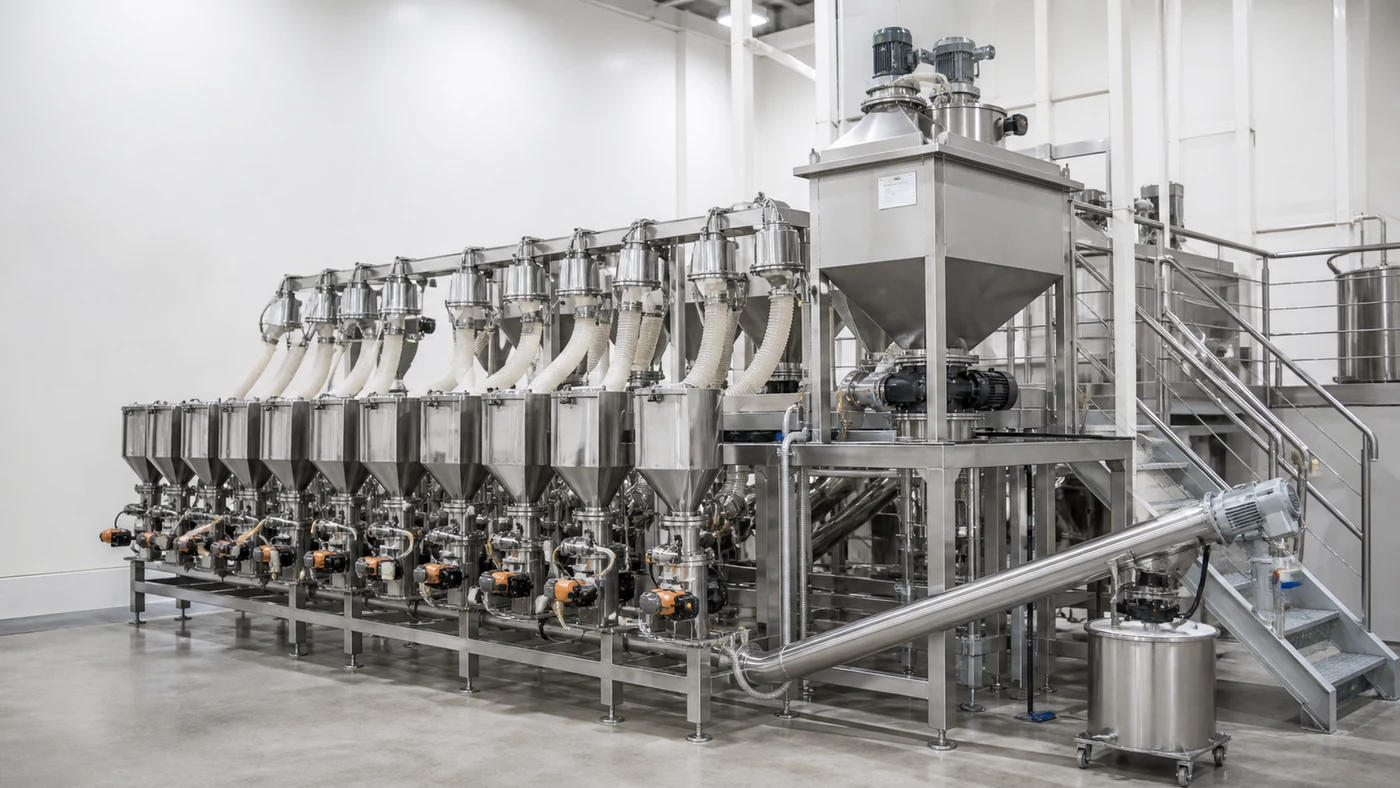
Micro-ingredient dosing is where a recipe becomes an actual production instruction. Vitamins, minerals, amino acids, palatants, colourants, functional additives, and premixes may represent a small mass fraction of a dry pet food batch, but they can have a large effect on formula control, traceability, handling risk, and product changeover. A factory needs a system that can receive, identify, store, weigh, discharge, and document these materials consistently.
A micro-dosing system is not simply a row of small bins. It includes incoming-material control, the selected weighing principle, feeder behaviour, dust containment, scale verification, batch logic, the transfer to the main mixer, sanitation access, and records that can explain what actually entered a batch. This guide sets out how to plan that system as part of a complete dry pet food factory.
Define the formula and batch basis first
Start with the real product portfolio. For every product family, list the micro ingredients and premixes, their target addition rates, tolerance or approved range where defined by the product owner, physical form, bulk density, particle size, flow behaviour, dust tendency, storage conditions, allergen or cross-contact status, and expected campaign length. A material that flows freely at 10 kg per batch may need a different solution from a cohesive powder added in grams or a pre-blended premix added at several kilograms.
State the batch size and the required number of batches per hour. The micro system must support the main mixer schedule rather than being sized from a single convenient weighment. Include low-rate operation, recipe changes, future ingredients, and manual additions. A good proposal makes its capacity and accuracy assumptions explicit instead of applying one generic figure to every component.
Keep the production basis aligned with the main mixing-system plan. A correctly weighed micro ingredient still needs a defined discharge path, batch identity, mixing time, and verified route into the main batch.
Separate storage, dosing, and verification functions
Micro bins, day bins, containers, weigh hoppers, feeders, and manual-addition stations have different jobs. Storage should protect material condition and identification. The feeder should deliver material predictably. The scale should provide a suitable measurement for the chosen batch or continuous operation. Verification should confirm that the commanded and realised quantities are within the approved process rules.
Do not assume that a large hopper solves a difficult material. Bridging, rat-holing, poor refill behaviour, segregation, residual powder, and dust release can affect whether a feeder reaches its target. Review hopper angle, agitation where justified, feeder type, refill logic, discharge time, and access for inspection. Test difficult ingredients with representative material before a final selection.
A manual-addition station may be appropriate for infrequent or specialised ingredients, but it needs the same discipline as automated dosing: material identification, scan or check logic, controlled weighing, batch confirmation, dust handling, and reconciliation. A manual station without a controlled record is a gap in the batch history.
Select batch weighing or loss-in-weight dosing for the actual duty
Batch systems commonly meter ingredients into a small weigh hopper according to the recipe, then discharge the verified group into the receiving process. They are useful where the factory works around discrete mixer batches and needs clear material-to-batch reconciliation. The sequence, scale capacity, refill cycle, and discharge method must still fit the mixer schedule.
Loss-in-weight systems measure a feeder and its supply hopper by the controlled reduction in weight over time. They can be useful when a micro component must be dosed continuously in proportion to a material flow. The system needs stable refill control, a suitable feed device, a defined transition through refill, and a verified relationship to the receiving process rate.
Neither arrangement automatically delivers formula compliance. Static scale condition, feeder behaviour, material flow, control logic, refill events, and the actual batch or line rate all matter. The engineering objective is repeatable, documented addition under normal operating conditions, not a supplier claim removed from its installed context.
Design for the material, not the nominal feeder range
Fine powders, granules, oily additives, hygroscopic materials, premixes, and fibres can behave very differently. A feeder that performs well with a free-flowing mineral may pulse, bridge, smear, or retain a vitamin premix. Review particle properties, moisture sensitivity, cohesive tendency, electrostatic behaviour, segregation risk, and the effect of vibration or conveying before choosing a screw, rotary device, vibratory feeder, or another mechanism.
Specify the required range from the smallest approved addition to the highest practical rate. Include the effect of start-up and refill, not only a steady-state calculation. A small micro addition may be within the theoretical scale resolution but still be unreliable if the selected feeder cannot deliver it smoothly or if material remains on product-contact surfaces.
Supplier demonstrations should use representative material or a documented substitute with similar handling properties. Where this is not possible, record the limitation and define the site trial needed before product release.
Use a clear recipe and batch-identification model
Every dose should be tied to a current approved recipe and a unique production batch or order. The system should identify the ingredient, source container or lot where required, target quantity, actual quantity, scale or feeder used, operator action if any, time, alarms, deviations, and disposition of an incomplete or rejected dose. The exact records depend on the site's quality system, but the information must be sufficient to investigate a formula question without relying on memory.
Control recipe change carefully. Authorised personnel should be able to distinguish a new recipe version from a temporary operating adjustment. The system should not silently substitute an ingredient or continue with a missing material. Define the actions for an empty bin, wrong-container scan, scale fault, blocked feeder, out-of-range result, interrupted batch, and line restart.
Traceability needs a physical counterpart. Containers, bin ports, transfer hoses, manual-addition stations, and discharge points should be arranged so that the operator can confirm the material path, not just its entry in software.
Manage dust and cross-contact at the source
Fine materials can create airborne dust during receiving, container opening, bin filling, weighing, manual additions, and cleaning. Enclosure, local aspiration, access doors, filter maintenance, housekeeping, and the site's dust-hazard assessment need to be planned together. A suction point that makes material identification or cleaning impossible is not a complete solution.
Cross-contact risk also lives in residual product. Map bins, feeders, screws, weigh hoppers, chutes, transfer lines, filters, manual tools, and collection points. Define how each is emptied, inspected, cleaned, or segregated between product families. A small retained mass is more significant when the next product uses a low addition rate or has a strict formula requirement.
The factory hygiene and sanitation plan should include micro-dosing equipment and its connected routes. Cleaning instructions need safe isolation, practical access, verification criteria, and a defined restart check.
Plan refill and buffer behaviour
Refilling a micro bin can interrupt dosing, introduce dust, or change the material condition. Define how material is transferred from its original container to the bin, what quantity can be present, who confirms identity, how the system prevents an incorrect fill, and whether the bin must be empty before a new lot or product is introduced. The correct answer depends on the factory's traceability and campaign model.
For continuous systems, review the loss-in-weight refill sequence in detail. The control strategy must cope with the change from measured discharge to refill and return to normal measurement without creating an unrecognised dosing error. For batch systems, verify that refill does not cause the next batch to miss the main mixer schedule or introduce a partially identified material into a weighment.
Buffer capacity is only useful if it remains controlled. Large bins can reduce refill frequency but may extend the time before a material issue is detected or complicate lot traceability. Size the buffer from the production plan and quality requirements rather than maximising storage volume.
Verify scales and feeders with a practical procedure
Calibration, verification, and routine checks have different roles. Calibration establishes the measurement relationship against suitable standards; routine verification confirms that the installed system is behaving acceptably for production; operational checks can identify a feeder or material-flow problem before a batch is affected. The site should define who performs each activity, what standard or check material is used, the frequency, acceptance rule, corrective action, and record.
A scale may be accurate while the feeder is not delivering smoothly. Conversely, a feeder may appear smooth while a load cell is drifting or a discharge gate is retaining material. Check the complete dose: commanded quantity, measured quantity, discharged quantity where practical, and the condition of the receiving route. Sampling and reconciliation should be meaningful for the small quantities involved.

Integrate micro dosing with mixing and production controls
The micro system must communicate with the main mixer or continuous process. A batch should not advance merely because a screen says dosing is complete; it needs an agreed status for correct ingredients, completed weighments, discharge confirmation, and any manual-addition confirmation. The main mixer should know whether it is receiving a valid batch, a held batch, or no batch at all.
Map the physical discharge path. Material can remain in the weigh hopper, chute, screw, or connection to the mixer. The timing of discharge, mixer fill level, transfer sequence, and material movement should be verified with representative batches. A missing dose can be caused by a blockage after the scale as well as by a control error before it.
The automation and traceability guide gives the broader system context. The micro-dosing package should define its own alarms, recipe permissions, batch records, instrument status, and interfaces before PLC or software programming begins.
Design access, ergonomics, and maintenance before installation
Operators need safe access to refill bins, inspect feeders, remove containers, clean contact parts, clear a bridge, verify a scale, and service drives or dust filters. Confirm platform loads, guard clearances, lifting points, working height, lighting, ventilation, electrical isolation, and the route for removing a feeder or weigh hopper. A compact dosing skid can become difficult to operate when it is placed under other equipment without headroom or service space.
Keep utilities and controls accessible without routing them across a cleaning or product-transfer area. Where material is sensitive to humidity or temperature, define the room conditions and storage arrangement. The physical layout should make the correct operating action easier than the incorrect one.
Commission with real recipes and real operating events
Factory acceptance testing should verify equipment identity, construction, controls, interlocks, supplied tools, documentation, and basic dry operation. Site commissioning must use representative materials and recipes. Test the smallest and largest practical additions, normal batch rate, bin refills, planned manual additions, feeder blockage response, recipe change, cleanout, control alarms, and transfer into the mixer.
Agree how results will be evaluated before trials start. Record material identity, target and actual quantities, batch number, feeder and scale status, refill state, deviations, and mixer interface. Review whether product observations and batch records remain coherent through the downstream process. Do not claim a universal formula accuracy from one successful trial; establish an approved operating window for the site's materials and procedure.
What to include in a micro-dosing system request
- all micro ingredients and premixes, their physical properties, addition rates, future products, and storage or cross-contact requirements;
- batch size, batches per hour, continuous or batch duty, minimum and maximum rates, refill plan, and required buffer time;
- weighing and feeder arrangement, target operating range, material-flow test expectations, accuracy basis, and verification procedure;
- recipe control, material identification, batch records, manual-addition logic, interlocks, alarms, permissions, and exception handling;
- dust containment, aspiration interfaces, cleaning access, product-contact materials, sanitation method, and maintenance clearance;
- connections to receiving, mixing, conveying, building utilities, controls, FAT, site trials, training, spare parts, and acceptance criteria.
Build a controlled ingredient system
A strong micro-dosing system brings together appropriate feeders and scales, real material behaviour, recipe control, traceable refill, dust management, sanitation access, practical verification, and a confirmed route into the mixer. It protects the integrity of the batch before the extrusion line begins.
PetFactorySystem.com can define the micro-ingredient map, batch logic, equipment specification, layout, dust and sanitation interfaces, automation requirements, and commissioning plan for a pet food factory project.
Review the related factory system
Compare the production route, equipment package, layout assumptions, capacity target, and operating requirements before confirming a factory plan.