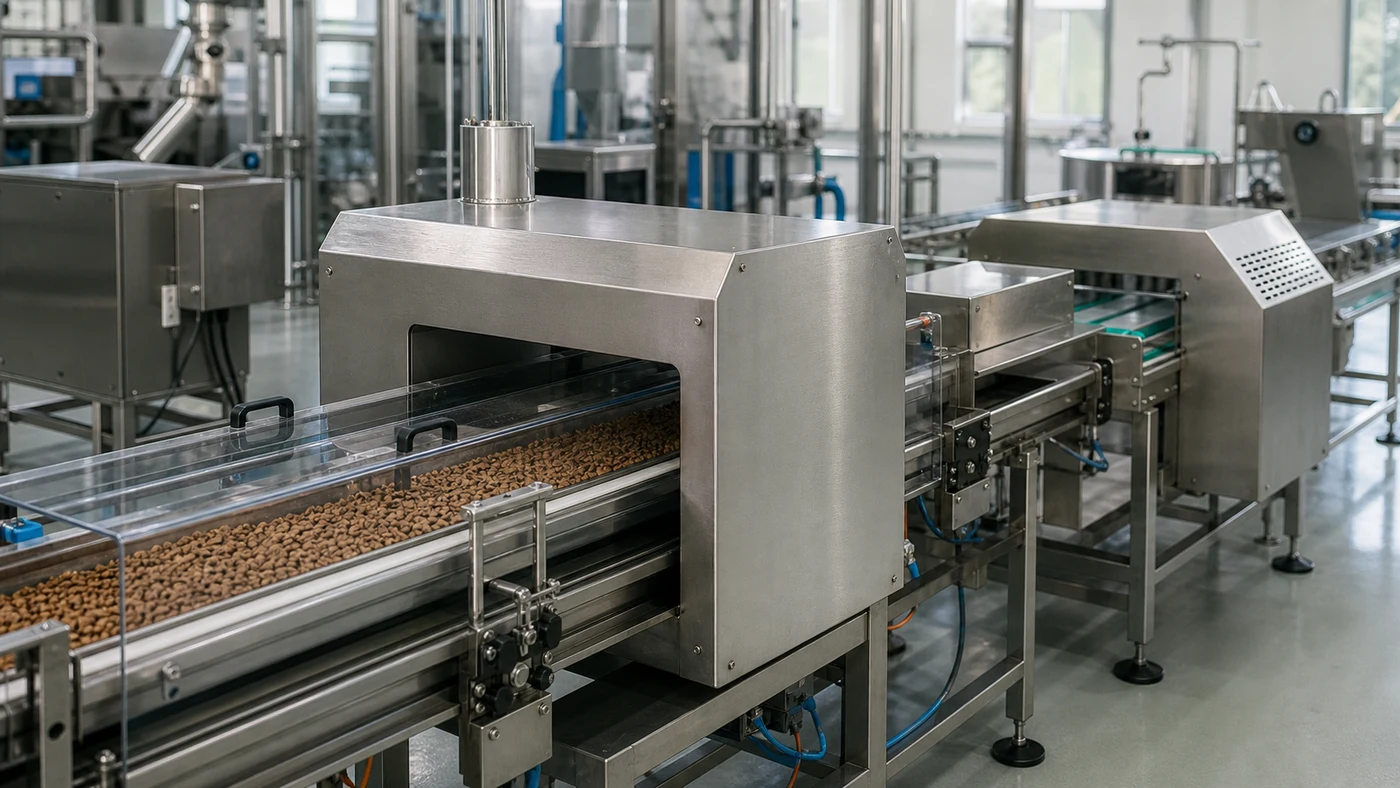
Metal control in a pet food factory is a process-design task, not simply a final packing-line purchase. A fragment can enter with a dry ingredient, arise from wear in a mill or transfer, be introduced during maintenance, or travel with product through the process. The useful question is not only whether a detector can find metal. It is where the factory should prevent it, where it should inspect it, how it will isolate a reject, and how the line will prove that the control continues to work during production.
For dry pet food, the process can include receiving, storage, grinding, batching, mixing, extrusion, drying, cooling, coating, conveying, and packing. Every handoff changes the product condition and creates a different opportunity for inspection. This guide explains how to plan magnets, metal detectors, reject arrangements, records, and layout interfaces around that route. The final control plan must still be set through the site's hazard analysis, customer requirements, and applicable local rules.
Map the contamination risk before choosing equipment
Begin with a material and equipment map. List each raw material, its receiving format, storage path, transfer method, size-reduction stage, mixer route, thermal process, cooling route, coating step, final conveyor, and packed-product discharge. Then identify credible sources of metallic foreign material: supplier-origin material, damaged handling equipment, fasteners, screen damage, tool control failures, maintenance work, and wear at high-contact points. A metal-control scheme that begins from a catalogue model rather than this route can leave gaps or put inspection where it is difficult to operate.
Each product family also matters. Meal, powder, mineral-rich premix, warm product, dry kibble, coated kibble, and finished packs do not behave in the same way. Record typical temperature, moisture, bulk density, particle size, belt speed, pack format, product flow depth, and the product's ability to create an electrical or magnetic signal. These details affect detector selection, aperture size, orientation, achievable sensitivity, and false-reject behaviour.
Use the map to decide whether a control is preventive, investigative, or final-product inspection. A magnet at a dry ingredient point may reduce the load entering downstream equipment. A detector after a high-wear process may help identify a process event. A detector before final dispatch may protect the finished-pack route. One device does not necessarily replace the purpose of another.
Separate the jobs of magnets, metal detectors, and other inspection methods
Magnetic separators and metal detectors do different work. A magnetic device retains magnetic material from a product stream. Its construction, magnet type, position, cleaning method, and product flow determine how it performs. It can be useful at receiving or ahead of sensitive processing equipment, but it is not a general inspection record for every metallic contaminant and does not remove the need for a defined downstream control where the risk assessment requires one.
A metal detector monitors a product stream or a pack through a detector aperture and triggers a configured response when its signal meets the installed programme and verification conditions. Its performance depends on the material being inspected, aperture, product position, product effect, speed, surrounding equipment, electrical environment, and the planned test procedure. A larger opening is not a neutral specification: it can change the relationship between product and detector. Avoid selecting a detector from a single nominal sensitivity figure without the product and conveyor conditions that produced it.
X-ray systems are a separate inspection technology and can be considered for particular product, pack, and hazard scenarios. They should be assessed for the actual application rather than treated as an automatic upgrade. The choice among magnetic separation, metal detection, X-ray, screens, supplier controls, and process monitoring belongs in one documented site control strategy.
Choose inspection locations that answer a real process question
There is no universal number of metal detectors for a pet food line. Start by asking what an inspection point protects. Receiving controls can prevent unsuitable material moving into bulk storage. A detector or magnet ahead of a grinder, mixer, or extruder may protect equipment and reduce a known material risk. A detector after a mechanical stage can help identify wear before it reaches the rest of the line. Final inspection is commonly planned near packing or finished-product discharge, where a rejected unit can be isolated without losing product identity.
For a dry kibble line, possible review points include ingredient intake, pre-grinding material, post-grinding transfer, a dry product transfer after cooling, and the final conveyor before or after packing. The best location must have a stable and controlled product presentation, enough straight conveyor or product flow, a reject path, safe access, and a workable response when the device trips. A location that cannot be cleaned, tested, or observed is rarely a strong operational control.
The upstream process affects the final choice. The pet food grinding-system guide explains why particle-size preparation and mill condition should be planned as a controlled process. A magnet or detector can support that system, but it cannot substitute for guarding, inspection, maintenance, and investigation of abnormal mill wear.
Protect raw-material and high-wear stages with practical magnet design
Dry ingredient receiving is often a logical place to evaluate magnetic separation because material has not yet been blended into a batch or processed through more equipment. Design questions include the product route, flow rate, magnet location, accessible cleaning, captured-material disposal, risk of retained product, and whether operators can confirm that the device is installed in its intended position. Magnetic bars, grate magnets, drawer magnets, and other arrangements have different flow and cleaning implications; select the arrangement from the vessel, chute, or conveyor geometry rather than its name alone.
High-wear equipment deserves a separate review. Grinding, conveying, rotary devices, and mechanical transfers can create risk points that are specific to the installed equipment and maintenance history. Plan inspection and maintenance access so the factory can distinguish a detected event from normal product variation. If a magnet collects unusual material, the response should include secure removal, product and lot identification where necessary, examination of the likely source, and a decision path for affected material. A collection tray without a record or follow-up does not provide a complete control.
Do not install a magnetic device where it creates hidden residue, bridging, an inaccessible cleaning task, or an uncontrolled product fall. The location must support its own sanitation, product-changeover, and maintenance procedures.
Size the detector around the actual product presentation
A detector and conveyor form one inspection system. Specify the product type, maximum product height and width, normal product position, belt type, guide rails, transfer conditions, speed range, spacing between units where relevant, expected vibration, and any metal adjacent to the aperture. Product should pass through the configured inspection zone in a repeatable way. A shallow, consistent stream of dry kibble is a different duty from a tall, irregular product bed or a finished product pack.
Product effect and false rejects need attention before commissioning. Moisture, minerals, temperature change, density variation, and product composition can influence the detector signal. Even a dry product can change when its formula, coating, temperature, or pack configuration changes. The supplier should review representative products and operating conditions. The factory should document the programme, test pieces, line speed, product route, reject response, and acceptance criteria that apply to each approved product configuration.
Do not use another product's test result as a promise for a new formula or pack. Confirm the application whenever the product changes in a way that could affect inspection performance. This is especially relevant when one line moves between different kibble sizes, recipes, coated products, or multiple packaging formats.
Design the reject route as carefully as the detector
Detection is only useful when the response protects the product stream. The reject device must remove the intended product or pack, direct it to a controlled location, and give the operator a clear status. Depending on the route, this can involve a pusher, air reject, diverting conveyor, flap, or another engineered mechanism. It must suit the product and speed without scattering material, damaging good packs, or causing an ambiguous gap in product identification.
Plan the reject bin, enclosure, access, locks or controls where required by the site system, and the physical route for investigating rejected material. A reject bin should not allow accidental return to the good-product route. Define who can open it, how the contents are identified, what records are created, and whether product can ever be reworked under an approved procedure. If the line continues after a reject, establish what downstream verification confirms that the correct item was isolated. If the line stops, define the hold and restart sequence.
Reject confirmation is part of the control. The logic should detect a full bin, missing bin, failed divert, detector fault, or loss of a required interlock and place the line in its defined safe and quality-protective state. Exact alarm and stop responses depend on the site's risk assessment and control philosophy.
Make verification meaningful for the installed line
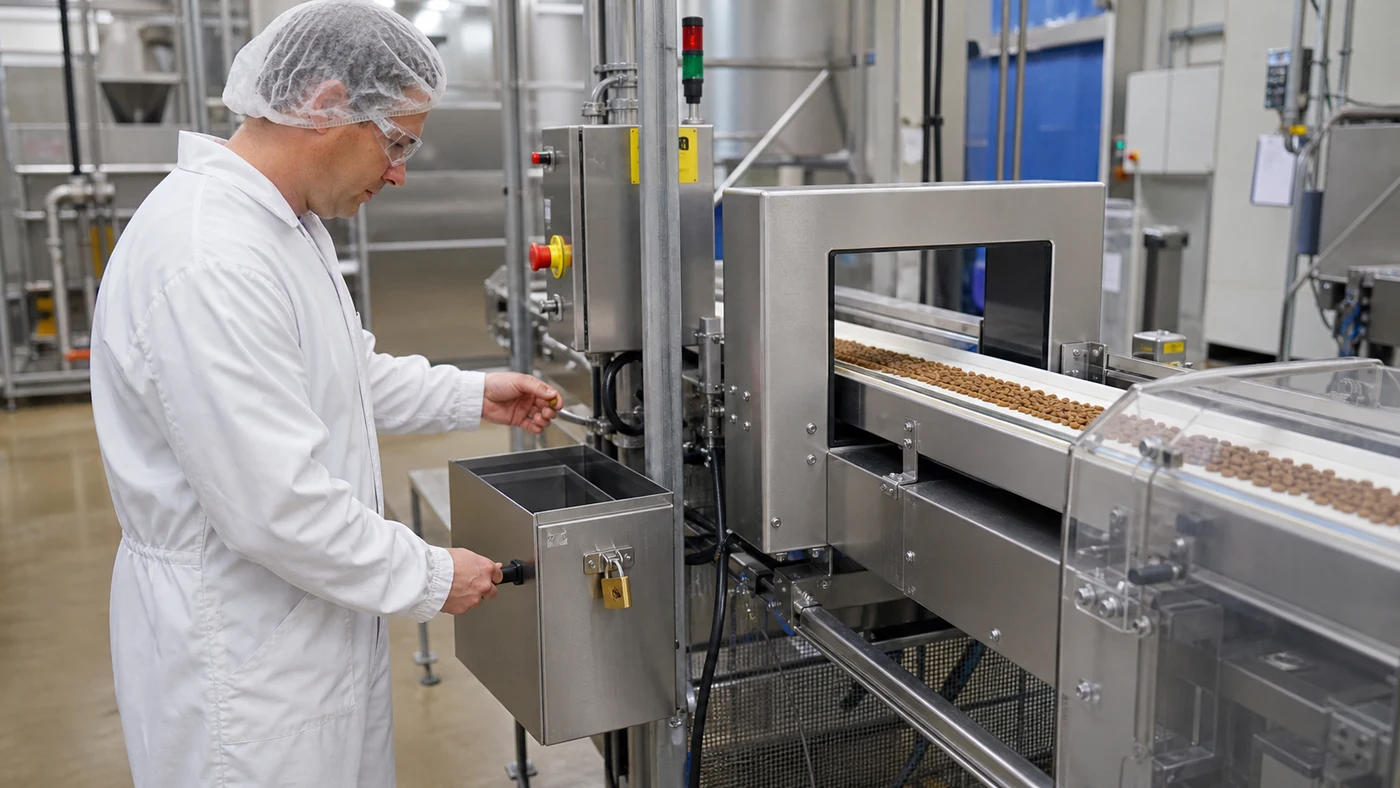
Verification demonstrates that the installed inspection system performs according to the approved procedure. It should use defined test pieces, product positions, line speeds, detector programmes, and reject checks that relate to the actual duty. The site's quality system should define the test frequency, who performs it, what happens when a check fails, how product since the previous acceptable check is handled, and how results are recorded. Calibration, routine performance verification, preventative maintenance, and investigation of a fault are distinct activities and should not be used as interchangeable labels.
Test the entire response, not just the detector signal. A useful trial verifies that a correct test sample triggers the configured reject action, reaches the intended controlled location, and is visible in the record. It should also establish expected behaviour when the bin is full, an access door is open, the reject mechanism does not confirm movement, or the device enters a fault state. The plant's approved procedure determines the details; the purpose is to avoid discovering a disconnected reject mechanism during production.
Keep test results connected to the relevant production period, product configuration, and machine status. This makes an investigation possible when a deviation occurs and supports disciplined release decisions. It also gives maintenance teams evidence about intermittent electrical noise, mechanical timing, belt tracking, worn components, or cleaning issues.
Coordinate cooling, coating, and packaging interfaces
Final inspection should be located after the product condition is stable enough for controlled presentation, while leaving room for rejection and packing. The cooling-system guide covers the relationship between dry-product condition, cooling, and the packing handoff. If warm, damp, or unstable product reaches an inspection conveyor, the effect may extend beyond quality and packing performance to detector stability and reject reliability.
Coated kibble needs a separate route check. Surface oil or palatant can change transfer behaviour, cause buildup at guide rails, and affect cleaning access. The detector conveyor should not become a product-accumulation point. Review belt construction, transfers, guard and rail geometry, access covers, drainage or dry-cleaning requirements, and the sequence for product changeover. The inspection system must fit the actual hygiene plan, not create a cleaning exception.
At packing, decide whether inspection is applied to bulk product, a finished bag, or another defined product unit. This affects throughput, product spacing, detector aperture, reject device, and how a reject is traced back to an upstream batch. The pet food packaging-line guide provides the wider layout context for weighing, filling, sealing, coding, finished-product handling, and inspection interfaces.
Give operators clear controls and usable records
The controls should make correct operation visible. Operators need a defined product programme, detector-ready status, reject-bin status, line speed or product-flow indication where relevant, alarm messages that distinguish an event from an equipment fault, and a controlled method for authorised changes. Maintenance staff need access to diagnostics, isolation points, component status, and service history without bypassing quality controls.
Records should be practical enough to use. Depending on the installed system, they may include product programme, batch or production order, detector status, verification results, reject count, reject reason, alarm and reset history, personnel action, maintenance event, and disposition record. The site should decide which records support its hazard analysis and customer commitments. A long record that is not reviewed does not improve control; a concise record with a defined response does.
Integrate the detector with the production control narrative. If a detector stops the line, identify which upstream machines stop first, what product remains on each conveyor, how the product is identified, and what must be checked before restart. If it diverts one item while the line continues, reconcile the event with the packing count and product flow.
Plan layout, sanitation, and maintenance access before fabrication
Metal-control equipment requires more than a rectangle on a process flow diagram. Confirm floor space, infeed and discharge elevations, straight conveyor length, access to the detector head, reject-bin removal route, safe working positions, guarding, lighting, electrical supply, compressed air where used, controls cabling, and a clear maintenance path. The team should be able to remove or service a belt, detector component, or reject device without dismantling the packing line or working across an open food path.
Design cleaning access around the product route. Doors, covers, belts, guide rails, detector apertures, and reject zones need to be inspectable and cleanable according to the site's procedure. Dry cleaning may be appropriate for a dry process, but any cleaning method needs to account for product residue, dust, moisture introduction, drying, and restart conditions. Include sanitation and quality staff in the layout review; they will identify residual-product and access issues that are not obvious from a process drawing.
Electrical environment is also part of the installation. Adjacent motors, drives, structural vibration, grounding, static, and cable routing can influence an inspection system. Define the supplier's installation requirements early and confirm them at site acceptance, especially when existing equipment is being retrofitted around a new detector.
Commission with representative product and exceptions
Factory acceptance testing can confirm supplied equipment, guards, basic controls, documentation, and the agreed scope. Site commissioning must prove the installed system with representative products, normal and practical maximum speeds, the intended conveyor arrangement, approved programmes, and the real reject route. Test start-up, normal running, planned stops, product changes, reject action, full-bin response, detector fault, product hold, and restart.
Record the conditions of every trial: product, formula or configuration, product state, speed, aperture, detector programme, test samples, reject result, line response, and any adjustment. Review the results with operations, quality, maintenance, and the equipment supplier before product release. A documented operating window is more valuable than an undocumented one-off demonstration.
After commissioning, maintain the system through planned verification, preventative maintenance, cleaning checks, operator training, and review of rejects or alarms. Repeated metal events, false rejects, or unexplained detector instability are process signals. Investigate the cause rather than only resetting the machine.
What to include in a pet food metal-control equipment request
- process-flow drawing and the risk purpose of each proposed magnet, detector, or other inspection point;
- product families, physical condition, kibble dimensions, product depth, speed, throughput, formula variation, temperature, moisture, and packing formats;
- available layout, conveyor elevations, infeed and discharge interfaces, utilities, electrical environment, access, cleaning method, and product-changeover requirements;
- magnet construction and cleaning expectations, detector aperture and conveyor requirements, product programmes, test procedure, and reject-system scope;
- reject-bin control, product hold and disposition logic, alarms, interlocks, records, controls integration, training, spare parts, and maintenance access;
- FAT and site acceptance tests using representative product, including detector checks, reject confirmation, fault response, cleaning, restart, and acceptance documentation.
Build one connected metal-control system
A practical pet food metal detection system connects prevention, inspection, controlled rejection, verification, records, and investigation. It is selected around the product and process route, then proved in the installed factory. By mapping risk points and designing the response as carefully as the detector itself, a project team can protect equipment, product flow, and finished-pack control without relying on an isolated machine claim.
PetFactorySystem.com can help define the product route, inspection-point purpose, equipment specification, reject and records logic, layout interfaces, and commissioning scope for a pet food factory project.
Review the related factory system
Compare the production route, equipment package, layout assumptions, capacity target, and operating requirements before confirming a factory plan.