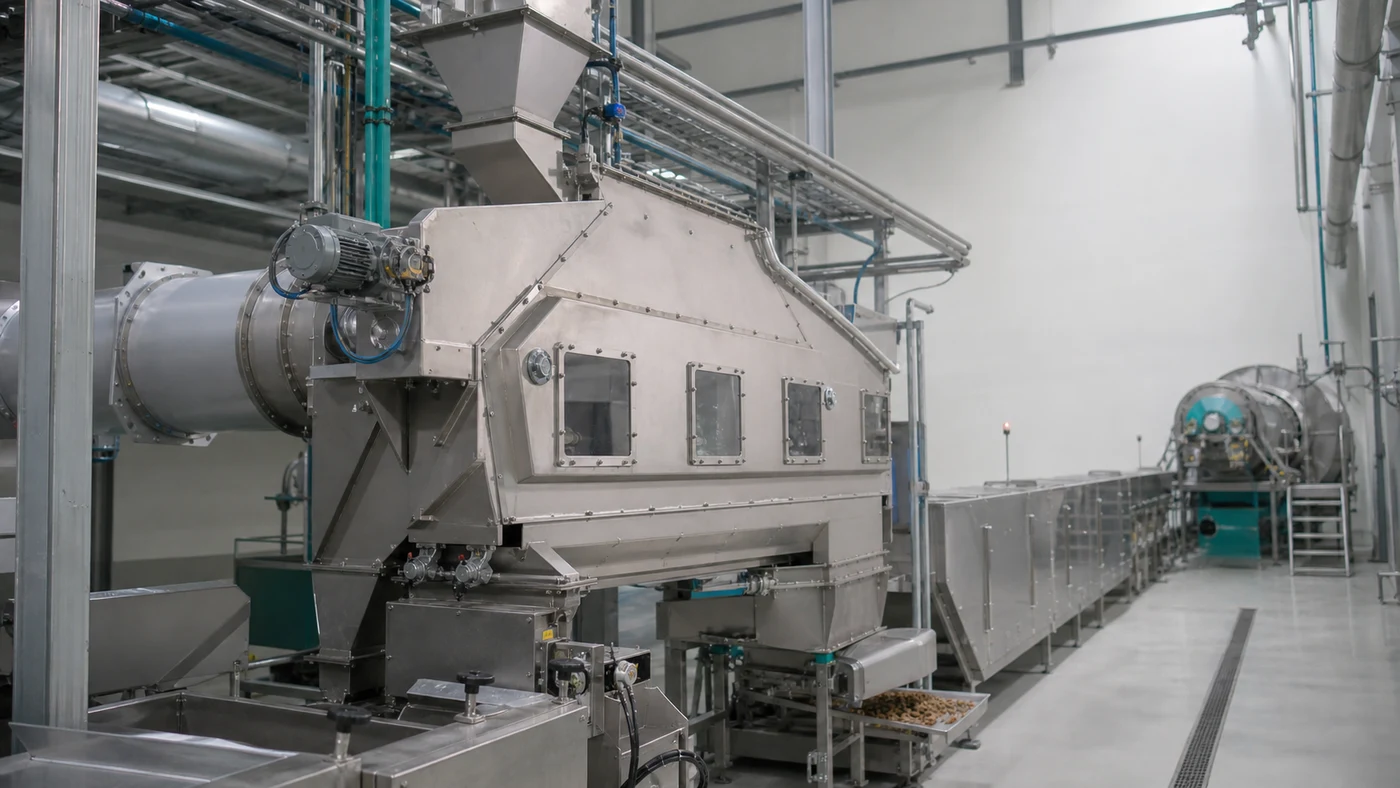
Cooling is a process step, not a passive conveyor between a dryer and a bagger. Freshly dried or coated kibble can carry heat, surface moisture, and mechanical fragility into the next stage. The cooling system must bring the product to a condition that is stable for the actual route that follows, whether that route includes coating, a second cooling step, inspection, or packaging.
A pet food cooler therefore has to be planned with the product, air, building, conveying, coating, and packaging system. A nominal tonnes-per-hour label does not establish that a cooler will deliver the right product temperature or the same condition across a full campaign. This guide explains how to specify cooling as part of a complete pet food factory system.
Start with the product state entering the cooler
Define the actual inlet condition for each product family: product temperature, moisture, bulk density, kibble size and shape, percentage of fines, fat or liquid addition status, bed depth, expected rate, and operating pattern. A cooler receives the outcome of upstream extrusion and drying; it cannot be selected correctly without knowing what arrives at its inlet.
Different formulations can leave drying with different temperature, surface condition, density, breakage sensitivity, and flow behaviour. A product that is easy to cool at a steady mid-range rate may behave differently at start-up, a low rate, after a dryer disturbance, or at the highest intended capacity. Specify the full practical product range rather than one optimistic test material.
The pet food dryer selection guide covers water removal and dryer residence. Its results should be used directly in the cooler duty: cooling is not a replacement for achieving the correct moisture condition in the dryer.
Define the required outlet condition, not just a temperature
Product temperature is important, but it is not the only acceptance measure. The outlet condition may need to address temperature relative to the factory air, surface dryness, stable handling, breakage, fines generation, coating compatibility, and whether the product can enter packaging without creating a risk of condensation in the pack.
The appropriate target depends on the product specification, packaging material, storage and distribution environment, and the order of downstream steps. It is normally more useful to define an approved temperature relationship to the actual ambient air condition than to copy one absolute value from an unrelated factory. Ambient conditions vary by geography, season, ventilation, and building design.
Counterflow technology is commonly used in pelleting and extrusion applications because product and air travel in opposite directions. For example, ANDRITZ describes counterflow cooling as a controlled air-through-product process for pelleting and extrusion. The equipment principle is relevant; the project must still validate its own product and packaging limit.
Place cooling correctly in the production route
There is no single downstream sequence for every dry pet food line. Some routes cool dried product before liquid or powder coating; some add a final cooling stage after coating; some use cooling conveyors or additional conditioning time before packaging. The correct sequence is determined by coating temperature, liquid viscosity, surface pickup, product fragility, packaging requirements, and the practical factory layout.
Map each transfer from dryer discharge to final pack. For every point, record product temperature, transfer duration, enclosure, product depth, air exposure, possible accumulation, and the equipment that can stop upstream or downstream flow. Product can gain or retain heat in an enclosed conveyor, a surge bin, or a densely packed elevator even after it has left the main cooler.
The pet food coating-system guide explains why temperature, product condition, and the route after coating must be evaluated together. A coating package should not be isolated from the cooler that sets its inlet condition or the packing system that receives its outlet.
Select the cooler type from product handling and air flow
Counterflow coolers, belt coolers, fluidised or vibrating cooling systems, and cooling conveyors use different product beds, air paths, residence-time methods, and discharge arrangements. The useful design question is not which type has the highest catalogue number; it is which mechanism can handle the proposed product without creating unacceptable temperature variation, damage, deposits, or cleaning difficulty.
Counterflow systems generally use an air flow that meets the descending product bed in the opposite direction. This can provide efficient heat transfer when product distribution, bed depth, air volume, and discharge behaviour are controlled. Bühler notes that uniform bed depth, gentle discharge, and direct air contact are key elements of counterflow cooler performance. See its counterflow-cooler overview.
For a fragile kibble, consider discharge action, drop heights, gates, vibration, and the interface to the next conveyor. A cooler that achieves the desired temperature but produces excessive fines is not meeting the factory requirement. Request product-specific handling trials where breakage risk is material.
Calculate duty using real heat and mass conditions
Cooling duty begins with mass flow and the product temperature reduction required. It also depends on specific heat, residual moisture, air conditions, residence time, air-to-product contact, heat losses from surrounding equipment, and the possibility of moisture movement between product and air. The calculation should clearly state the assumed product rate and inlet state.
Use minimum, normal, and maximum practical production rates. A continuous cooler at a very low fill level may not behave like the same system at normal fill. Conversely, a product bed that is too deep or poorly distributed can reduce air contact and create temperature differences from one discharge point to another.
Clarify the capacity basis in every proposal. Is the rating based on dryer discharge mass, final coated mass, an assumed inlet temperature, a defined air condition, or an ideal product bed? These distinctions change whether two supplier numbers are comparable. Reconcile the cooler rating with dryer, coater, and packing-line rates before selecting the system.
Use the actual air condition, including humidity
Cooling air is not simply cold air. Its temperature, relative humidity, cleanliness, pressure, and flow path all affect the product and equipment. In humid conditions, air that cools product can still create a risk of moisture pickup or condensation at unsuitable surfaces. In dry conditions, excessive air movement can change product handling or increase dust movement. The design must use realistic ambient design data for the factory location.
Review the seasonal air range, building ventilation, louvre location, dust ingress, recirculation, air filtration where needed, and whether the cooler needs conditioned or controlled air. Do not rely on a meteorological average when the factory will operate through hot and humid periods that create the toughest packaging condition.
Air paths must be intentional. Confirm where air enters, passes through the product, leaves the cooler, and is exhausted or treated. Poor duct routing, inadequate fan selection, or uncontrolled room air can reduce cooling consistency and introduce unwanted dust or odours into the process area.
Prevent condensation before it reaches the package
Condensation occurs when a surface or product condition meets air at or below its dew point. In a dry-food plant, this can appear on a cool metal surface, inside an enclosed transfer, or later inside a package if warm product is sealed without a suitable margin. The risk cannot be judged from product temperature alone; it must be assessed with product temperature, surrounding-air condition, product moisture, package format, and dwell time.
Map the warm-to-cool transitions in the actual building. Inspect hoods, ducts, conveyors, lids, inspection doors, bins, packing hoppers, and metal-detector enclosures. Identify places where a warm product stream meets a cold surface or where humid air can enter after the main cooler. Provide drainage, insulation, access, and cleaning provisions where the risk assessment requires them.
Packaging trials should use the real product, normal package, planned sealing conditions, and representative storage exposure. A bag that looks acceptable immediately after sealing may behave differently after it equilibrates. Do not treat an empty-bag seal test as evidence that the product has been cooled adequately.
Control product distribution and residence time
Air can only cool the product it contacts. In a bed cooler, uneven distribution creates local channels, shallow areas, and deep areas with different residence times and air exposure. A product pile entering one side of the chamber can lead to mixed outlet conditions even when fan pressure looks stable.
Define the feed-spreader arrangement, bed-depth range, level sensing, discharge logic, and the result expected at low, normal, and high rates. The cooler must not repeatedly empty and refill in a way that produces widely different residence times without an approved operating rationale. Control settings should be documented by product family and reviewed when the product portfolio changes.
Residence time is an actual process behaviour, not a volume divided by a nominal rate. It changes with product bulk density, fill level, discharge pattern, bridging, and bypass routes. Where temperature uniformity is important, use representative tests and samples rather than relying only on a theoretical calculation.
Protect kibble integrity through discharge and conveying
Cooling equipment can reduce product temperature while still damaging the product at its discharge. High drop heights, uncontrolled gates, sharp transfer lips, fast belt transitions, or poorly aligned elevators can increase breakage and fines. Those fines can later affect coating distribution, metal detection, weighing, bag appearance, and customer perception.
Evaluate the product route from the cooler outlet through every downstream transfer. Specify gentle discharge, appropriate chutes, removable inspection panels, low-friction or suitable contact surfaces, accessible cleanout, and a method to collect or measure fines where relevant. Do not defer these details to site fabrication after the main equipment has been selected.
Trial evaluation should include product temperature and condition, not merely the number of tonnes passed. Measure visual damage, fines, flow behaviour, and the stability of the subsequent coating or packaging process over a sustained run.
Integrate cooling controls with the full line
A pet food cooler should exchange meaningful signals with upstream and downstream equipment. These may include inlet rate, product level, bed depth, fan status, airflow or pressure, discharge position, product temperature, downstream conveyor readiness, coater demand, and packing-line status. The required controls depend on the selected technology, but the overall line needs a clear response to a stoppage.
When coating or packaging stops, a cooler may need to reduce feed, maintain airflow, discharge in a controlled way, or stop according to a defined sequence. A simple emergency stop without a recovery procedure can leave an unknown quantity of warm or partially cooled product in the system. Define material disposition and restart checks before commercial production.
Record the signals that help explain a product result, rather than collecting large volumes of data that operators cannot use.
Verify the outlet condition at the right location
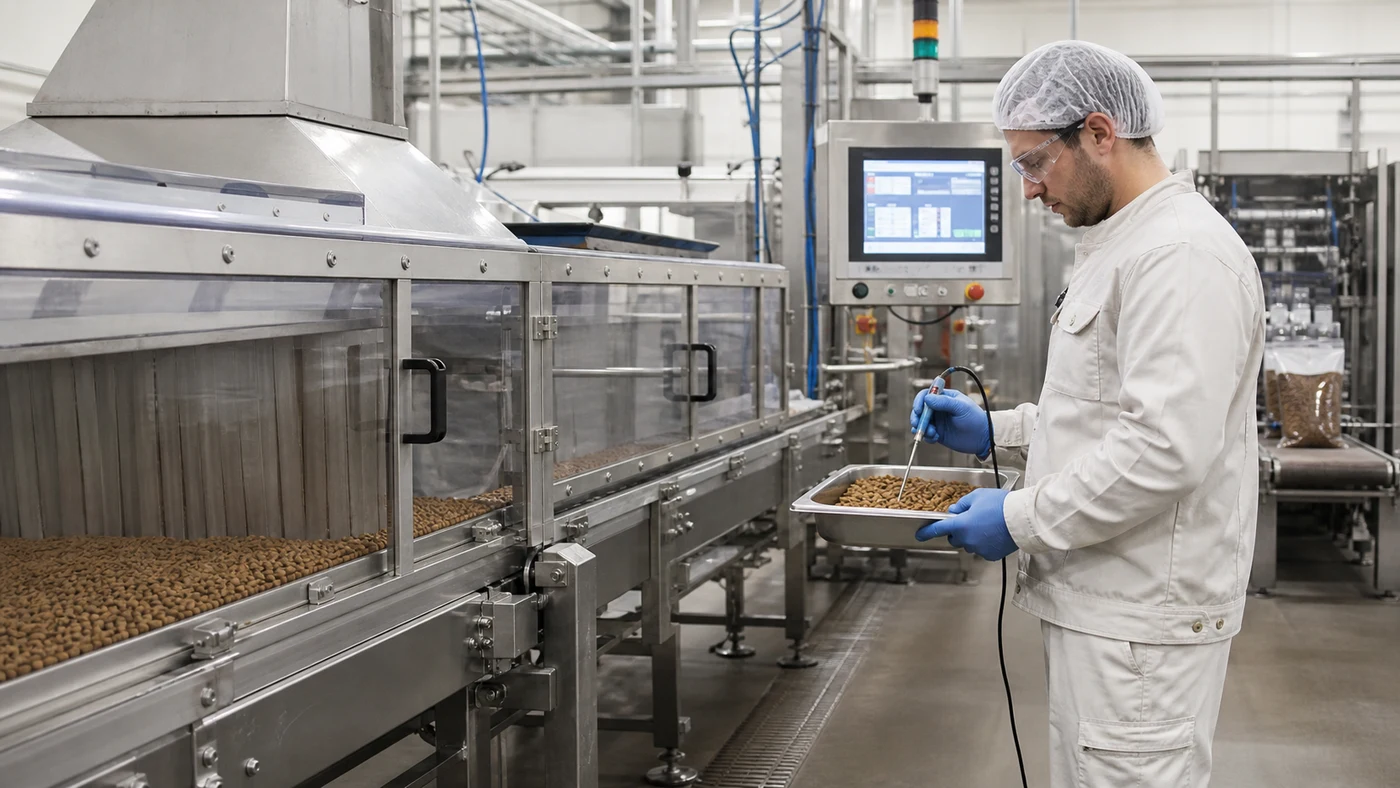
Sample near the point where the product enters the next critical step, not only from a convenient point at the cooler cabinet. A cooler discharge may be followed by an elevator, conveyor, bin, coater, or short hold period that changes the condition before packaging. The verification point must represent the product that packaging or coating actually receives.
Use a defined sampling method. Record product family, lot or batch identity, time, rate, cooling settings, air condition, sample point, product temperature method, observed fines, and downstream status. Temperature readings should be repeatable enough for the operating decision, and any moisture checks should use a method that is appropriate for the product specification.
Keep cooling hygienic and accessible
Dry pet food equipment still needs a deliberate sanitation design. Product can accumulate at inlets, spreaders, perforated surfaces, walls, discharge gates, conveyors, inspection doors, and dust-extraction points. Oil or palatant residue from an upstream or adjacent route can change how material adheres and how often equipment must be inspected.
Specify access panels, safe lockout points, removable parts where practical, cleanout paths, dust control, lighting, platforms, drainage where wet cleaning is used, and inspection criteria. The chosen cleaning method must match the hazard review and the equipment materials. Adding wet cleaning to a dry-process area requires its own drying, drainage, and restart controls.
Product changeover must be considered across the cooler and all connected transfers. Residue can cause protein, flavour, colour, or label carryover. The sanitation and changeover guide provides the broader factory framework for mapping and managing that risk.
Plan the fan, duct, dust, and building interfaces
The cooler is an air-handling system as well as a product-handling system. Confirm fan duty, static pressure, duct size, dampers, silencers where needed, access for cleaning, support loads, weather protection for external components, and the location where exhaust air will be released or treated. A retrofit can fail because the building has no route for ducts, maintenance space, or structural support.
Where dust is generated or carried with air, align the cooler design with the site's dust-hazard assessment and housekeeping approach. Air discharge should not deposit dust onto clean product or packaging zones. Collection, containment, inspection, and safety review need to be designed as one system.
Review noise, vibration, energy, roof penetrations, outside-air intake, weather exposure, and safe access to external fans or filters. These details influence maintenance cost and production reliability even though they are not visible in a small equipment footprint drawing.
Commission with real products and real ambient conditions
Factory acceptance testing can verify mechanical operation, materials, guards, fan rotation, controls, documentation, and basic interlocks. It cannot prove cooling performance for a specific pet food formula in the final building. That needs site trials with the actual product route and operating air conditions.
Site acceptance should cover start-up, normal rate, low and high practical rates, product temperature reduction, temperature uniformity, air flow, pressure, bed distribution, fan response, discharge behaviour, fines, transfers, downstream coating or packaging, cleaning access, alarms, and controlled stoppage. Agree in advance on sample locations, methods, allowable ranges, repeat-testing conditions, and responsibility for a result that does not meet the project requirement.
GEA presents dry pet food processing as an integrated route spanning extrusion, drying, flavouring, cooling, final handling, and packaging. Its pet food process overview reinforces the planning principle: assess cooling as a connected process stage rather than an isolated machine.
Information to include in a pet food cooling-system request
- product families, kibble size and shape, density, moisture, inlet temperature, fines sensitivity, and whether coating is before or after the proposed cooling step;
- minimum, normal, and maximum product rate, capacity basis, campaigns, start-stop pattern, and anticipated future product range;
- required product outlet condition, temperature measurement method, packaging condition, storage environment, and how air humidity will be accounted for;
- factory location, seasonal air data, ventilation concept, air cleanliness, exhaust route, dust assessment, and available utility power;
- cooler type, feed distribution, bed depth, residence-time basis, fan and duct duty, discharge method, fines limit, and downstream transfer arrangement;
- materials, product-contact surfaces, access, cleanout, sanitation, changeover, inspection, safety guards, platforms, and maintenance requirements;
- controls, alarms, line stop response, operating records, FAT, SAT, training, manuals, spare parts, and agreed performance testing.
Plan cooling around the packaged product
A well-designed pet food cooling system makes the downstream process more stable. It considers the product state arriving from drying or coating, air condition and humidity, contact and residence time, gentle discharge, sanitation, building interfaces, and verification at the real handoff to the next step. The right system protects product condition before packaging rather than merely lowering a temperature at the cooler outlet.
PetFactorySystem.com can help define cooling duty, process layout, air and utility interfaces, equipment specification, control requirements, hygiene access, and site acceptance tests for a dry pet food factory. For a technical review, share the planned products, target capacity, factory location, packaging route, and applicable quality requirements.
Review the related factory system
Compare the production route, equipment package, layout assumptions, capacity target, and operating requirements before confirming a factory plan.