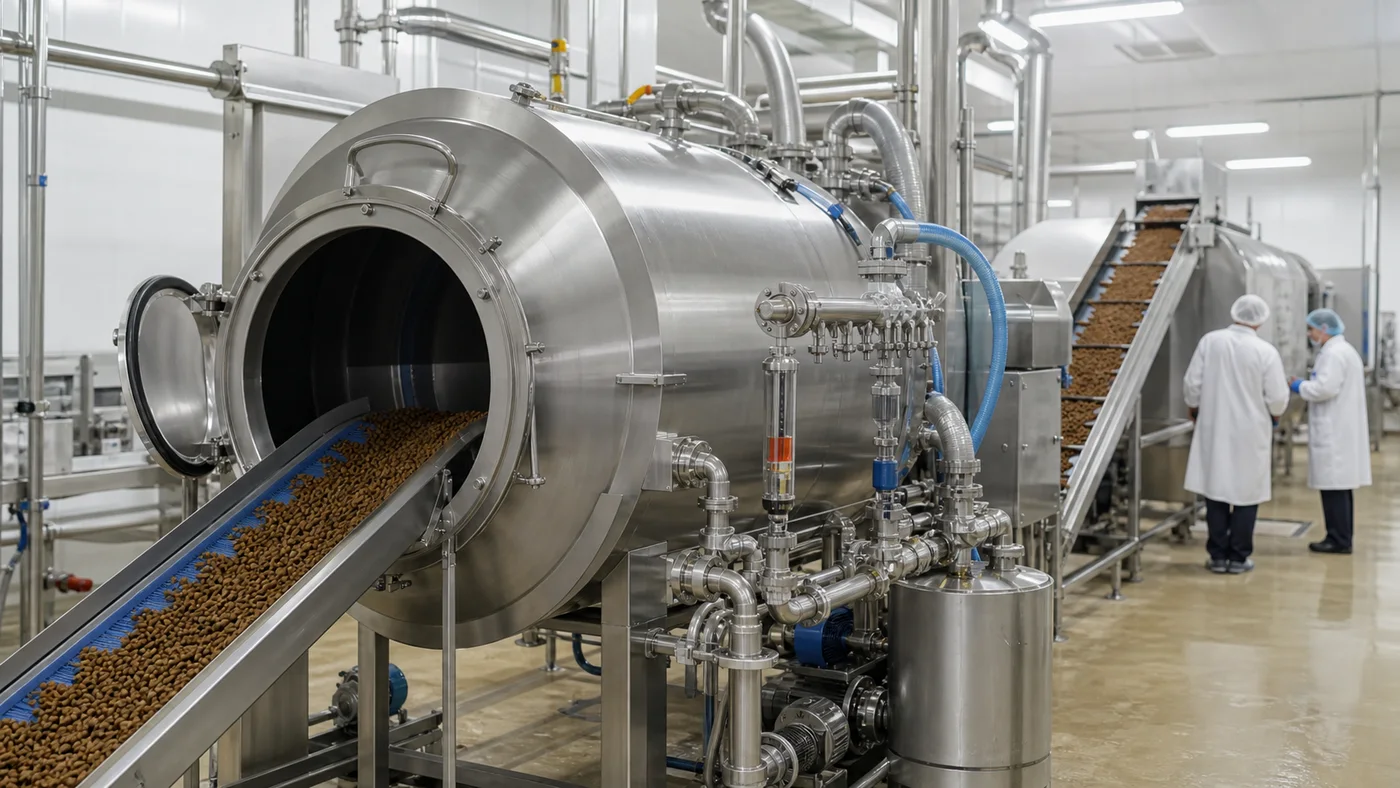
For dry pet food, coating is the process that applies selected liquids, powders, flavours, or palatants after the core piece has been formed. It is often described as the last step before cooling or packing, but it should be designed as a controlled production system. The coating route influences product appearance, surface feel, energy density, aroma release, package condition, cleaning work, changeover risk, and the consistency of every bag produced.
A coating system cannot be specified from finished tonnes per hour alone. The right arrangement depends on the product portfolio, product temperature and moisture at the coating point, kibble density and porosity, liquid and powder properties, required pickup, operational flexibility, hygiene standard, downstream cooling and packaging, and the evidence needed to release product. This guide explains how to define that system within a complete pet food factory system.
Define the coating objective before choosing a machine
Start with the finished product, not an equipment name. For each formula family, identify what must be added after extrusion and drying: fat or oil for energy and texture; liquid flavour or palatant for aroma and acceptance; powder coating for a particular surface effect; or a combination of liquids and powders. Record the addition range, ingredient identity, temperature, viscosity, solids content, sensitivity to heat or shear, required homogeneity, accepted surface appearance, and any market-specific restrictions.
Also define the physical condition of the kibble at the coating inlet. Piece size, density, pore structure, surface temperature, moisture, fines level, breakage rate, and product flow all affect how it handles and how much applied material it can retain. A coating result achieved with one formula, shape, or temperature cannot be assumed for a different product.
Separate launch products from future concepts. High-fat formulations, dense small kibbles, fragile pieces, multiple palatants, and powder additions can impose different requirements on vessel fill, spray capability, dust control, cooling, cleaning, and process controls. The line needs a documented operating envelope, not only one nominal recipe.
Understand where coating fits in the process
Post-extrusion coating is connected to drying, cooling, and packaging. In many dry-kibble routes, product is dried, coated, and cooled; other designs may use different sequencing or intermediate conditioning. The process map must therefore show the actual location of each addition, the product temperature at that point, the transfer time, and the downstream cooling and packing limits.
Coating should not be used to hide inconsistent upstream product. Variation in extrusion, cutting, expansion, or density changes the surface and internal structure presented to the coater. Variation in the drying stage changes both product temperature and the way liquids behave on or within the kibble. Those upstream conditions must be defined alongside the coating design.
At the outlet, a cooler and packaging system must protect the finished product condition. Coating can add mass and change surface temperature; inadequate cooling can create difficulty at packaging, while unsuitable packaging or seals can compromise the intended storage condition. Equipment boundaries should therefore follow the product, not a supplier package.
Choose atmospheric or vacuum coating by product need
Atmospheric coating generally applies liquids or powders while product tumbles or moves through a coating vessel. It can be suitable where the required addition, surface distribution, and product behaviour are achievable without a vacuum cycle. Its performance still depends on controlled product movement, spray coverage, liquid condition, residence time, and discharge.
Vacuum coating uses a controlled vacuum and pressure cycle to encourage liquid movement into the porous internal structure of suitable extruded pieces. It is not a requirement for every dry pet food. Whether it is useful depends on the product's porosity, formula, target pickup, addition type, product quality criteria, and economics. ANDRITZ describes its pet and feed vacuum coater as controlling vacuum pressure, liquid addition, and cycle time to manage repeatability of absorption and penetration; it also notes that its system can apply liquids and powders. That is a practical illustration of the variables to specify, not a universal performance guarantee for every product or coater. Read the official technical overview.
Compare both routes using representative material. Ask suppliers to show the actual product, liquid types, planned addition range, cycle sequence, retained pickup, surface condition, breakage, residue, and cleanout approach. A comparison that only demonstrates water or an easy test pellet is insufficient for an investment decision.
Specify the complete coating package
The vessel is only one part of the system. A complete coating package normally includes infeed metering and isolation, the coating drum or vessel, drive and speed control, liquid storage and preparation, pumps, filters, flow meters, heaters where appropriate, spray manifolds and nozzles, powder dosing or distribution where required, vacuum equipment for vacuum routes, controls, discharge, downstream conveyance, cleaning provisions, and safety guarding.
Define how the product enters and leaves. An unstable infeed rate or an unmeasured upstream surge can cause changes in fill level and residence time. Confirm the usable minimum, normal, and maximum fill range, not only the vessel's geometric volume. A batch coater also needs sufficient time for loading, coating, any vacuum cycle, discharge, verification, and reset; those activities determine sustained capacity.
Evaluate maintenance access, floor drainage, service clearance, load path, headroom, removal route, and the interfaces to the dryer, cooler, dust collection, utility systems, and packaging. Late layout changes around a coater frequently create inaccessible nozzles, trapped residue points, or difficult operator access.
Match liquid handling to the formulation
Liquid performance begins before the nozzle. For each oil, fat, liquid palatant, or flavour, document viscosity over the working temperature range, density, solids or suspended particles, filtration need, storage stability, allowable residence time, compatibility with seals and hoses, and required sanitation or flush procedure. A pump selected only for nominal flow may not maintain accurate delivery when viscosity, tank level, or temperature changes.
Temperature must be controlled through the tank, pump, pipework, valve, and nozzle where the formulation needs it. Long uninsulated runs, dead legs, or unmonitored heated sections can alter viscosity or encourage deposits. The process should have a defined response to low temperature, high temperature, blocked filters, low tank level, loss of flow, or a failed trace heater.
Use mass or a validated flow measurement to confirm actual liquid delivery. Pump speed alone is not a delivered-mass measurement. Reconcile the amount requested by the recipe, the amount drawn from the storage system, and the calculated product mass leaving the coater. Differences may reveal line hold-up, leakage, calibration drift, nozzle blockage, or a batch-boundary error.
Engineer spray coverage, not only spray pressure
Spray performance depends on nozzle type, number and position of nozzles, droplet size, spray pattern, pressure, liquid viscosity, product curtain or bed shape, vessel motion, and the exposure time of each piece. Large droplets can produce local wet areas or deposits. A very fine mist can be carried toward aspiration or coat unintended surfaces. Neither outcome is corrected reliably by increasing pump flow.
Specify the spray arrangement with access for inspection and cleaning. Include filtration, nozzle isolation, pressure or flow verification, anti-drip measures, and a process for checking spray quality. Plan how an operator detects a partial blockage rather than waiting for a finished-product deviation.
For powder additions, define the feed rate, feeder turndown, powder flow properties, addition point, distribution method, and the relationship with the liquid spray. Powders can bridge, flood, segregate, or accumulate in transfer points. Dust extraction must control airborne material without selectively removing a formula component from the product stream.
Calculate coating capacity from the full operating cycle
Hourly output is not simply the coater's stated product throughput. For a batch system, calculate usable product load divided by the complete cycle: filling, coating, vacuum and pressure steps where used, mixing or tumbling, discharge, valve closure, and any batch confirmation. For continuous systems, calculate stable product feed, retention, dosing range, and any planned recirculation or start-up loss.
Include the additional material introduced by coating. A line planned around dry-kibble tonnes per hour needs to define whether every supplier uses inlet product mass, final coated mass, or another basis. The dryer, coater, cooler, conveyors, metal detector, and packer must use compatible capacity assumptions. The pet food dryer selection guide explains why product condition and water-removal load must be defined before nominal equipment ratings are compared.
Assess the slowest credible product, not only the easiest. A more viscous liquid, a larger addition, more frequent changeovers, a smaller batch, a longer vacuum cycle, or a downstream cooler limit can determine the actual factory rate. The correct capacity test is sustained performance over a representative campaign.
Verify pickup and distribution with a mass balance
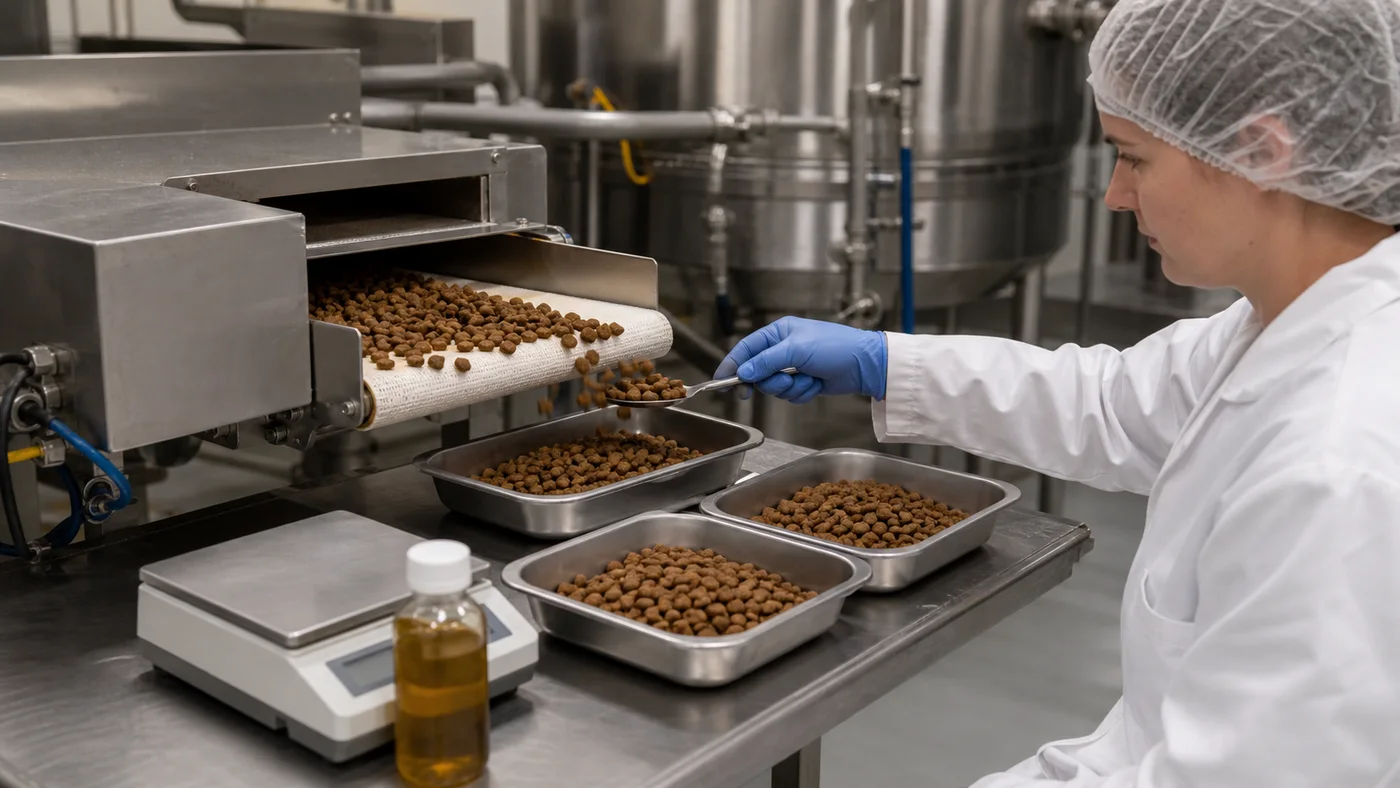
Coating pickup is the amount of added material retained by product. It should be verified using a practical mass-balance method appropriate to the formulation. Compare product mass before and after coating, recipe-set addition, measured liquid draw, known equipment hold-up, and any recoverable residue. Do not infer pickup from the pump setting alone.
Product samples should be taken from a defined discharge point and time sequence after the process has stabilized. Evaluate the properties that matter for the product: total fat or another validated analytical marker, surface appearance, free surface oil, bulk density, breakage, fines, odour, and relevant palatability or sensory protocols. Averages can hide unstable start-up, end-of-batch, or cross-stream variation.
Set the acceptance plan before trials. It should identify sample locations, sample mass, collection interval, analytical method, instrument calibration, retained samples, calculation method, and the action when results fall outside the defined window. “Uniform coating” is not an acceptance criterion until the measure and range are agreed.
Manage oxidation as a product-and-package issue
Oils and fats can change during storage and processing depending on composition, exposure to oxygen, heat, light, time, handling, and the final package. A coating system should therefore be evaluated together with the incoming-liquid controls, tank design, product temperature, line residence time, finished-product storage, package barrier, and seal integrity.
Use the formula owner's approved oxidation-control strategy and local regulatory requirements. Depending on the product, this can include controlled liquid storage, suitable tank headspace management, defined temperature limits, validated cleaning, an approved antioxidant approach, stock rotation, and retained samples. There is no universal peroxide value or shelf-life number that can responsibly be copied across oils, recipes, and markets.
Control plans should distinguish a fresh-liquid issue from a coating-distribution issue and from an inadequate package or storage condition. Recording liquid lot, receiving condition, tank history, coating recipe, product temperature, packaging lot, and production time makes investigation possible when finished-product results drift.
Design sanitation and changeover from the product risk
Residual coating material can remain in drums, nozzles, manifolds, pumps, filters, flexible hoses, low points, and discharge transitions. Those residues can contribute to cross-contact, odour carryover, microbiological risk where conditions allow, or an incorrect formula at the start of the next run. Cleaning and changeover must be designed into the equipment, not left to informal operator judgement.
Document the coating ingredients and the relevant site rules for allergens, animal proteins, customer segregation, and export markets. Identify product sequence, flush material, drain and purge points, disassembly access, cleaning chemistry, rinse or dry-out requirements, inspection method, verification sampling where required, and recordkeeping. FDA states that CGMP requirements provide baseline safety and sanitation standards for animal-food manufacturing and that preventive controls are based on the facility's hazard analysis. See FDA's animal food manufacturing overview.
Choose a cleaning approach that matches the product and equipment. A dry cleanout route may suit dry systems; wet cleaning introduces its own drying, drainage, and restart controls. Validate residue removal with a method appropriate to the risk rather than assuming visual cleanliness proves a successful changeover.
Protect people and maintain hygienic access
Coating areas combine rotating equipment, hot liquids, pressurised or vacuum vessels, electrical drives, slippery floors, and sometimes dust from powders. The layout should include guarded moving parts, interlocked access doors, lockout/tagout points, safe vessel opening logic, pressure and vacuum protection, spill containment, non-slip floors, drainage, ventilation, and clear cleaning access.
Operators need safe access to sample points, filters, nozzles, tanks, and control stations without climbing over conveyors or opening guards during motion. Maintenance should be able to remove pumps, motors, nozzles, and seals without dismantling unrelated equipment. These details affect uptime as much as the coater's mechanical design.
Use controls that connect recipe to traceability
The control system should preserve the agreed product route and capture meaningful operating data. Typical records include recipe version, planned and actual product mass, liquid and powder setpoints, actual dosing, tank and ingredient lots, product temperature, vessel speed, vacuum and pressure trend when applicable, cycle time, alarms, bypasses, user changes, and release status.
Alarm philosophy matters. A high-level alarm may protect equipment, but it does not confirm the correct coating pickup. Define which deviations stop the batch, which require product hold, which permit controlled continuation, and how exceptions are reviewed. Interfaces to upstream process controls and downstream cooling or packing should use clear batch boundaries.
A simple dashboard can show trends, but the plant also needs controlled permissions, a recipe-change process, backup and recovery, calibration records, and a procedure for manual operation. Digital records are useful only when they can be connected to actual product and lot decisions.
Commission the coater with representative product
Factory acceptance testing should verify supplied materials, drives, vessel functions, guards, control logic, pumps, flow instruments, nozzle operation, vacuum integrity where applicable, documentation, and dry mechanical operation. It is useful for catching assembly issues, but it cannot fully prove performance with the project's recipe.
Site commissioning should use defined product families, real coating ingredients, agreed product temperatures, normal and boundary capacities, planned changeovers, and the intended downstream cooler and packaging interfaces. Confirm product handling, coating pickup, distribution, breakage, residue, cleaning, controls, alarms, records, and sustained rate. Review the results with the actual analytical methods and acceptance criteria agreed before the trial.
The capacity-planning and line-balancing guide can help turn these trials into a full-factory constraint review. A coater that meets an isolated test rate may still be limited by the dryer outlet, cooler, liquid preparation, or packing system.
Information to include in a coating-system RFQ
- product families, kibble dimensions, density, porosity, moisture, inlet temperature, and finished-product condition;
- minimum, normal, and maximum product rate, including the declared mass basis;
- liquid and powder identities, addition ranges, viscosity, temperature, solids, filtration, storage, and approved ingredient controls;
- required pickup, distribution, appearance, breakage, free-oil, and analytical acceptance measures;
- atmospheric or vacuum route, required vacuum and pressure profile, batch size or continuous retention, and verification approach;
- tank, pump, heater, piping, nozzle, flow-meter, powder feeder, filtration, and cleanout requirements;
- changeover matrix, sanitation expectation, residue limits, product segregation, and cleaning validation method;
- interfaces with dryer, cooler, packing, utilities, dust collection, building structure, drainage, and maintenance access;
- control narrative, recipe permissions, traceability, alarms, calibration, data retention, FAT, SAT, training, and spare parts.
Select a verified coating system, not an isolated drum
A reliable pet food coating system combines stable upstream product, appropriate vessel selection, conditioned liquids and powders, controlled dosing, suitable product movement, verified pickup, sanitation, safe access, traceable controls, cooling and packaging integration, and representative acceptance testing. The result should be repeatable across the agreed formulas and operating range, not only visually acceptable on a first demonstration.
PetFactorySystem.com can help define the coating route, equipment package, liquid and powder handling, utility load, hygiene and changeover concept, layout interfaces, control requirements, and commissioning protocol for a new line. To begin a technical review, share the planned products, coating ingredients, capacity range, factory location, and applicable quality requirements.
Review the related factory system
Compare the production route, equipment package, layout assumptions, capacity target, and operating requirements before confirming a factory plan.