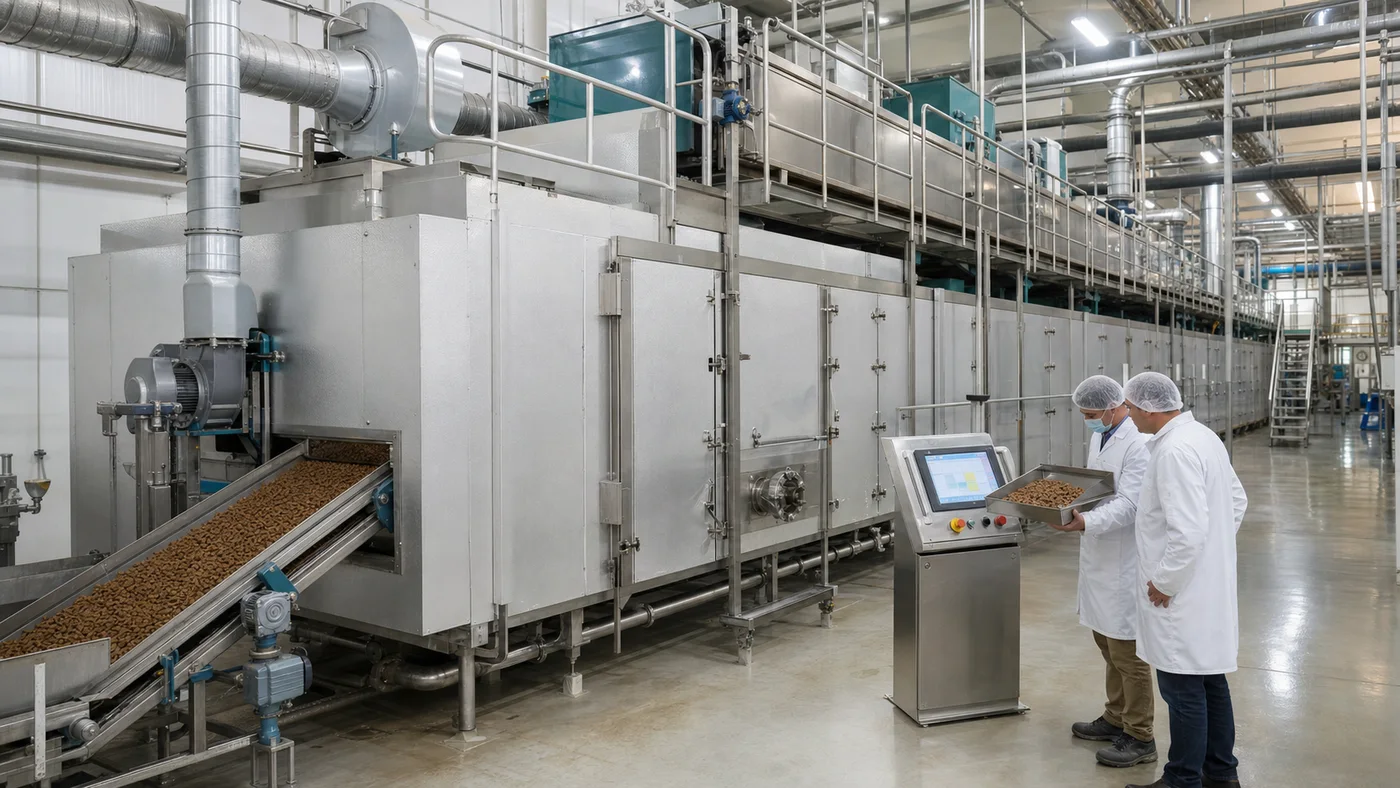
A pet food dryer should not be selected from finished tons per hour alone. Two lines can produce the same mass of kibble but impose very different drying duties because the extruder discharge moisture, final specification, kibble size, density, formula, bed depth, and product mix are different. The dryer must remove the required water while keeping moisture distribution, texture, density, color, palatability, and energy use within an acceptable operating window.
The dryer is also part of a connected process. Its performance depends on the extruder feed, cutter stability, product spreading, process air, exhaust conditions, coating and cooling sequence, packaging barrier, utility supply, controls, cleaning access, and operator response. Treating it as an isolated machine usually moves variability downstream rather than solving it.
This guide focuses on hot-air conveyor drying for extruded dry dog and cat food. Spray drying, vacuum drying, and freeze drying serve different products and require separate process design. The principles below help define a project-specific dryer specification within a complete pet food factory system.
Start with the product portfolio, not a dryer model
List the products expected at launch and the products that may be added during the design life. For each SKU family, document kibble diameter and thickness, bulk density, formula type, fat and fiber range, fresh-meat inclusion where relevant, extruder discharge moisture, target moisture, target water activity, temperature entering the dryer, desired texture, coating route, production rate, and expected campaign length.
The design case is not automatically the largest kibble or the highest throughput. A dense product can dry slowly; a small low-density kibble can create a high air-side resistance at deep bed depth; a high-moisture formula can impose the largest evaporation load; and a low-volume premium SKU can define the required turndown and changeover performance. The selected dryer needs a documented operating envelope rather than one nominal point.
Separate guaranteed cases from development cases. An equipment supplier can reasonably guarantee defined products and conditions, but cannot guarantee every future recipe without representative data. Pilot trials or controlled production tests are useful when new formulations fall outside existing experience.
Do not use moisture content and water activity interchangeably
Moisture content describes how much water is present in the product. Water activity, written as aw, describes the availability of water in equilibrium and is related to microbial growth and product stability. Products with the same moisture content can have different water activity because proteins, starches, salts, sugars, humectants, fats, and processing history bind water differently.
The FDA's technical guide to water activity explains that water activity should be brought to a suitable level at the end of drying and maintained during storage. FDA Guidance for Industry #245 also discusses drying and water-activity control in animal food. These documents do not create one universal target for every kibble; the facility must establish specifications appropriate to its product and regulatory context.
A recent study of three dry dog foods and three dry cat foods found that moisture-sorption behavior varied between products and that a simple drying curve did not replace product-specific sorption information. The peer-reviewed pet food sorption-isotherm study reinforces why a moisture-to-water-activity relationship should be demonstrated for the actual formula family rather than copied from another product.
Define moisture on a stated calculation basis
Moisture can be reported on a wet basis or a dry basis. Commercial specifications and many routine pet food tests commonly use wet-basis percentage, while engineering calculations may use either basis. A number without the stated basis can create serious sizing and acceptance errors.
Also define the reference method. A rapid moisture analyzer, near-infrared instrument, online sensor, and laboratory oven method may not produce identical results. The project specification should state which method controls product release, how rapid methods are calibrated to it, how samples are prepared, and how often the relationship is checked.
Size the dryer from water-removal load
The fundamental duty is kilograms of water removed per hour over the full operating range. Calculate it from wet product flow, inlet moisture, and outlet moisture using a consistent moisture basis. Include normal variability and realistic process losses, but do not hide an uncertain process behind an arbitrary oversized safety factor.
For example, increasing extruder discharge moisture while holding finished output constant increases the mass and heat load entering the dryer. A line advertised as 5 tonnes per hour of finished kibble can therefore require different dryer capacity for different formulations. Dryer sizing should include at least:
- minimum, normal, and maximum wet feed rates;
- inlet and target outlet moisture for each guaranteed product family;
- inlet product temperature and expected seasonal variation;
- bulk density, piece geometry, bed permeability, and allowable bed depth;
- ambient air temperature and humidity at the factory location;
- turndown, startup, shutdown, changeover, and recirculation conditions.
This calculation must also agree with upstream and downstream rates. The pet food factory capacity and line-balancing guide explains why nominal equipment ratings do not by themselves define sustained factory output.
Choose the dryer architecture for the operating envelope
Single-pass conveyor dryers provide a straightforward product path and can be appropriate when footprint is available and the product range suits the required bed depth and residence time. Multi-pass conveyor dryers stack belts to obtain more residence time or capacity within a smaller floor area. Product transfers between passes can redistribute the bed, but they also add mechanical handling and cleaning points.
Airflow can be arranged through one or both sides of the bed, and direction can alternate between zones or passes. The correct arrangement depends on bed resistance, product fragility, desired uniformity, and equipment geometry. Bühler's official conveyor dryer technical overview, for example, describes single- and dual-plenum, single-pass, multi-pass, and multistage configurations with zoned control. It is useful as an illustration of available architectures, not as a substitute for comparing project-specific guarantees.
Fluid-bed, spray, vacuum, and freeze-drying systems should not be treated as interchangeable alternatives to a kibble belt dryer. They apply different heat- and mass-transfer mechanisms and often serve powders, ingredients, small particles, or premium raw products. Define the product and process first.
Control feed distribution before adding more heat
Uneven product loading is a common cause of uneven discharge moisture. If the center of the belt carries a deeper bed than the edges, air follows the path of lower resistance and the heavily loaded area can remain wet. Increasing average air temperature may over-dry exposed areas while failing to correct the root cause.
Specify the spreader, feed conveyor, oscillating distributor or other loading device together with the dryer. Confirm the acceptable bed-depth profile across the full usable belt width and over time. The system should handle changes in kibble size and bulk density without persistent ridges, empty strips, or segregation.
Provide access or instruments to observe loading. A covered transfer that cannot be inspected can conceal a distribution problem until finished-product tests fail.
Design airflow around product resistance
Drying depends on heat transfer to the kibble and mass transfer of water from the product into the process air. Useful measurements include air temperature, humidity or dew point, airflow, static pressure, and pressure drop through the bed. Temperature alone cannot show whether the air has enough drying capacity or is distributed uniformly.
Fans, plenums, dampers, screens, belt condition, product bed, seals, and recirculation paths form one air system. Leakage, blocked perforations, damaged seals, product buildup, or an unbalanced plenum can change the effective airflow without an obvious change in heater output. Instrument locations should represent conditions that operators can act upon.
Use zones to follow the product drying curve
A multi-zone dryer allows different air conditions along the product path. Early zones may remove readily available surface moisture, while later zones address slower internal moisture migration and equalization. The optimum profile depends on formula, kibble geometry, incoming state, and product-quality limits.
More zones do not automatically create better control. Each zone needs effective isolation, repeatable dampers, adequate sensing, stable heat input, and a recipe structure that operators can manage. Adjacent zones that exchange large amounts of uncontrolled air may not perform as independent zones.
Define recipe parameters and permitted adjustment ranges during trials. Avoid a practice where operators compensate for every variation by raising the first-zone temperature; that can mask extruder or distribution problems and narrow the product-quality window.
Set residence time and bed depth as linked variables
Residence time is usually changed through belt speed, pass configuration, or product path length. Bed depth changes product inventory and airflow resistance. Altering one affects the other, so control recipes should not treat them as independent knobs.
The effective residence-time distribution also matters. Product retained on ledges, short-circuited through gaps, or mixed during transfer can leave the dryer with a different history from the nominal belt time. First-in/first-out behavior, transfer design, cleanout, and low-level running should be evaluated during trials.
Design for uniformity, not an acceptable average
An average discharge result can conceal wet and dry zones. A composite sample that mixes the belt edges and center may pass even when part of the flow is outside specification. Wet pockets can affect stability and packing; over-dried areas reduce saleable yield and can change texture or palatability.
Specify uniformity acceptance criteria across belt width, over a defined time window, and across representative production rates. Report the distribution, range, or standard deviation as appropriate, not only the mean. Acceptance limits should reflect the product specification and measurement uncertainty.
Build a representative sampling and measurement plan
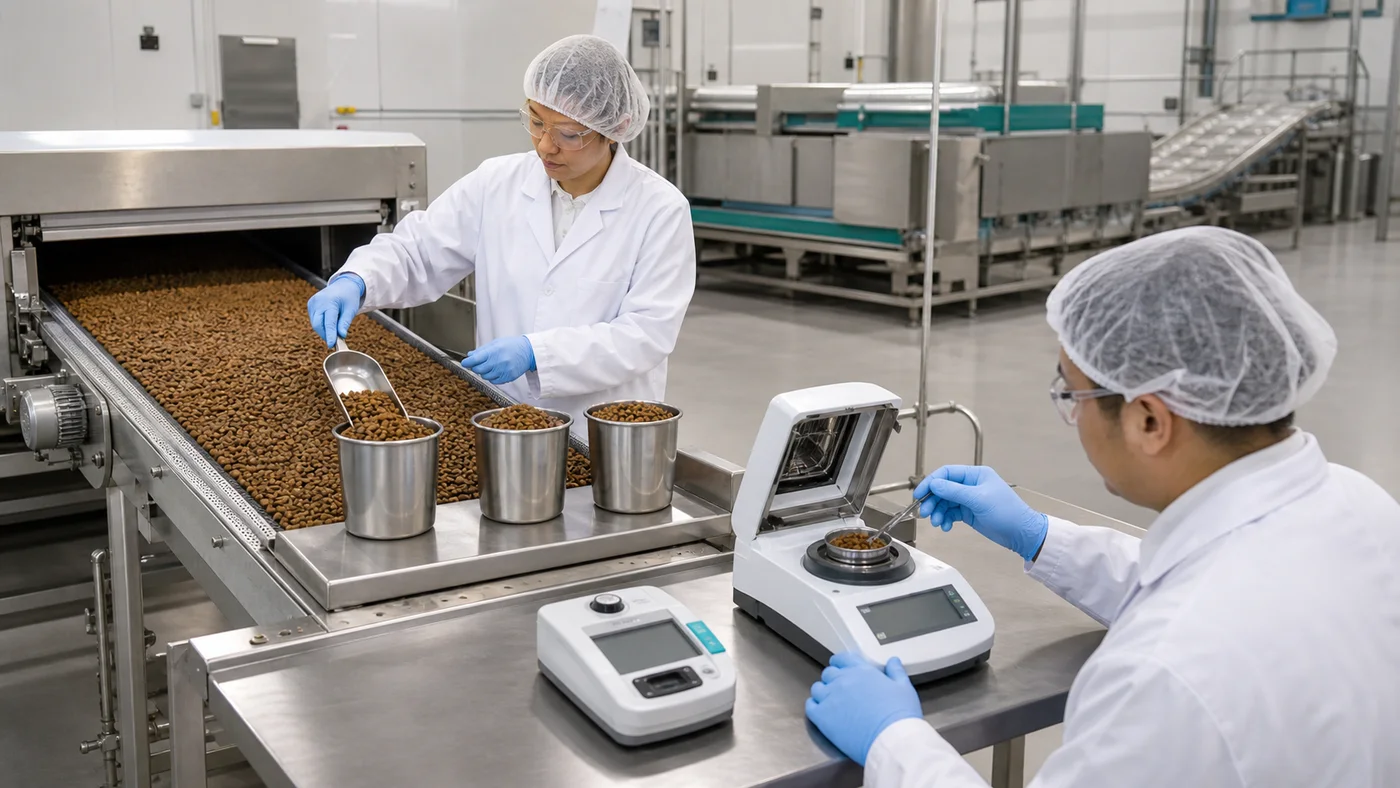
During commissioning, collect samples at planned positions across the belt and at repeated time intervals after the process reaches stable operation. Test distinct samples before creating any composite. Record the product code, formula revision, extruder conditions, wet feed rate, inlet moisture, dryer recipe, ambient condition, sampling position, time, and downstream status.
Routine sampling may be simpler than commissioning mapping, but it should remain capable of detecting relevant drift. Online moisture sensors can provide frequent data and useful trends, yet they require representative installation, product-specific calibration, reference checks, cleaning, and a response procedure for implausible values.
Water-activity measurements require controlled sample handling and temperature. Moisture measurements require consistent grinding, sample mass, time, and method where applicable. The measurement system should be assessed before tight product tolerances are promised.
Understand the cost of under-drying and over-drying
Under-dried product can miss the validated or specified stability target, develop condensation during cooling or packing, cake in storage, change texture, or challenge the packaging system. The appropriate response depends on the hazard analysis and product disposition procedure; simply blending a wet lot into dry product is not automatically acceptable.
Over-drying removes saleable water and consumes unnecessary energy. It can increase breakage, alter density and texture, affect coating uptake, and expose sensitive nutrients or flavors to a longer or harsher heat history. The financial effect should be calculated from yield loss, energy, rework, downtime, and product quality, not only fuel consumption.
Coordinate drying with coating, cooling, and packaging
The line sequence varies by product and process design. In many dry-kibble systems, product proceeds from drying to liquid or powder coating and then cooling, but other arrangements exist. Coating adds mass and can influence surface moisture, temperature, oxidation, and cooling load. Cooling too far below the local dew point can cause condensation, while packing product that is too warm can transfer heat and moisture into the bag headspace.
Define transfer times, product temperature at each stage, coating addition, cooler duty, and maximum temperature at packaging. Packaging material and seals must protect the established product condition through expected storage and distribution. FDA GFI #245 notes that when drying is used as a process control, packaging may need to prevent rehydration and closures should protect against moisture exposure.
Specify utilities from the drying duty
A dryer can use gas, steam, thermal oil, electricity, or another heating system depending on equipment design and local infrastructure. The utility specification must cover peak and normal load, pressure, temperature, control quality, fuel quality, ventilation, combustion air, exhaust, condensate, electrical power, and safe shutdown.
Ambient humidity affects the amount of moisture that process air can absorb. A site with hot humid seasons can require a different design margin or operating strategy from a cool dry site. The factory's utility planning and load schedule should therefore be developed with dryer calculations rather than after equipment purchase.
Evaluate energy efficiency without trapping moisture
Heat recovery, insulation, variable-speed fans, staged heating, exhaust-air recirculation, burner modulation, and stable production can reduce energy use. However, recirculating too much humid air can reduce drying potential. The useful recirculation ratio changes with zone, product load, ambient condition, and exhaust state.
Request energy guarantees with clear boundaries: product and water load, ambient condition, utility type, included fans and auxiliaries, startup exclusion or inclusion, and measurement method. A single energy number without these conditions is difficult to compare.
Track energy per kilogram of water removed as well as energy per tonne of finished product. The first measure helps distinguish dryer performance from changes in inlet moisture.
Make hygienic access part of the purchase specification
Evaluate surfaces above and below every belt, plenum access, fan housings, screens, seals, transfers, doors, drains, insulation joints, ledges, hollow sections, and product-collection points. Operators need safe access to inspect and remove retained material. A dryer that is difficult to open or enter safely will not be cleaned as intended.
Choose a cleaning method consistent with product, construction, zoning, and environmental controls. Introducing water into a dry area can create moisture and microbial risks if drainage and drying are inadequate. Dry cleaning may not remove every soil. The sanitation procedure should state disassembly, tools, inspection, release, and complete drying requirements.
Account for hot surfaces, confined-space controls where applicable, lockout, stored energy, and access platforms. Cleaning time and post-cleaning dry-out time belong in the capacity model.
Address dust, fire, and abnormal operating conditions
Pet food dust and product deposits can create fire or combustible-dust hazards depending on material properties and jurisdiction. The project team should assess dust generation, ignition sources, hot surfaces, bearings, fans, electrical classification, ducting, housekeeping, detection, suppression or isolation needs, and emergency response with competent specialists.
Define what happens during belt stoppage, fan failure, heater failure, high temperature, low airflow, power loss, blocked discharge, or upstream surge. The control system may need to stop heat, continue cooling airflow, stop feed, divert product, retain affected material, and alarm operators in a safe sequence. These actions require hazard assessment and equipment-specific engineering.
Connect controls, recipes, alarms, and data
The dryer control system should manage belt speed, zone temperatures, fan speeds, dampers, heater output, exhaust conditions, interlocks, product feed permissives, and safe shutdown. Recipe permissions should prevent uncontrolled edits while allowing authorized optimization.
Record actual values, not only setpoints. Trend wet feed rate, key air conditions, belt speed, alarms, operator changes, discharge moisture, water activity, and product disposition under a common batch or time reference. This data helps separate a dryer problem from an upstream moisture or loading problem.
Alarm limits need action instructions and suitable delays. An alarm that activates constantly will be ignored; an alarm based on a slow sensor may need product hold to cover the period before and after detection.
Plan startup, shutdown, and product changeover
Steady-state samples do not describe startup. At startup, metal temperature, air humidity, bed loading, and residence time are changing. Define when product becomes eligible for release and where off-specification startup material goes. The same applies after an interruption or major rate change.
For shutdown, coordinate feed stop, belt emptying, heat reduction, fan operation, cooling, and inspection so product is not left in a hot or humid enclosure. Changeover procedures should address retained product, allergen or formulation carryover where relevant, recipe selection, and restart verification.
Commission across the real operating range
Factory acceptance should begin with mechanical and safety checks, then verify unloaded airflow, belt tracking, controls, alarms, interlocks, heater modulation, exhaust, and instrument calibration. Product trials should cover agreed representative SKUs and rates, not only the easiest product at nominal capacity.
For each guarantee case, allow the line to stabilize, measure water-removal load, map discharge uniformity, evaluate product quality, confirm utility consumption, and test sustained operation. Deliberately test approved turndown, rate changes, startup, shutdown, and specified abnormal conditions. Record the agreed test method before the trial so acceptance is not decided after results are known.
Document the final validated recipes and permitted ranges. Training should include process principles, sampling, alarm response, safe access, cleaning, and how to recognize distribution or airflow problems.
Information to include in a dryer RFQ
- product families, formula characteristics, kibble dimensions, bulk density, and fragility limits;
- wet feed rates, inlet moisture and temperature, target moisture and water activity, and calculation basis;
- required water-removal load for each guarantee case;
- ambient design temperatures, humidity, elevation, and factory utility conditions;
- required turndown, recipe count, campaign length, changeover method, and future products;
- uniformity criteria across the discharge and the agreed test method;
- available footprint, building height, access, floor loads, maintenance removal routes, and exhaust constraints;
- sanitation method, hygienic access, materials, zoning, and dry-out expectations;
- control-system interface, historian data, cybersecurity responsibilities, alarms, and remote support rules;
- energy-guarantee boundaries, heat-recovery options, spare parts, training, and service scope;
- factory and site acceptance tests, product trials, documentation, and performance remedies.
Documents required before equipment release
Before final order release, align the process flow, heat and mass balance, equipment data sheet, dryer general arrangement, building loads, utility schedule, exhaust plan, process-control narrative, instrument list, motor list, hygienic review, cleaning procedure, hazard review, access plan, maintenance clearances, commissioning protocol, and acceptance criteria.
The upstream pet food extrusion process and downstream coating, cooling, and packing assumptions should use the same product cases. Conflicting design bases between suppliers are a common source of startup problems.
Select the drying system as a verified process package
A reliable pet food dryer specification links product science, water-removal duty, airflow distribution, residence time, utilities, sanitation, controls, sampling, and acceptance testing. It defines both steady production and the transitions that occur every day. This produces a more meaningful comparison than choosing the largest nominal machine or the lowest heater rating.
PetFactorySystem.com can develop the product matrix, water and energy balance, line interfaces, layout, utility basis, control philosophy, hygienic requirements, and commissioning protocol for a new dry pet food line. To prepare an initial drying-system review, send the planned products, capacity range, inlet and target moisture, kibble sizes, factory location, and available utilities.
Review the related factory system
Compare the production route, equipment package, layout assumptions, capacity target, and operating requirements before confirming a factory plan.