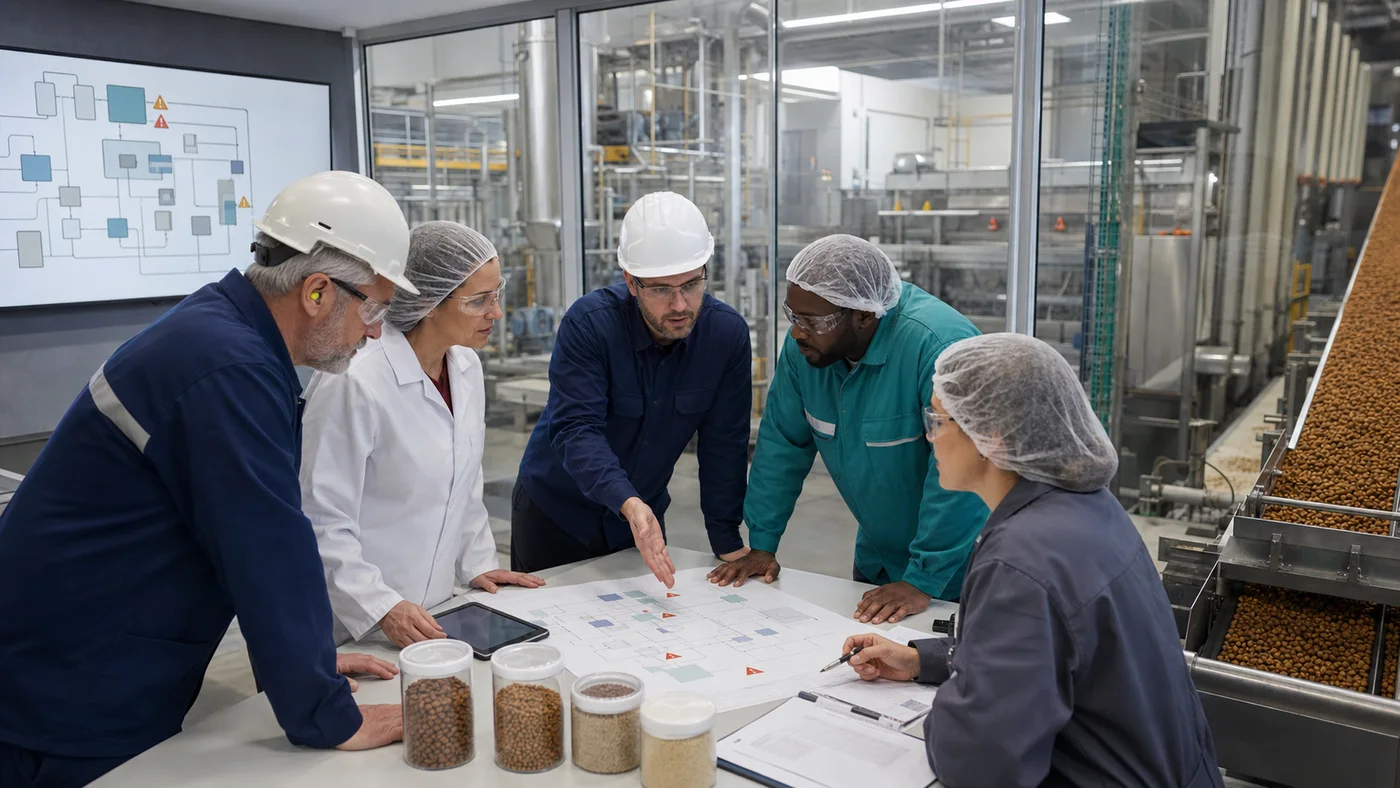
A pet food factory food safety plan should explain how a specific facility prevents or significantly minimizes hazards in the products it actually makes. It is not a generic certificate file, a copied HACCP table, or a list of every hazard ever reported in animal food. The plan must connect ingredients, formulation, process conditions, equipment, people, utilities, packaging, storage, and distribution to evidence-based controls.
The plan also has to work during normal production. Operators must know what to monitor, supervisors must know when to stop or hold product, quality staff must be able to verify records and results, and management must provide the people, equipment, time, and authority needed to act. A technically correct document that cannot be executed on the factory floor is not an effective control system.
This guide describes the planning logic for a new or upgraded pet food factory system. Legal requirements differ by country, product, market, and facility status, so the final plan must be reviewed against the rules that apply to the project.
Establish the regulatory and market scope first
Define where the factory operates, where products will be sold, which animal species and life stages are served, and whether the facility makes complete diets, complementary products, treats, supplements, premixes, or contract-manufactured products. Product classification can change registration, ingredient, labeling, facility, and safety-plan obligations.
In the United States, covered facilities subject to 21 CFR Part 507 must establish and implement a food safety system that includes a hazard analysis and, when needed, risk-based preventive controls. The FDA Preventive Controls for Animal Food rule overview also explains that exemptions and modified requirements can apply, so applicability should be determined rather than assumed.
For the European Union, Regulation (EC) No 183/2005 establishes feed-hygiene requirements and introduces HACCP principles for feed business operators other than at primary production. The European Commission feed-hygiene page provides the current regulatory context and implementation resources. Other markets use their own feed, pet food, food safety, and import frameworks.
Assign competent ownership and a cross-functional team
Food safety cannot be delegated to the quality department alone. Build a team with practical knowledge of formulation, procurement, receiving, production, sanitation, maintenance, engineering, packaging, warehousing, distribution, and regulatory requirements. Include operators who understand what actually happens during startup, changeover, stoppage, rework, and abnormal conditions.
For a U.S. facility covered by the preventive-control requirements, the written food safety plan must be prepared, or its preparation overseen, by one or more preventive controls qualified individuals. Other markets may define different competence or HACCP-team expectations. Regardless of terminology, the responsible team needs documented training or job experience appropriate to the products and processes.
Define who can place material on hold, stop the line, release product, approve a deviation, change a monitoring frequency, close a corrective action, and communicate a recall. Authority should be explicit before commercial pressure tests the system.
Describe each product family and intended use
Group products only when ingredients, process, hazards, controls, packaging, storage, intended species, and intended use are sufficiently similar. Dry adult dog kibble and a high-mineral puppy diet may share equipment but have different nutrient risks. Freeze-dried raw treats and extruded kibble should not be forced into the same hazard analysis merely because both are pet products.
The description should include:
- species, life stage, complete or complementary use, and any vulnerable target population;
- formula families, significant ingredients, additives, and inclusion-rate constraints;
- physical form, moisture or water-activity expectations where relevant, and packaging system;
- thermal or other processing steps, post-process additions, and rework policy;
- storage, transport, shelf life, and consumer handling instructions;
- markets, regulatory category, and customer specifications.
A product description is not a marketing paragraph. It provides the technical context needed to judge hazard severity, likelihood, and control.
Map the complete process and verify it on the floor
Build a flow diagram from ingredient and packaging receipt through storage, dosing, grinding, mixing, thermal processing, drying, cooling, coating, post-process additions, foreign-material control, packing, palletizing, warehousing, and dispatch. Include utilities or processing aids that can contact product, rework loops, returns, waste, outsourced steps, temporary holding, and product recovered after a stoppage.
Then walk the actual route across every shift. Drawings often omit manual additions, temporary bins, bypasses, maintenance access, shared transfer equipment, or material moved during a breakdown. Verify where product is exposed and where contamination, carryover, wrong addition, time delay, or loss of control can occur.
The verified process flow should use the same equipment and room names used in operating procedures, batch records, maintenance records, and the control system. This connection reduces ambiguity during monitoring and investigations.
Build prerequisite programs before selecting preventive controls
Current good manufacturing practices and prerequisite programs provide the operating foundation. Typical subjects include personnel hygiene, training, pest control, water quality, waste, supplier management, chemical control, glass and brittle material, maintenance, calibration, cleaning, zoning, traffic control, storage, transport, and complaint handling.
Do not label every prerequisite program as a critical control point. First determine whether a known or reasonably foreseeable hazard requires a preventive control in the specific facility. The answer depends on the product, process, environment, and role of the control. A prerequisite program can still be essential and must be implemented consistently even when it is not classified as a preventive control.
The detailed pet food factory hygiene and sanitation plan should support, but not replace, the hazard-based food safety plan.
Identify biological, chemical, and physical hazards
Consider hazards that are known or reasonably foreseeable for each ingredient, process step, environment, packaging system, and product. Under FDA's animal-food framework, hazard categories include biological, chemical including radiological, and physical agents. Hazards may occur naturally, be unintentionally introduced, or be intentionally introduced for economic gain when that adulteration can affect safety.
Examples that may require evaluation include:
- Biological: Salmonella or other relevant pathogens in ingredients, exposed product, the processing environment, or finished products;
- Chemical: mycotoxins, pesticides, heavy metals, cleaning chemicals, lubricants, excessive or deficient nutrients, additive overdose, and residues relevant to a particular ingredient;
- Physical: metal, glass, hard plastic, stones, equipment fragments, or other objects capable of causing injury;
- Formulation and labeling: wrong ingredient, wrong premix, incorrect inclusion rate, formula carryover, or packaging applied to the wrong product where these errors create a safety hazard.
Not every example applies to every facility. FDA's final Guidance for Industry #245 specifically emphasizes evaluating hazards for the animal food and facility rather than treating all examples as universally applicable.
Evaluate severity and probability without existing controls
For each identified hazard, assess the severity of illness or injury to animals or humans and the probability that the hazard will occur in the absence of preventive controls. Consider the ingredient source, supplier history, formula, target species, inclusion rate, process capability, product exposure, facility environment, storage, distribution, consumer handling, scientific information, regulatory alerts, complaints, and recall history.
Do not reduce probability merely because the proposed control is expected to work. The initial evaluation asks what can happen without that control. This prevents circular reasoning in which a hazard is judged unlikely only because an unvalidated control has already been assumed.
Document the rationale, evidence, uncertainty, and decision. A risk score can support consistency, but the final conclusion should not depend on arithmetic alone. A low-frequency hazard with severe consequences may still require strong control.
Determine which hazards require preventive controls
A hazard requiring a preventive control is not simply any possible hazard. It is one for which a knowledgeable person would establish one or more controls to significantly minimize or prevent the hazard, based on the hazard analysis. The control and its management components should be appropriate to the product, facility, and role of the control.
Possible control categories include process controls, sanitation controls, supply-chain controls, recall plans, and other controls suited to the hazard. More than one control may address the same hazard, and one control may help manage several hazards. The plan should show why the selected combination is adequate and where responsibility sits.
A conventional HACCP critical control point is not the only way to manage risk. Conversely, renaming a normal inspection as a preventive control does not make it effective. Classification must follow the applicable regulatory framework and the facility's documented hazard analysis.
Control ingredient and supplier hazards at the correct point
Some hazards are best controlled before an ingredient reaches the factory. Examples can include mycotoxins, pathogen risk, chemical residues, incorrect premix composition, or contamination associated with a specific source. Define ingredient specifications that translate the food safety decision into measurable purchasing and receiving requirements.
Supplier approval should consider the hazard, supplier performance, process capability, audit or certification evidence, test history, traceability, change notification, complaint response, and regulatory status. A certificate of analysis is useful only when the test, method, sampling, laboratory, lot identity, result, and verification strategy provide meaningful assurance.
If a U.S. covered facility relies on its supply chain to control a hazard requiring a preventive control, Part 507 supply-chain program requirements may apply. The exact activity and frequency should be determined from the hazard and supplier performance. Integrate this decision with the raw-material receiving and supply-chain plan.
Design process controls around measurable parameters
A process control should define the parameter, target or limit, measurement method, location, frequency or continuous system, responsible person, record, and action when the result is unacceptable. Examples may involve thermal treatment, drying, cooling, formulation, dosing, sieving, or other steps identified by the hazard analysis.
For thermal processing, the critical relationship may involve product temperature, residence time, moisture, equipment configuration, throughput, particle size, and startup or shutdown conditions. A displayed machine temperature is not automatically proof of product lethality. Validation must demonstrate that the selected parameters control the target hazard under the intended operating range.
Drying and cooling also need defined safe operating conditions. Excess moisture, condensation, product accumulation, uneven airflow, or delayed cooling can create conditions outside the validated process. The plan should address abnormal operation, not only steady-state production.
Manage nutrient and formulation hazards
Animal food has product-specific risks from nutrient deficiency or toxicity. Premix identity, weighing accuracy, scale range, dosing sequence, mixer performance, rework, flush material, formula version, and label selection can all affect the delivered nutrient profile.
Controls may include approved formulas, controlled master data, independent verification of high-risk additions, barcode or material identity checks, scale interlocks, tolerances, reconciliation, batch review, laboratory verification, carryover controls, and restrictions on rework. The appropriate combination depends on the nutrient, inclusion rate, consequence, equipment, and process capability.
Automation can reduce manual error, but software configuration, permissions, recipe changes, sensor failure, bypasses, and data interfaces become part of the control system. The factory automation and traceability architecture should therefore be reviewed against the hazard analysis.
Prevent post-process contamination
A validated thermal step does not protect finished product if exposed kibble is recontaminated during drying, cooling, coating, conveying, storage, or packing. Review airflow, dust movement, condensate, leaks, personnel traffic, tools, cleaning equipment, pests, maintenance activity, and the separation of raw and post-process areas.
Post-process liquids and powders deserve particular attention because they may be added after the main lethality step. Their supplier controls, storage, transfer, temperature, filtration, cleaning, and exposure should be included in the analysis.
If environmental contamination is identified as a hazard requiring a sanitation preventive control, environmental monitoring may be an appropriate verification activity. Zoning, sites, organisms, methods, frequency, follow-up, and trend review must be designed for the facility. Environmental monitoring is not automatically required in the same form for every pet food plant.
Control foreign material with a layered strategy
Foreign-material control begins before the final metal detector. Supplier controls, intake inspection, magnets, screens, sifters, filters, equipment condition, fastener control, tool accountability, preventive maintenance, brittle-material control, and good housekeeping can prevent or remove hazards at different stages.
A detector or X-ray system should be selected for the product, packaging, line speed, aperture, likely contaminant, and required sensitivity. Define test pieces, test position, challenge method, test frequency, reject confirmation, failed-test response, affected product window, and record review. Product effect and packaging material can influence performance.
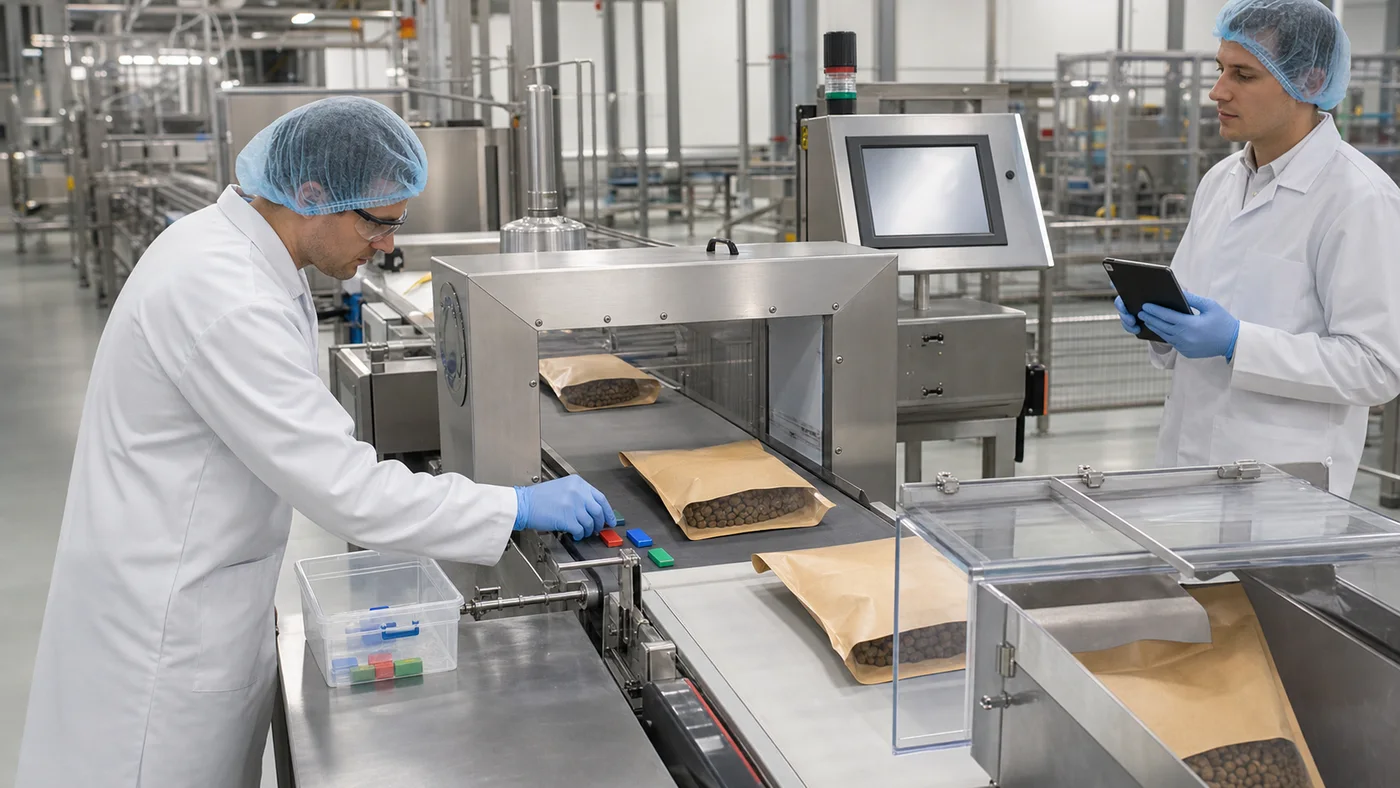
A successful test confirms performance at that moment under the tested conditions; it does not replace equipment maintenance, investigation of rejects, or preventive controls earlier in the process.
Write monitoring that operators can execute
Monitoring determines whether the preventive control is operating as intended. Specify what is measured or observed, how, when, where, by whom, and on which record. The frequency should be capable of detecting loss of control in time to limit affected product.
Use instruments and records suitable for the decision. Continuous data may still require review, alarm response, and verification. Manual checks need clear sampling and timing. Avoid vague instructions such as “check regularly” or “temperature acceptable.” Operators should know the defined value, tolerance, response, and escalation path.
Train personnel to record results at the time of observation. Pre-filled, reconstructed, or batch-end records weaken both control and investigation. Electronic records need secure identity, timestamps, permissions, change history, backup, and review.
Separate corrections from corrective actions
A correction addresses a problem in a timely manner, such as segregating a small amount of material and restoring a parameter. A corrective action addresses a failure in implementation or effectiveness and should identify affected product, evaluate safety, correct the cause, reduce recurrence, and verify that the action works. The applicable framework determines when each approach is permitted.
Every deviation procedure should answer:
- when the process stops and who has authority to restart it;
- how the potentially affected lot and time window are identified and physically controlled;
- what technical evidence supports release, reprocessing, diversion, or disposal;
- who investigates root cause and approves the disposition;
- whether customers, authorities, suppliers, or certification bodies must be notified;
- how the plan, validation, training, maintenance, or supplier controls will be updated.
Commercial urgency is not evidence that product is safe. Product disposition should be documented by authorized personnel using relevant process, test, traceability, and hazard information.
Verify implementation and validate control capability
Verification asks whether the system is being implemented and remains effective. Activities can include calibration, record review, observation, testing, environmental monitoring where appropriate, internal audit, trend analysis, and review of corrective actions. Define who performs each activity and ensure the reviewer has enough independence and competence to challenge incomplete evidence.
Validation establishes that a control or combination of controls is capable of significantly minimizing or preventing the hazard under the facility's conditions. Evidence may come from scientific literature, regulatory guidance, process-authority work, challenge studies, equipment data, predictive models, or properly designed plant trials. The evidence must match the product, hazard, parameters, equipment, and operating range.
Not every preventive control uses the same validation requirement. The responsible qualified person should determine what is required under the applicable framework and document the basis.
Use testing as verification, not as a substitute for process control
Finished-product testing samples only a small part of a lot. A negative result does not prove that every unit is free of a non-uniform hazard. Testing should answer a defined question and use a sampling plan, method, laboratory, acceptance rule, and response suited to the hazard and product.
Ingredient tests can verify supplier performance. In-process tests can confirm formulation or process conditions. Environmental tests can detect loss of hygienic control. Finished-product tests can support release or verification. Their roles should be documented so that teams do not treat all tests as interchangeable.
Trending is as important as pass or fail. Repeated low-level findings, increasing moisture, borderline nutrient results, or recurring foreign-material rejects may show deterioration before a specification is exceeded.
Connect records to lot genealogy and release status
The food safety plan needs records that can reconstruct what happened. Link each finished lot to ingredient lots, packaging lots, formula and revision, operators, equipment, process data, monitoring, deviations, tests, rework, cleaning status, and release decision.
Define lot boundaries around actual risk. A day code may be too broad if a failed check affects one hour, while a very narrow code can create false precision if shared bins mix several batches. Material genealogy should reflect silos, bins, continuous processing, flushes, rework, and packaging transitions.
Use clear statuses such as quarantined, awaiting result, released, rejected, rework approved, or destroyed. Physical labels, warehouse locations, ERP status, and line controls should agree so that held material cannot be shipped through an administrative mismatch.
Prepare the recall plan before the first shipment
For U.S. facilities producing animal food with a hazard requiring a preventive control, the FDA rule requires a written recall plan. It addresses direct-consignee notification, public notification when appropriate, effectiveness checks, and appropriate disposition, with responsibilities assigned.
Regardless of legal format, a practical recall system should include decision authority, regulator and customer contacts, lot-genealogy method, distribution records, communication templates, product retrieval, reconciliation, effectiveness checks, storage, disposal, and after-action review. Include weekends, holidays, absent managers, multiple languages, contract warehouses, distributors, and export customers.
Run periodic trace exercises or mock recalls against realistic scenarios. Measure the time needed to identify ingredient and finished-product scope, locate shipped and onsite quantities, contact consignees, and reconcile the mass balance. A successful exercise is not just a completed spreadsheet; it should reveal gaps and produce corrective actions.
Reanalyze after changes and new information
The plan should be reviewed when products, ingredients, suppliers, formulas, equipment, layout, packaging, process parameters, intended use, scientific information, regulations, complaints, environmental results, or hazards change. A serious deviation, recall, or evidence that a control is ineffective also requires prompt evaluation.
For covered U.S. facilities, Part 507 includes reanalysis requirements and an interval requirement of at least once every three years, as well as specified triggers. Other jurisdictions and certification schemes may use different intervals. A calendar review does not replace change-triggered analysis.
Connect change control to procurement, R&D, engineering, maintenance, software, and sales so food safety reviews occur before the change is implemented.
Translate the plan into factory design requirements
The hazard analysis should influence the physical factory. It may define raw and post-process separation, cleanable equipment, hygienic access, controlled-addition rooms, dust containment, drainage, air pressure, personnel routes, quarantine space, laboratory sampling, detector locations, waste paths, utility quality, and secure storage.
Specify monitoring points, sample ports, instrument accuracy, data retention, reject devices, hold areas, and access for verification before equipment is ordered. Retrofitting these features after installation is usually more difficult and can leave control gaps.
Commission controls with real products, operating ranges, startup and shutdown states, alarms, power recovery, bypass permissions, reject handling, record creation, and staff response. The approved food safety plan and validated process should be ready before routine commercial production.
Documents to complete before launch
- regulatory applicability and product-family register;
- team responsibilities, competence, and decision authority;
- verified process-flow diagrams and product descriptions;
- hazard analysis with evidence, severity, probability, and control decisions;
- written preventive controls and prerequisite programs;
- monitoring, correction, corrective-action, verification, and validation procedures;
- supplier approval, receiving, specifications, and supply-chain verification records;
- calibration, testing, environmental monitoring where appropriate, and trend-review plans;
- lot coding, material genealogy, hold, release, rework, and disposition procedures;
- recall plan, contact lists, trace exercises, and effectiveness review;
- record controls, training, internal audit, change control, and reanalysis schedule.
PetFactorySystem.com can connect the product route, process flow, factory layout, equipment controls, sanitation, quality workflow, automation, and commissioning plan into one project-specific food safety design basis. To discuss a new facility, send the product types, target market, capacity, ingredient sources, process route, and applicable customer or regulatory standards.
Review the related factory system
Compare the production route, equipment package, layout assumptions, capacity target, and operating requirements before confirming a factory plan.