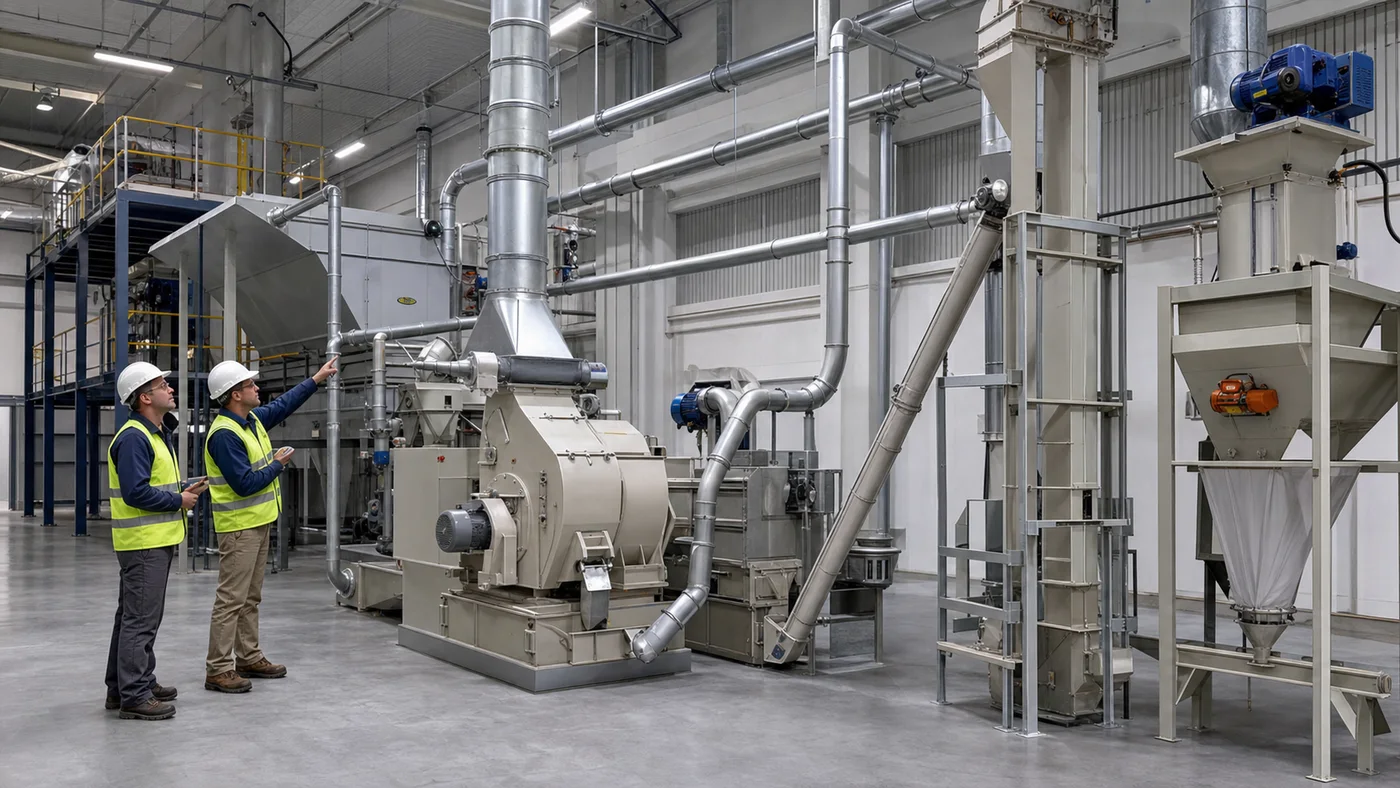
Dust collection in a dry pet food factory is not only a cleanliness or ventilation project. Grain, protein meal, vitamin premix, starch, dried palatant, fines, and other powdered ingredients can create worker-exposure concerns, product loss, cross-contamination, equipment reliability problems, and in some conditions fire or explosion hazards. The design must therefore connect process engineering, hygiene, occupational safety, fire protection, electrical classification, automation, and maintenance.
A general exhaust fan does not replace source capture, and a fabric filter does not by itself make a combustible-dust process safe. The project must identify the actual materials, test representative dust where needed, map release points and ignition sources, evaluate credible events, and select prevention and protection measures under the applicable local code.
This guide supports early planning for a pet food factory system. It is not an explosion-protection design and does not provide vent-area, suppression, isolation, hazardous-area, or duct-sizing calculations. Those decisions require qualified specialists using material test data, equipment details, building conditions, and the rules adopted in the project country.
Understand why fine organic dust requires a separate review
A fire needs fuel, oxygen, and an ignition source. A dust explosion additionally depends on fine particles being dispersed and sufficiently confined. Dry pet food plants can contain all of these conditions at different points: fine organic powder, air movement, enclosed equipment, ducts, filters, bins, and potential ignition sources such as overheated bearings, friction, impact sparks, electrical faults, static discharge, or hot work.
Not every ingredient behaves the same way. Particle size, moisture, composition, processing history, concentration, and contamination can change dust behavior. A value found in a generic table should not be treated as the final basis for a specific formula or collected dust mixture. The dust inside a filter collector may also differ from the bulk ingredient because the collection system preferentially captures finer particles.
The project team should distinguish at least three objectives:
- Product and hygiene control: prevent dust migration, formula carryover, and deposits on equipment or building surfaces.
- Worker exposure control: capture airborne material near release points and verify compliance with applicable exposure limits.
- Fire and explosion risk control: prevent ignition where practicable and limit the consequences of a credible event.
One airflow number cannot prove all three objectives. The design basis must state which hazard each control measure addresses.
Start with a dust and process inventory
List every dry ingredient and intermediate material handled by the factory. Record supplier form, expected moisture, particle-size range, bulk density, handling method, annual volume, delivery format, and the process steps that can generate additional fines. Include rework and collected dust because they are often omitted from the original ingredient list.
Then map dust-release points across the process:
- bulk truck or container unloading and receiving pits;
- bag opening, tipping, and empty-bag handling;
- screens, magnets, de-stoners, and transfer chutes;
- hammer mills and grinder inlet or discharge points;
- bucket elevators, screw conveyors, pneumatic transfer, and bin vents;
- weigh hoppers, mixers, premix stations, and micro-ingredient dosing;
- screening, fines handling, rework addition, and packing scales;
- filter collector hoppers, rotary valves, and dust-disposal containers.
This inventory should be coordinated with the raw material receiving and storage plan. A late change from small bags to bulk pneumatic delivery can alter release points, conveying duty, filter demand, and hazardous-area decisions.
Use representative dust data and a qualified hazard analysis
Where combustible-dust potential exists, representative samples may need laboratory characterization. Depending on the governing standard and analysis method, specialists may request information related to explosibility severity, maximum pressure, minimum explosible concentration, minimum ignition energy, ignition temperature, particle size, moisture, and electrical properties. The correct test program is selected by the hazard-analysis team; the website should not prescribe one universal panel for every project.
A dust hazards analysis, or the equivalent process required by local rules, should review where combustible dust can be present, credible ignition sources, confinement, propagation paths, existing safeguards, required additional measures, management systems, and follow-up actions. The current 2025 edition of NFPA 660, Standard for Combustible Dusts and Particulate Solids, consolidates combustible-dust requirements and includes chapters on hazard identification, dust hazards analysis, and management systems. Adoption and applicability must still be confirmed locally.
The analysis should be completed early enough to influence building layout and equipment purchasing. If it starts after collectors, bucket elevators, walls, roofs, and electrical systems are installed, safe corrective options can become limited or expensive.
Capture dust at the source before it spreads
Effective aspiration begins with enclosure and source control. A hood located far from an open transfer may pull large volumes of room air while capturing little released dust. A well-designed transfer enclosure contains the release and allows the extraction point to maintain inward airflow without removing excessive product.
Review each transfer under normal running, start-up, shutdown, bin filling, empty-bin conditions, and blockage clearing. Material falling a long distance can entrain more air and release more dust. Choke feeding, reduced free fall, sealed covers, controlled inlet air, and better chute geometry can sometimes reduce the required extraction duty before a larger fan is considered.
OSHA's explanatory material for grain handling describes dust-tight enclosures, lower pressure inside conveying enclosures, minimizing free falls, and removing ferrous material before grinding as useful controls. These principles are relevant planning references, but the exact U.S. legal scope and the final engineering solution depend on the facility and operation.
Build an aspiration schedule by pickup point
The equipment list should include an aspiration schedule. For every pickup point, record the process served, material, enclosure type, design airflow basis, expected static pressure, operating sequence, duct branch, damper or balancing method, required monitoring, and the collector that receives the air.
The schedule should also identify which pickup points operate simultaneously. Adding every branch maximum can oversize a system, while assuming too little simultaneity can leave active points without capture. Production modes, cleanout, maintenance, and future expansion should be included.
Air balance must consider both extraction and replacement air. Excessive negative pressure can make doors difficult to operate, pull outdoor contamination into controlled zones, disturb burners, or interfere with room pressure relationships. Dust collection therefore connects with the wider factory utility and ventilation plan.
Duct design must protect transport, inspection, and maintenance
Ducts need sufficient conveying performance to prevent routine deposition, but higher airflow is not automatically safer or more efficient. Diameter, air velocity, pressure loss, material loading, elbows, branch entries, duct length, abrasion, leakage, condensation, and fan selection are connected calculations.
Layout should minimize unnecessary horizontal runs and difficult pockets while providing safe access to inspection and cleanout points. Abrasive material may require wear-resistant components. Flexible connections should be suitable for the service and should not become an uncontrolled ignition or propagation path. Grounding and bonding, where required, must be designed and verified rather than assumed from visual contact between metal parts.
Do not route a duct merely because space is available above a ceiling or through a fire separation. The route can affect fire and explosion propagation, access, structural support, condensation, noise, pressure balance, and the location of protection devices. Penetrations and supports need coordination with the building and fire-protection design.
Select and locate collectors from the hazard analysis
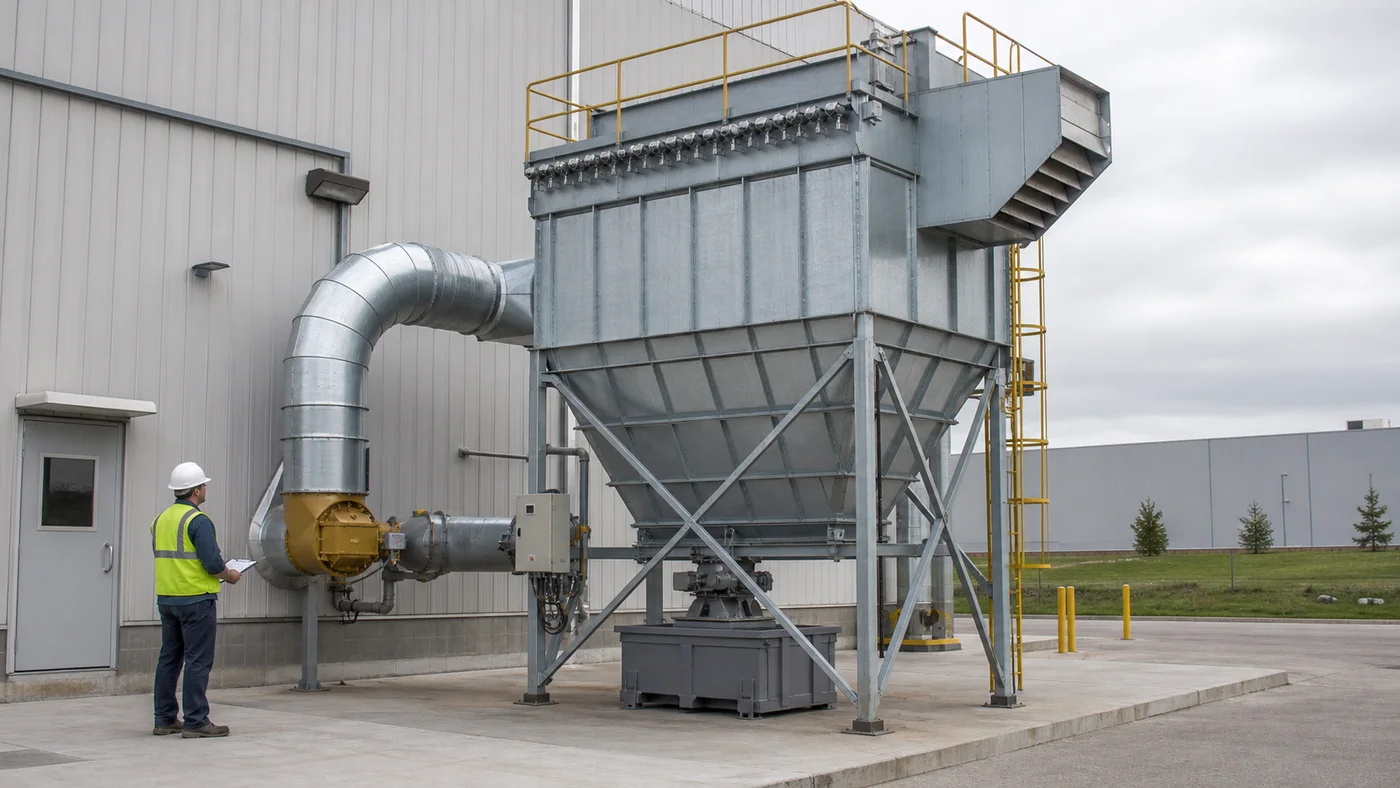
A cyclone may remove coarse particles but does not necessarily provide the final filtration needed for fine dust. Fabric filter collectors use bags or cartridges and require cleaning, pressure-drop monitoring, safe dust discharge, and a plan for failed filter elements. The selected filter media must suit the dust, temperature, moisture, cleaning method, and food-factory hygiene requirements.
Collector location is a major safety decision. Outdoor placement can create more options for separation and discharge of pressure or flame toward a controlled area, but it still requires weather protection, structural design, safe access, freeze or condensation review, discharge handling, and properly engineered isolation from connected equipment. Indoor collectors are not automatically prohibited in every jurisdiction, but they can require specific containment, suppression, flameless venting, separation, or other measures.
OSHA 29 CFR 1910.272 applies specified provisions to feed mills in the United States and includes requirements for fabric filter-collector pressure-drop monitoring and conditions for collector placement or protection. Projects outside the United States should use this as reference only and follow their own adopted law and standards.
Explosion relief, suppression, containment, and isolation are different functions
Explosion protection is not a single accessory. Depending on the dust data, equipment strength, location, connected process, occupancy, and code, the design may use explosion relief, flameless relief, suppression, containment, or a combination. Each option has limits and requires engineered sizing, installation, inspection, and maintenance.
Protection of the collector alone is incomplete if pressure and flame can propagate through inlet or return-air ducts into occupied rooms, bins, mills, or other equipment. Explosion isolation is intended to limit propagation between connected volumes. Rotary valves, fast-acting valves, chemical isolation, flap devices, or other systems may be considered only where their certified application and installation match the process conditions.
Relief discharge must not be directed toward doors, walkways, vehicles, occupied areas, air intakes, property boundaries, or maintenance positions. A drawing that shows a vent panel without its discharge zone is not a complete layout review.
Control ignition sources at receiving, grinding, and conveying
Prevention begins upstream. Screens, magnets, and other foreign-material controls can reduce the chance that metal or stones reach a hammer mill. Bearing-temperature monitoring, belt-alignment or motion monitoring, proper lubrication, overload protection, and preventive maintenance help identify friction or mechanical failure before it becomes an ignition source.
Electrical equipment and wiring must match the area classification determined for the project. Static control, grounding and bonding, hot-work permits, contractor control, smoking restrictions, and safe maintenance procedures should be part of the management system. Portable electrical tools and vacuum cleaners also need to be suitable for the classified or hazardous environment in which they are used.
The UK Health and Safety Executive guidance for food-industry dust explosions specifically discusses screening, de-stoning, pneumatic separation, and magnets before milling, and warns that sparks or smoldering material can pass from a mill to more vulnerable cyclones or collectors. This is one reason the entire connected system must be reviewed, not only the grinder housing.
Housekeeping is a designed operating system
Dust collection reduces releases but does not eliminate housekeeping. A written program should define areas, inspection frequency, acceptable conditions, cleaning method, responsibility, escalation, and records. Horizontal ledges, cable trays, beams, light fittings, equipment tops, and inaccessible platforms should be minimized during building design because they become long-term dust shelves.
Use industrial vacuum systems suitable for the material and area. Sweeping or uncontrolled compressed-air blowing can disperse settled dust and create a larger cloud. OSHA 1910.272 restricts compressed-air cleaning in covered grain-handling operations unless machinery presenting ignition sources is shut down and other known ignition sources are removed or controlled. This should not be simplified into a general permission to blow down a plant.
The well-known OSHA one-eighth-inch dust action threshold applies to specified priority housekeeping areas for grain elevators under that standard; it is not a universal design target for every pet food factory. A facility should establish its housekeeping criteria from its dust properties, hazard analysis, applicable regulation, and safe operating program.
Housekeeping tools, changeover cleaning, and product carryover should also align with the pet food factory sanitation plan, because a method that controls combustible dust must also protect product hygiene and prevent cross-contamination.
Monitor filter condition and system performance
A filter collector needs a baseline operating envelope. Differential pressure indicates resistance across the filter media and can reveal loading, cleaning problems, blocked discharge, damaged media, or abnormal airflow. It should be interpreted together with fan condition, branch airflow, pulse-cleaning pressure, hopper level, and process operation.
Monitoring may include differential-pressure alarms, fan status, motor current, pulse-cleaning status, compressed-air pressure, hopper high level, rotary-valve status, broken-filter indication, temperature or spark detection where selected, and interlocks with process equipment. Alarm response must be defined: an operator needs to know whether to inspect, reduce rate, stop one process, or execute a controlled shutdown.
Returning filtered air to an occupied building can save energy, but it can also create exposure and fire-propagation concerns. Recirculation should only be considered after checking filtration integrity, monitoring, isolation, local code, and the consequences of filter failure or an event in the collector.
Design dust discharge and disposal as part of the process
Collected dust must leave the hopper reliably. Bridging, high level, a stopped rotary valve, a full drum, or air leakage at the discharge can impair collector performance. The discharge system should be sealed, monitored where appropriate, accessible for maintenance, and included in the start/stop sequence.
The project must decide whether collected material is waste, controlled rework, or a product stream. Reintroducing dust without a documented quality and safety assessment can change formula accuracy, contaminant concentration, microbiological risk, particle distribution, and combustible-dust load. Waste containers should be closed, identified, removed on schedule, and kept away from ignition sources.
Commission the complete system, not only the fan
Commissioning should confirm installation against drawings, rotation and fan operation, duct cleanliness, branch balance, capture at representative operating modes, baseline differential pressure, filter cleaning, discharge operation, alarms, interlocks, and controlled shutdown. Protection and isolation devices require their own manufacturer and specialist checks; they should not be tested by creating a hazardous event.
Record baseline readings when filters and ducts are in known condition. These values help maintenance teams distinguish normal aging from a developing blockage, leak, failed pulse system, or broken filter. Operators should be trained to recognize visible dust release, unusual sound, smell, vibration, heat, pressure change, and failed discharge.
Acceptance should include representative raw materials and simultaneous pickup points, not an empty-air test alone. Any capacity guarantee must state how aspiration affects process airflow and product loss, particularly at grinders, screens, transfer points, and pneumatic systems.
Maintain protection through change management
A dust-control system can become ineffective after seemingly small changes. A new ingredient may create finer or more combustible dust. A higher production rate may increase air displacement. A new branch can reduce airflow at existing pickups. Replacing filter media, changing a rotary valve, relocating a bin, enclosing a machine, or returning air indoors can alter the hazard basis.
Use management of change before modifying materials, equipment, airflow, control logic, protection devices, building openings, or production rate. Keep current drawings, test reports, device certificates, inspection records, alarm set points, maintenance instructions, and training records. Periodically revisit the hazard analysis as required by the governing standard and whenever significant change occurs.
Documents to request before equipment ordering
A serious dust-collection package should be supported by more than a fan and collector quotation. Depending on scope, request:
- process and dust inventory with representative test-data basis;
- dust-release-point and aspiration schedule;
- duct calculations, pressure-loss summary, fan curve, and operating modes;
- collector selection, filter media, cleaning method, and discharge arrangement;
- hazardous-area or electrical-classification drawings where applicable;
- dust hazards analysis or equivalent action register;
- explosion prevention, protection, vent-discharge, and isolation basis;
- instrument list, alarms, interlocks, and shutdown narrative;
- structural loads, access, weather protection, and maintenance clearances;
- commissioning procedures, baseline readings, inspection intervals, and spare-parts list.
PetFactorySystem.com can include dust-release mapping, aspiration scope, collector location, utility interfaces, building zones, and specialist-design requirements in the early factory plan. For a new dry pet food line or an existing building review, send the raw materials, process route, target capacity, country, and available layout information.
Official reference basis
Primary references used for this planning guide include OSHA 29 CFR 1910.272 for grain-handling facilities and feed mills, the 2025 edition of NFPA 660 linked above, and UK HSE guidance on preventing dust explosions in the food industry. They do not replace the law, adopted standards, dust testing, or professional engineering required for a specific country and factory.
Review the related factory system
Compare the production route, equipment package, layout assumptions, capacity target, and operating requirements before confirming a factory plan.