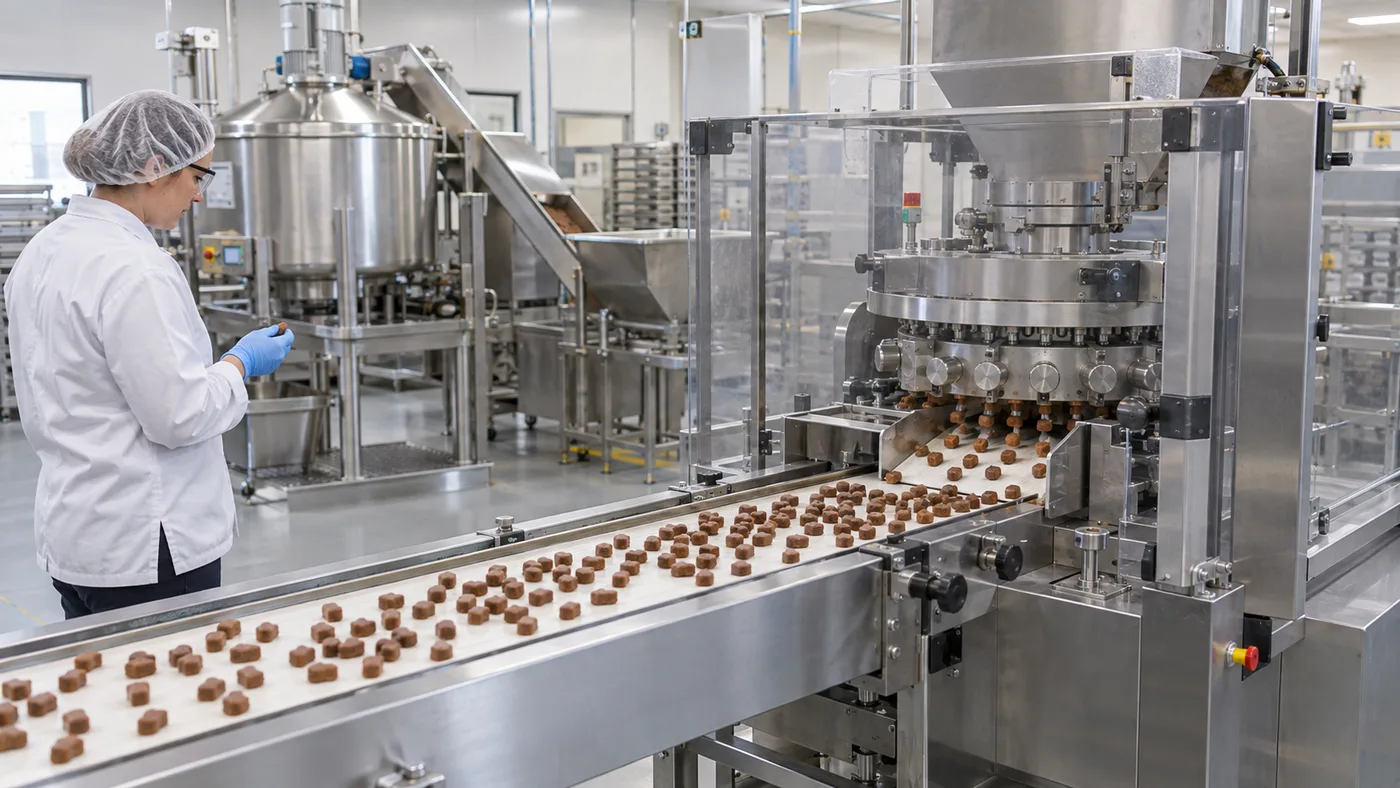
A pet supplement soft chew line has to deliver a repeatable dose in a product that remains easy to handle, acceptable in texture, and stable through its intended shelf life. Mixing and forming are only part of that job. Ingredient identity, water activity, microbial controls, piece weight, drying or conditioning, packaging, and batch records must work together.
This guide covers food-type, non-medicated soft chews for dogs and cats. It is a factory-planning guide, not a universal formula or a claim that one processing method suits every active ingredient. Veterinary drugs, medicated products, and disease-treatment claims require a separate regulatory and technical review in each target market.
1. Set the product specification before choosing a forming machine
Define species, serving size, number of chews per daily serving, intended ingredients, active level per chew, target texture, shape, package count, planned shelf life, and markets of sale. Record whether a serving is one piece or several pieces; that choice changes the acceptable variation in piece weight and active content. Set the allowable range for appearance, firmness, dimensions, water activity, microbiology, and package integrity through product development and risk assessment.
Ask suppliers for ingredient identity, permitted use, particle size, moisture, microbial status, storage conditions, and compatibility information. Heat-sensitive cultures, enzymes, some vitamins, oils, and flavors may need special processing or stability work. Do not promise that a low-temperature line preserves every ingredient: mixing energy, residence time, oxygen exposure, drying, and storage can also affect activity. Verify retained content in the finished chew at release and through the intended shelf life.
The broader pet supplement factory system should connect formula development, controlled ingredient handling, the chew process, packaging, quality control, and the required workshop layout.
2. Choose a process route that matches the formulation
A practical process map is receiving and release → ingredient weighing → premixing of low-dose ingredients → base mixing → forming or depositing → setting, conditioning, or drying if needed → inspection → packing → finished-product release. This is a sequence to test, not a prescribed machine list. Some cohesive masses can be extruded and cut; others may suit rotary molding or a forming system. Depositing can suit a pumpable mass with a different setting mechanism. A baked treat route is different again.
Evaluate the mass at the actual planned temperature and residence time. Does it feed steadily, hold a shape, release from a mold, or smear on a cutter? Does it stick after a short hold? How much rework is produced and can it be safely reused under a defined rule? Pilot trials with representative ingredients are the right place to answer these questions. Equipment suppliers such as Provisur describe forming equipment for pet treats, while Baker Perkins emphasizes testing the customer's own formulation before equipment selection. Neither example implies that a supplier's advertised output is the output of a new formula.
3. Control minor-ingredient dosing before the main mix
A soft chew may contain a large base fraction and much smaller additions of functional ingredients. If a low-dose powder is added directly to a large mixer without a suitable premix or validated addition method, distribution may be uneven. Identify each ingredient and lot, weigh against an approved formula, verify the addition, and retain a batch record. Set scale range and resolution for the smallest relevant addition rather than using one large floor scale for everything.
Premix trials should determine the addition sequence, mixing time, and sampling plan. A satisfactory result in the dry premix does not automatically prove uniformity after liquids, fats, or humectants enter the mass. Sample the finished chews at meaningful points in the run and use a suitable analytical method for the ingredient of concern. The supplement powder production guide explains ingredient weighing and blend transfer in more detail; a chew line needs additional checks after forming and conditioning.
4. Engineer mixing around dough behavior and cleanability
Specify the mixer using working batch mass, fill level, viscosity or dough resistance, required dispersion, liquid addition, temperature control, discharge method, and cleaning access. Record the actual power draw and product temperature in trials. A mixer that handles a dry powder blend may not discharge a cohesive chew mass reliably; a mixer that works at full load may perform poorly on a small campaign.
Plan how sticky residue is removed from paddles, seals, valves, and transfer surfaces. Avoid inaccessible product traps. Define when dry cleaning is appropriate and when a controlled wet clean is necessary, including drying and line release before the next batch. Cross-contact controls should follow the ingredient and market risk assessment, especially when the same workshop handles multiple formulas.
5. Test forming, cutting, and piece-weight control as one stage
Forming should be evaluated on the complete operating window: startup, steady production, normal refill, and restart after a stop. Measure piece-weight distribution, dimensions, shape retention, sticking, scrap, and equipment cleaning time. A neat sample made slowly in a laboratory does not establish commercial speed.
For an extrusion-and-cut route, coordinate feed pressure, die opening, cutter action, conveyor speed, and product temperature. For molded pieces, confirm cavity filling, release, and tool wear. For deposited pieces, confirm mass delivery, placement repeatability, and setting behavior. Product contact materials, guards, access, and foreign-material controls belong in the machine specification. Do not allow a favorable average piece weight to conceal outliers: the sampling plan must detect meaningful over- and underweight pieces.
6. Separate moisture content from water activity
Moisture percentage describes the amount of water in a product; water activity describes how available that water is. Two chews can have similar moisture content and different water activity because ingredients bind water differently. A soft texture by itself does not prove safe ambient storage. Humectants, acidification, preservatives, thermal processing, and packaging may all matter, depending on the formula and hazard analysis.
The FDA's animal-food preventive-controls guidance describes intermediate-moisture animal foods, including soft or semi-moist pet foods, and explains that shelf life can still be limited by yeast and mold. Its water-activity ranges are descriptive categories, not a universal pass/fail limit for every soft chew. Set a product-specific release specification using actual microbial challenge or stability work where appropriate, the formulation, expected storage conditions, and the requirements of each market.
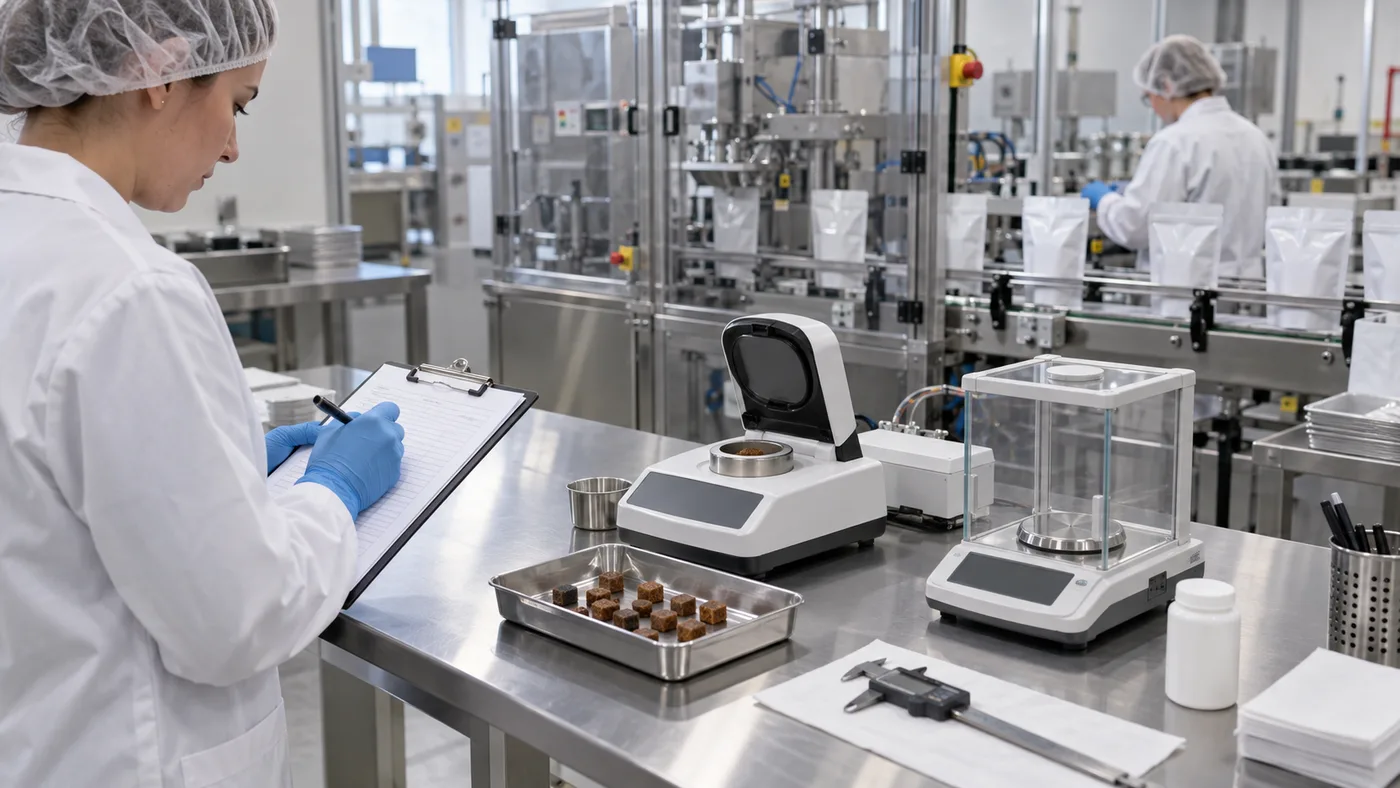
Check whether conditioning or drying creates uneven pieces. Sample different positions across trays or belts, different times in the run, and pieces of different sizes when justified. Measure water activity with a maintained instrument under a defined temperature and sample procedure. Keep laboratory results linked to the production batch and packaging lot.
7. Treat hygiene and pathogen control as a separate decision
Neither forming nor low water activity should be assumed to eliminate pathogens. Map reasonably foreseeable hazards in incoming ingredients and in the finished-product environment. Decide whether the process includes a validated kill step, whether a supplier control is relied upon, and what prevents recontamination during cooling, handling, and packing. Where no kill step exists, the ingredient and environmental control plan becomes especially important.
For facilities subject to United States animal-food rules, FDA explains that registered facilities generally need current good manufacturing practices and, where applicable, a hazard analysis and risk-based preventive controls. The exact legal obligations vary by facility and product. For projects elsewhere, review the destination country's animal-food, labeling, and product-claim rules rather than treating U.S. guidance as a worldwide certificate. The factory food-safety planning guide provides the wider framework for hazards, controls, verification, and records.
8. Build an inspection and packing route for fragile pieces
Transfer chews gently after forming or setting. Long drops, narrow bends, and aggressive vibratory conveying can damage shape or create fines. Choose inspection points based on the product hazard assessment: visual checks, checkweighing, metal detection, or other controls each serve a different purpose. Challenge and verify any reject device under operating conditions. Keep rejected and retained samples identified.
Choose a pouch, jar, or other pack only after shelf-life trials establish the required moisture and oxygen barrier, seal performance, fill count, and transport protection. A pouch that seals in a lab may fail after dust or fat contaminates the seal area. Test the filled pack, including start and end of roll, normal line stops, coding, closure torque where relevant, and distribution conditions. Label each finished lot so a complaint can be traced back to formulation, incoming lots, processing records, quality results, and packaging materials.
9. Calculate saleable capacity from pieces and operating time
Chew lines are often quoted in pieces per minute, while investors plan in kilograms, jars, and shifts. Convert between them using the approved piece weight. Illustrative calculation only: at 240 pieces per minute and 6 g per piece, nominal forming output is 86.4 kg per hour. If productive running time is 75% of scheduled time and 97% of formed product passes inspection, saleable output is about 62.9 kg per scheduled hour. These factors are examples, not equipment guarantees. Trials must establish actual yield, cleaning frequency, warmup, changeover, drying or setting time, inspection losses, and pack speed.
For a 60-piece jar, the same example represents about 175 jars per scheduled hour before any additional packaging losses. If the packer sustains fewer accepted jars, it becomes the line limit. A cooling, setting, or conditioning step may also require hold space and batch identity control. Do not size the whole factory from a forming machine's nameplate rate.
10. Plan quality release and shelf-life evidence
A release plan may include identity and dose verification for selected functional ingredients, piece weight, appearance, texture, water activity, microbiological tests chosen from the hazard analysis, foreign-material controls, package seal checks, and label review. The exact specification needs to be justified for the product, not copied from another brand's chew.
Stability work should use the commercial formula, final package, and credible storage conditions. Track meaningful changes in ingredient potency, water activity, texture, color, odor, microbial condition, seal integrity, and any other relevant quality attributes. Accelerated conditions can help screen problems but should not replace an appropriate real-time program when setting a commercial shelf life. Record changes in ingredient supplier, package material, or process that require renewed evaluation.
11. Commission the line with representative batches
At factory acceptance testing, check guards, emergency stops, recipe controls, scales, mixer discharge, forming adjustments, reject logic, cleaning access, and documentation. At site acceptance testing, run representative recipes and packaging formats through the installed route. Verify startup and restart, normal stoppages, forming weight distribution, scrap, temperature, water activity, inspection rejects, seal quality, and traceability from raw materials to final packs.
Run long enough to see whether dough condition changes as a batch ages, whether product builds up on tooling, and whether packing keeps pace after normal interruptions. Retain samples and record causes of nonconforming pieces. The acceptance protocol should distinguish a machine's mechanical capability from saleable product output at the agreed quality.
Information to prepare for a soft chew line review
- Species, serving size, chew shape and target weight, package count, and intended shelf life.
- Formula families, functional ingredients, dosage ranges, heat or moisture sensitivity, and any segregation needs.
- Laboratory or pilot samples with texture, water activity, piece-weight, and stability observations.
- Expected pieces per hour, number of SKUs, batch size, shifts, campaign length, and changeover frequency.
- Planned market, labeling and claim review, hazard analysis, hygiene expectations, and release tests.
- Available building space, utilities, environmental conditions, packaging formats, and expansion plans.
These inputs allow the mixer, forming system, conditioning or drying stage, inspection, packing, and laboratory workflow to be sized around one tested product route.
Technical references
- FDA CVM Guidance #245 discusses animal-food hazard analysis, preventive controls, and water activity in semi-moist foods.
- FDA's Regulation of Pet Food explains the United States animal-food safety framework and the distinction between food and drug claims.
- Baker Perkins pet-food process support describes trials using the customer's ingredients to assess equipment and process conditions.
Review the related factory system
Compare the production route, equipment package, layout assumptions, capacity target, and operating requirements before confirming a factory plan.