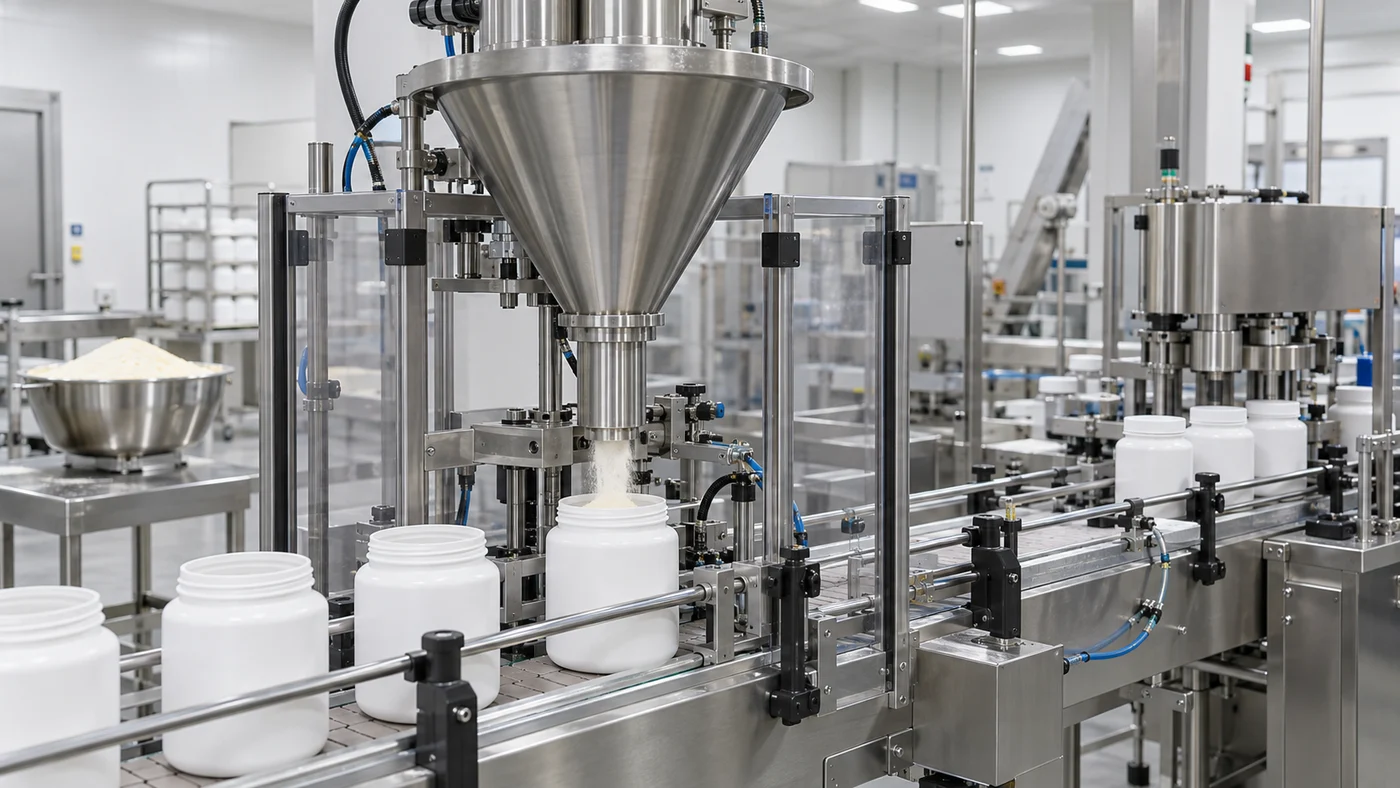
A pet supplement powder production line connects ingredient weighing, blending, controlled transfer, filling, closing, and batch release. For an investor or brand bringing powder production in-house, the important output is a repeatable finished pack: the right blend, the right net weight, a sound closure, and a traceable batch history.
This guide focuses on dry-blended nutritional powders for pets, packed in jars or pouches. It does not cover manufacturing individual active ingredients, spray drying, pharmaceutical production, or every possible supplement formulation. Those processes need their own specifications. Start with the finished product and work backward through the operations needed to make and protect it.
1. Define the powder and pack before selecting machines
Build a product specification for each planned formula. Record the ingredients, inclusion levels, approved suppliers, physical form, particle-size range, loose and settled bulk density, flow behaviour, sensitivity to moisture, and relevant storage conditions. Include the smallest planned batch, the typical batch, and expected campaign length. This information is more useful to an equipment supplier than a request for a generic supplement factory.
Then define the finished pack: fill mass, container dimensions, neck opening, closure, liner where applicable, label, batch code, and any scoop or other insert. A 100 g jar and a 500 g pouch create different filling and handling duties even when the powder is identical. Actual jars, caps, liners, and film samples should be available for trials before the final packaging arrangement is ordered.
If several dosage forms are being considered, the pet supplement factory system outlines the broader planning scope. A powder route can share selected receiving and support functions with other products, but its filling, dust control, and changeover requirements deserve a separate process review.
2. Map the complete production route
A practical starting route is: receive and identify ingredients; hold or release them under the quality procedure; weigh the recipe; prepare any approved preblend; mix; transfer to a controlled receiving container or hopper; fill; close and seal; inspect and code; reconcile the batch; and release finished goods.
Each arrow represents an interface that needs ownership. Identify the container or equipment involved, how the batch is identified, how residual material is handled, and what confirms that the next step may begin. Specify screening or foreign-material controls where justified by the product and process review. Do not assume every ingredient should be screened through one universal mesh size.
Distinguish bought-in ingredients from processes performed on site. Dry blending and packing do not establish microbial safety by themselves. Incoming-material specifications, supplier approval, handling conditions, and finished-product checks must match the actual production route. A layout drawing should show where unreleased ingredients and finished goods can be held without confusion with released stock.
3. Keep batch weighing and blend uniformity connected
Prepare a weighing instruction that identifies each ingredient, target quantity, permitted operating tolerance, scale, lot record, and addition sequence. Small inclusions require a weighing range and procedure appropriate to their quantity. A scale selected for a large carrier addition may not be suitable for the smallest ingredient.
For some formulations, an approved preblend or staged dilution helps distribute a low-inclusion ingredient before the main blend. The formulation and process team should establish the method through trials rather than assume that adding every ingredient together produces a uniform result. Control manual additions with the same identity checks and records as automated additions.
Mixer selection should address usable working volume, minimum and maximum fill, mixing action, discharge behaviour, access, and cleaning. Longer mixing is not a universal correction for an unsuitable process. Establish an operating window using representative batches and a sampling plan that can detect relevant variation. The mixing-uniformity guide explains related selection questions; the powder formulation still needs its own trials and acceptance criteria.
4. Protect the blend after discharge
A mixture that is uniform at the mixer can separate during subsequent handling. Differences in particle size or density can make transfer drops, vibration, storage, and dosing important. Review the route from mixer discharge to the final pack, including any mobile bin, conveyor, buffer hopper, and feeder. The objective is to preserve the composition already established by mixing.
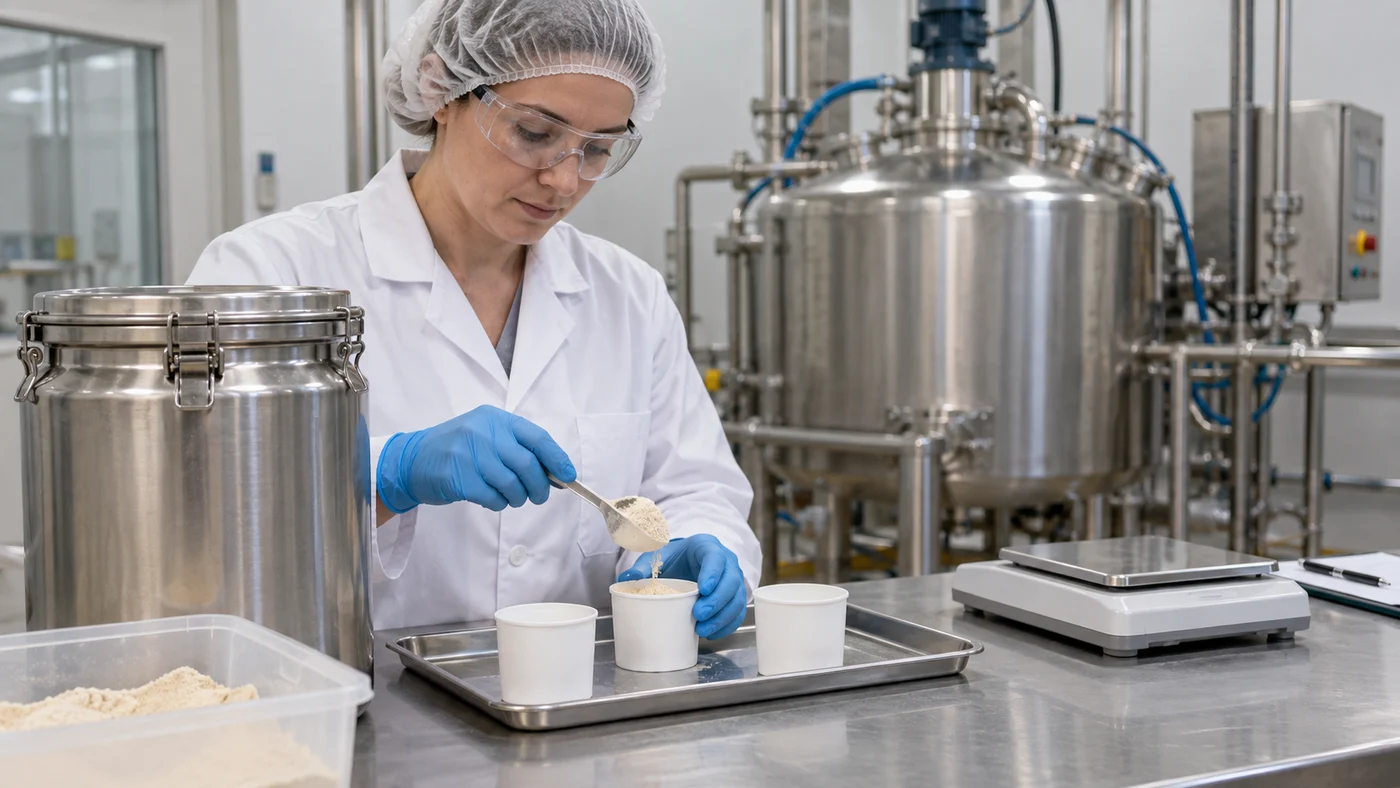
Minimise unnecessary handling where practical, then verify the chosen route. Agree which samples will be taken from the beginning, middle, and end of discharge or packing, what will be measured, and how the results will be assessed. A single combined sample can conceal variation between individual portions. A checkweigher confirms a mass result; it does not measure the concentration of each ingredient.
Define what happens to a partially used blend when packing stops. Record the remaining quantity, container identity, hold conditions, and restart decision. Avoid topping up an unidentified remainder with the next batch. The process should retain batch identity even when production and packaging do not run at the same speed.
5. Choose a filling principle using representative powder
Auger fillers are a common option for powders. In a volumetric arrangement, the screw dispenses a controlled volume; the resulting mass depends partly on the powder's condition and bulk density. Fill-to-weight arrangements use weighing during filling, while other systems use downstream weight feedback to adjust subsequent fills. These configurations should be compared for the intended powder, fill size, and production rate.
Request a trial that includes hopper refill, low hopper level, normal running, and restart after a stop. Record fill weights and rejects alongside speed. A demonstration with a free-flowing substitute may not represent a cohesive, aerated, or dusty formula. Confirm screw tooling, container presentation, dust capture, and change parts for each pack size before accepting a performance statement.
For a project review, ask the supplier to state exactly which powder and packaging samples were tested, how long the trial ran, and what was excluded. Include repeatability across the batch, product loss, cleaning time, and operator tasks in the comparison. Those observations help determine whether semi-automatic filling is sufficient or an indexed automatic line is justified.
6. Translate demand into a line-capacity requirement
Use saleable packs per shift and kilograms per shift as separate planning figures. The relationship is simple, but both are needed because a small pack can be demanding for handling equipment while using comparatively little powder.
Illustrative planning example, not a production guarantee: suppose the target is 6,000 jars per shift at 200 g net content. The required saleable powder is 6,000 × 0.2 kg = 1,200 kg. If the plan allows six hours of actual running after planned activities, the required accepted output is 1,000 jars per running hour, or approximately 16.7 accepted jars per minute.
If a trial-supported planning assumption is that 95% of filled jars are accepted on the first pass, the filling requirement becomes approximately 17.6 jars per running minute. Keep that acceptance assumption distinct from downtime: the six hours already account for planned non-running time. Further unplanned losses would reduce the achievable output and need separate allowance. These figures demonstrate the calculation, not a recommended efficiency target.
Check whether weighing, mixing, discharge, filling, capping, sealing, inspection, and manual case packing can support the schedule. For example, a 300 kg usable batch would represent four batches for the theoretical 1,200 kg saleable requirement before accounting for samples, retained material, and other losses. The mixer cycle includes loading, discharge, and cleaning as well as mixing.
7. Control dust without losing the formula
Identify where powder becomes airborne: bag opening, weighing, charging, discharge, hopper refill, filling, and cleanup. Plan suitable enclosure and extraction around these tasks, with accessible filters and a defined method for handling collected material. The equipment and building design should reflect the properties of the actual powders, including any combustible-dust hazards identified for the process.
Extraction should be evaluated during product trials. Record losses at each collection point and investigate unexplained yield differences. Material captured by a dust system is not automatically suitable for return to the batch. Its identity, condition, and approved disposition must be known before any reuse is considered.
Room conditions should come from ingredient and finished-product requirements. Do not specify a generic humidity target for every nutritional powder. Check moisture sensitivity, exposure time, storage conditions, and the suitability of the selected packaging together. Where a formula contains sensitive components, ask for product-specific stability evidence rather than infer performance from the room specification alone.
8. Treat sealing as a separate operation to prove
Powder residue on a jar's sealing surface can interfere with an induction liner bonding correctly. Evaluate the filling nozzle position and product presentation so powder reaches the container without unnecessarily contaminating the rim. Then test the actual container, cap, liner, cap application, and sealing settings as a combination.
For pouches, establish a filling and closing sequence that keeps the seal area suitable for the film and sealing process. Include real powder in the packaging trials; an empty-pack seal demonstration does not show the effect of product contamination during filling. Agree inspection methods and acceptance criteria with the packaging supplier and quality team.
Specify how missing caps, unacceptable seals, incorrect codes, and underweight packs are identified and isolated. Product shelf life must be supported by the finished formulation in its chosen package and storage conditions. Installing a sealer does not, by itself, establish a shelf-life claim.
9. Make changeover practical for several formulas
A shared powder line needs a changeover plan for the complete product-contact route. Include weighing tools, mixer surfaces, discharge valves, containers, transfer hoses, filler hopper, agitator, screw, nozzle, and any product recovery points. Record which parts can be removed, where they are cleaned, how they are dried when wet cleaning is used, and who approves restart.
Trial changeover with products that represent difficult residue or cross-contact conditions. Define inspection and verification against the site's product requirements. An attractive machine exterior says little about powder trapped behind a seal or inside a transfer connection. Ask operators and cleaning personnel to review access before installation.
Separate product changeover from packaging changeover. The latter includes old labels, coded containers, caps, scoops, film, cartons, and line settings. Both must be reconciled before the next order starts. Clear container identification and line-clearance records are particularly useful where one factory handles several brands.
10. Connect quality checks to batch release
Write a release plan that identifies the evidence required for each product. Depending on the specification, this may include incoming-material identity, weighing reconciliation, blend checks, relevant analytical results, fill-weight records, closure checks, code verification, and microbiological or stability work. The required tests and limits should be selected for the product rather than copied wholesale from another formula.
Keep a record linking ingredient lots, production batch, packing order, packaging components, samples, deviations, and finished units. Establish responsibility for held material and the conditions for release or rejection. If a trial or routine check fails, the system should identify the affected production and prevent an unresolved batch from being treated as released stock.
Marketing descriptions such as nutritional support do not determine the product's legal classification by themselves. Before finalising market-specific labels or claims, confirm the relevant requirements for that formula and destination. This planning step should inform specifications without turning a general equipment proposal into a claim of regulatory approval.
11. Prove the line before scaling production
Prepare an acceptance plan before ordering. At the supplier's factory, check equipment scope, construction, controls, guarding, change parts, and documentation. At the installation site, use actual powders and packaging to test the connected route. Include the smallest and largest intended fills, representative batches, hopper refill, a planned stop, restart, changeover, and the response to an inspection failure.
Record accepted packs, powder input, rejects, samples, retained material, setup time, cleaning time, and operator workload. These results reveal whether a stated machine rate translates into the factory's production schedule. Repeat the relevant trials if a powder, container, filling tool, or transfer arrangement changes materially.
A useful equipment brief includes the formula families, batch range, powder-handling observations, packaging samples, output schedule, room and utility information, cleaning expectations, inspection requirements, and the tests used for acceptance. The pet supplement line equipment overview provides a starting point for defining the equipment package around those inputs.
Plan the project around finished-pack consistency
The strongest starting point for a pet supplement powder factory is an agreed product and packaging specification, followed by trials of the blend-to-pack route. That sequence makes it possible to choose equipment, estimate realistic output, plan the room layout, and define quality checks using the same production assumptions.
For a project discussion with PetFactorySystem.com, share the planned powder types, destination market, pack formats, target output, and available building information. These details provide the basis for reviewing the production route and equipment scope.
Technical references
- amixon: segregation during powder handling provides background on preserving mixtures through transfer and dosing.
- All-Fill: powder filling technology explains application factors and weighing configurations.
- Enercon: sealing powdered products describes why residue on the container sealing surface matters.
Review the related factory system
Compare the production route, equipment package, layout assumptions, capacity target, and operating requirements before confirming a factory plan.