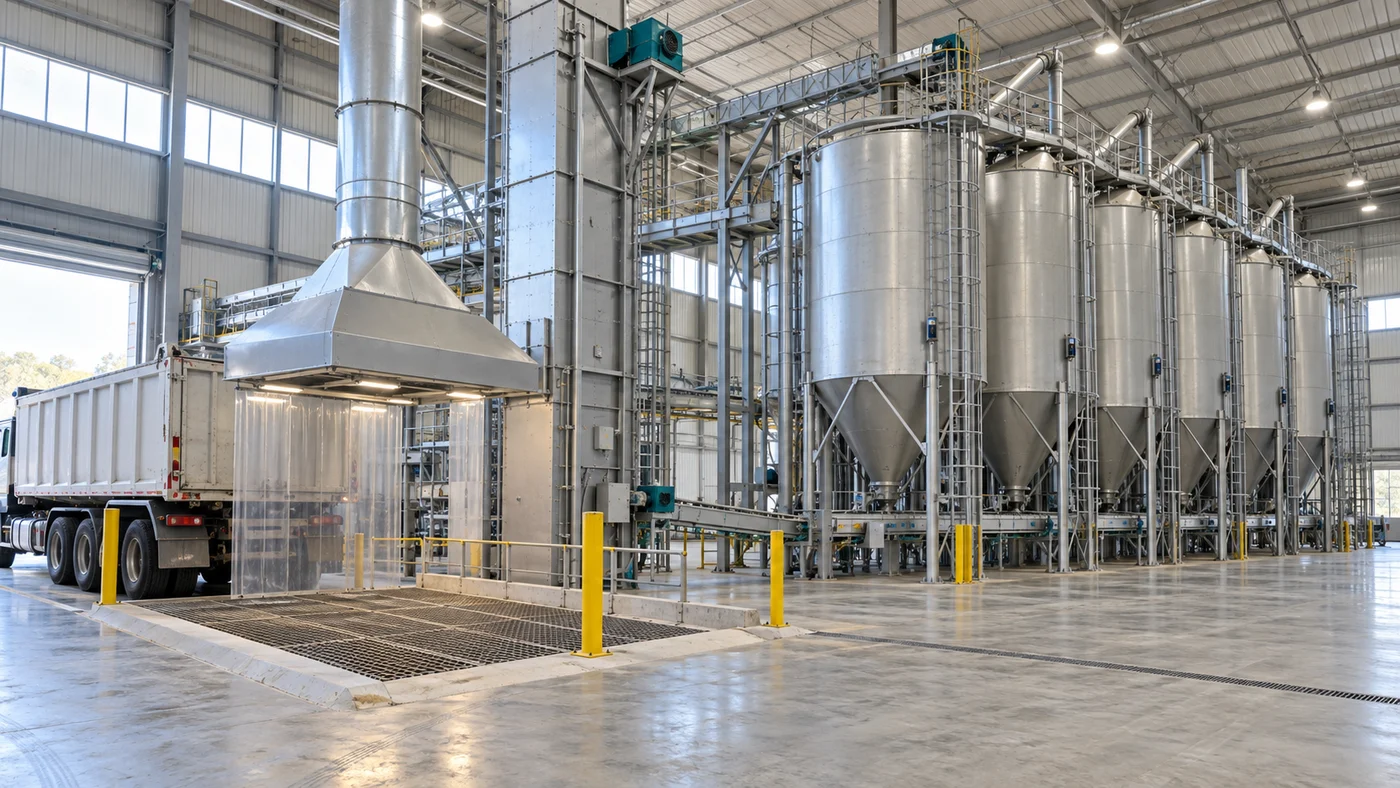
A pet food ingredient silo system connects bulk receiving, storage, inventory control, discharge, weighing, and traceability. It is not simply a row of large bins. The system must preserve ingredient identity and condition while supplying the grinding or mixing section at the required rate.
This guide focuses on dry bulk ingredients used in pet food factories, such as grains, flour, starch, and selected protein meals. It does not assume that every ingredient should be stored in a silo. Products with low use, poor flow, short shelf life, special segregation needs, or unsuitable delivery logistics may be better handled in bags, big bags, or dedicated smaller bins.
1. Define the ingredient portfolio before sizing silos
List every planned dry ingredient and record its annual use, maximum daily use, normal delivery lot, delivery method, approved suppliers, bulk density range, particle size, moisture sensitivity, flow behaviour, storage-life requirement, and relevant contamination or cross-contact controls. The storage concept should follow this data rather than a generic number of silo cells.
High-use ingredients supplied in bulk are the strongest silo candidates. Low-use ingredients can consume a complete cell while turning over too slowly. A formula may also use ingredients with similar names but different specifications; combining them in one cell can destroy lot identity or recipe accuracy. Mark which materials can share an intake route and which require dedicated transfer, cleaning, or scheduling.
The overall pet food factory system should show where bulk storage connects to receiving, grinding, batching, extrusion, and quality control. Decide whether the factory will grind whole grain before storage, store meal after grinding, or use a combination. Each route changes dust generation, flow properties, energy use, and the consequence of a storage problem.
2. Separate storage volume from usable ingredient capacity
A silo supplier may quote geometric volume, but factory planning needs usable mass. Convert volume using a justified bulk-density range and an agreed usable-volume factor. Allow for headspace, the required high-level stop point, material that cannot be reliably reclaimed, and any operating reserve. Do not calculate every ingredient with the same density.
Illustrative example, not a design guarantee: suppose one ingredient is consumed at 12 tonnes per production day. Four days of working inventory requires 48 tonnes. If the delivery lot is 20 tonnes and the factory wants enough free capacity to accept that load without first emptying the cell, the required usable capacity becomes 68 tonnes.
If trials and supplier data support a planning bulk density of 0.62 tonnes per cubic metre and an assumed usable-volume factor of 92%, the corresponding geometric volume is approximately 68 / (0.62 × 0.92) = 119 cubic metres. Both 0.62 and 92% are project assumptions. They must be replaced with actual ingredient and silo data before ordering.
Review minimum inventory as well as maximum inventory. Excessive storage can increase age, tie up working capital, and complicate lot rotation. Capacity should reflect delivery reliability, seasonal risk, supplier distance, production schedule, available unloading hours, and the consequences of a late truck.
3. Size the receiving station around delivery operations
Define vehicle type, payload, discharge method, arrival pattern, sampling status, documentation checks, and the time available for unloading. The intake rating should be based on the complete event: positioning, identification, sampling or release, opening, unloading, cleanout, reconciliation, and departure. A conveyor's maximum rate is not the same as truck turnaround.
Illustrative throughput check: unloading a 28-tonne dry bulk delivery in 45 minutes of actual material flow represents an average of about 37.3 tonnes per hour. The installed route needs additional consideration for startup, slowdown, uneven discharge, cleaning, and the receiving schedule. This calculation does not establish a recommended intake rate.
Provide a covered, drained, and cleanable receiving area suited to local weather and traffic. The receiving pit or discharge connection needs guarding, controlled access, dust capture, and a method for removing foreign material without exposing workers to moving equipment. Vehicle routes should avoid conflict with pedestrians, forklifts, and finished-goods dispatch.
4. Protect ingredient identity at the intake point
Before unloading, confirm supplier, material, lot, vehicle, quantity, destination cell, and release status. The control system should not rely only on an operator remembering the correct route. Use a verified destination selection, permissive logic, and clear indication of the open path. Where practical, prevent unloading when the selected cell lacks sufficient capacity or the route is not correctly positioned.
Sampling should represent the delivery and follow the site's approved plan. Check documents and relevant receiving criteria before material enters a shared system. The pet food raw-material supply-chain guide covers supplier approval, incoming inspection, hold status, and warehouse zoning in more detail.
Define what happens to rejected or unreleased material. Once a truck has discharged into a common elevator and silo, physical recovery can be difficult. The receiving procedure, control logic, and release decision should therefore be designed together.
5. Include pre-cleaning and equipment protection where justified
Bulk agricultural materials can contain oversized pieces, fines, dust, and foreign objects. The required pre-cleaning route depends on the ingredient specification, supplier controls, downstream process, and hazard analysis. A coarse screen, aspiration, magnet, or other separation step may be selected for a defined purpose, but no single arrangement is suitable for every material.
Place inspection and cleanout access where operators can use it safely. Identify how removed material is collected, labelled, reconciled, and disposed of. A separation device that is difficult to inspect can become an unnoticed restriction or source of contamination.
Monitor the transfer equipment that protects production continuity. Bucket elevators, chain conveyors, screws, and diverter valves need suitable speed, alignment, blockage, position, or overload monitoring according to the design and local requirements. Interlocks should stop upstream feed before a blocked route overfills.
6. Design each silo around actual powder flow
Material does not leave every hopper in the same way. Some ingredients flow freely; others compact, form stable arches, create rat holes, flood after an arch collapses, or segregate as they move. Hopper angle alone does not solve these behaviours. Use representative material testing and a competent bulk-solids design method to establish wall material, hopper geometry, outlet size, and discharge device.
Mass-flow and funnel-flow patterns have different consequences. In mass flow, the contents move as material is discharged; in funnel flow, a channel may form while other material remains stationary. The appropriate design depends on the ingredient, turnover, first-in/first-out objective, segregation risk, structure, and project economics. Avoid promising first-in/first-out performance without analysing the complete bin and outlet.
Discharge aids such as agitators, air pads, vibrators, or fluidising devices must be selected for the ingredient and structure. An unsuitable vibrator can compact some materials or damage the silo. Air-assisted devices also introduce air-quality, moisture, and dust considerations. Manual entry should never be treated as the routine solution to poor flow.
7. Prevent condensation, moisture ingress, and pest access
Storage condition starts with the received ingredient. Record moisture and temperature where relevant, then consider weather, solar gain, night cooling, humid air, roof leaks, and long residence time. Temperature differences can contribute to condensation on internal surfaces. The appropriate monitoring and ventilation approach depends on the material, climate, silo construction, and storage duration.
Protect roof openings, vents, inspection hatches, and conveyor penetrations from rain and pest entry. Keep the surrounding area accessible for inspection and housekeeping. Outdoor structures may need additional corrosion protection and weatherproof instrumentation.
For projects supplying the United States, FDA animal-food CGMP requirements provide baseline expectations for manufacturing, processing, packing, and holding animal food. Other markets have their own rules. The project's storage, inspection, and record system must be matched to the destination and operating country rather than described as universally compliant.
8. Use level measurement and inventory reconciliation together
High-high level protection helps prevent overfilling, while continuous or point level devices support operating decisions. Radar, guided-wave, capacitance, weight, pressure, or mechanical technologies each have application limits. Dust, dielectric properties, buildup, vessel geometry, and mounting location can affect readings.
A level percentage is not automatically an accurate mass. Convert readings using a verified vessel profile and ingredient density, or use a weighing arrangement where justified. Compare receipts, measured inventory, recipe use, transfers, samples, and adjustments. Unexplained differences can indicate sensor error, incorrect routing, leakage, bridging, or record problems.
Set alarm responses. A high alarm should stop or prevent the relevant intake route before an overflow; a low alarm should warn production before a batch cannot be completed. Avoid bypassing alarms without authorisation and a documented temporary control.
9. Connect silo discharge to accurate batch weighing
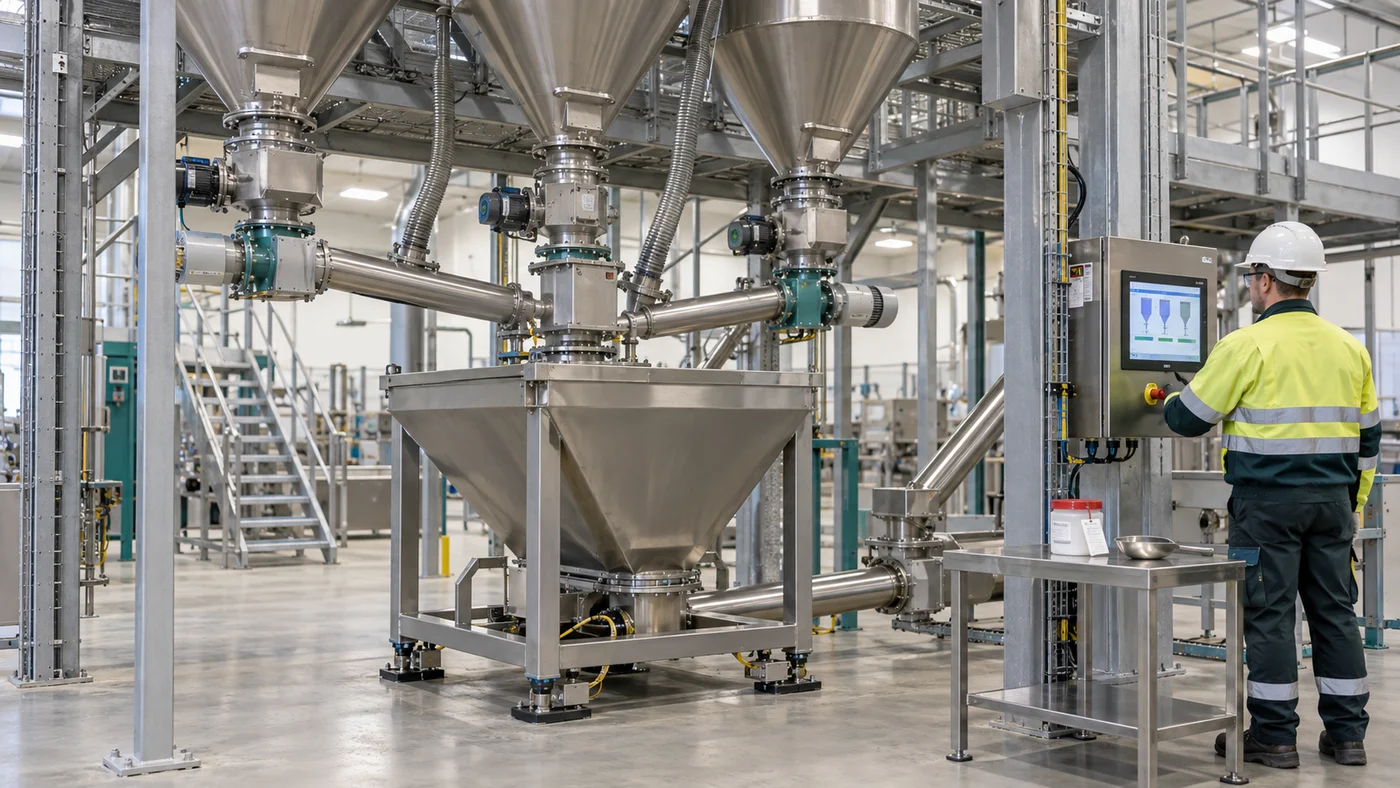
The discharge and feeder must support both capacity and accuracy. A large slide gate may fill a batch scale quickly but can be difficult to stop precisely. A screw feeder, rotary valve, or two-stage coarse-and-fine arrangement may provide better control for some ingredients. The selected method must also handle the material without unacceptable compaction, residue, or segregation.
Size the batch scale for the recipe range and production cycle. Check maximum load, minimum practical addition, load-cell resolution, structural isolation, flexible connections, refill time, discharge time, and calibration access. Vibrating equipment or rigid pipe loads can affect measurement. A scale reading should be tied to the correct ingredient, silo, recipe, and production batch.
Sequence the feeders so the mixer receives the correct quantity on time. The scale cycle includes taring, coarse feed, fine feed, settling, confirmation, discharge, and verification of empty status. Line balancing should use the complete cycle rather than a feeder's peak rate.
10. Keep traceability through shared conveying routes
The batch record should link supplier lot, receipt, destination silo, transfer events, inventory adjustment, recipe addition, and finished production. Define when one lot ends and the next begins inside a cell. If a new delivery is added before the previous lot is empty, the traceability model must represent the resulting overlap rather than claim a false boundary.
Shared elevators and conveyors can retain material. Identify carryover points, cleanout access, sequencing rules, and any flush procedure. Ingredients with special segregation requirements may need dedicated paths or a validated changeover. Traceability software cannot correct a physical route that mixes materials without control.
Maintain valve-position feedback and route records where automated routing is used. A command to open a diverter is not proof that it reached the intended position. Alarm and hold logic should address disagreement between commanded and confirmed state.
11. Treat dust and confined-space hazards as design inputs
Dry ingredient receiving, elevators, silo filling, transfer points, and discharge can release combustible dust. The hazard depends on the actual materials and process. Arrange appropriate testing and a site-specific dust-hazard assessment, then coordinate extraction, equipment selection, electrical classification, ignition control, isolation, venting or suppression, housekeeping, and emergency planning under applicable local requirements.
For United States facilities within its scope, OSHA 29 CFR 1910.272 specifically covers feed mills and addresses grain-dust fires and explosions, training, housekeeping, preventive maintenance, hot work, and entry into bins, silos, and tanks. It should not be represented as a universal international design code, but it illustrates why these risks cannot be left to an equipment quotation.
Silo entry can involve engulfment, mechanical, atmospheric, and fall hazards. Design inspection and maintenance to minimise entry. When entry is unavoidable, the operator must apply the applicable permit, isolation, atmospheric, attendant, rescue, and training requirements. No one should enter to clear a bridge while material can move.
The pet food factory dust-collection guide explains how capture points, ducting, collectors, isolation, housekeeping, and commissioning should be reviewed as one system.
12. Coordinate structure, foundations, and maintenance access
Silos impose vertical, lateral, dynamic, and sometimes eccentric loads. The structural engineer needs vessel geometry, material density range, fill and discharge pattern, support reactions, conveyor loads, access platforms, wind, seismic criteria, settlement information, and local code requirements. A generic foundation detail should not be copied between sites.
Provide safe access to roof instruments, filters, level devices, diverters, feeders, load cells, and cleanout points. Plan lifting routes for motors and gearboxes. Avoid locating critical service points where technicians must stand on pipes or cross unguarded openings.
Allow space for future expansion only when it has a defined route. A spare silo position also needs foundation capacity, intake and distribution capacity, conveyor route, electrical load, controls, dust protection, and maintenance access.
13. Prove the system through FAT, SAT, and material trials
Factory acceptance testing should confirm controls, route logic, valve feedback, level alarms, scale functions, interlocks, motor protection, alarm history, and documentation. Mechanical checks should cover supplied materials, fabrication, guards, access, drives, bearings, and intended cleanout points.
Site acceptance must test the installed system with representative material. Include truck receiving, destination selection, high-level prevention, transfer rate, dust capture, elevator and conveyor interlocks, silo discharge, coarse and fine weighing, scale calibration, route change, power interruption, restart, inventory reconciliation, and cleaning.
Run long enough to reveal flow and buildup problems. A short empty-machine test cannot prove storage discharge or batch accuracy. Record actual tonnes received, transfer time, dust observations, residue, scale results, alarms, stops, and operator workload. Agree how deviations will be corrected and retested.
Information to prepare for a silo-system proposal
- ingredient names, specifications, bulk-density ranges, flow observations, moisture limits, and annual use;
- maximum daily consumption, delivery lot, delivery frequency, required reserve, and stock-rotation rule;
- truck type, unloading method, receiving hours, sampling and release process, and target turnaround;
- required silo cells, segregation rules, usable capacity basis, level measurement, and inventory accuracy;
- pre-cleaning, aspiration, magnets or other justified controls;
- conveyor route, batch size, weighing accuracy, cycle time, mixer demand, and production schedule;
- dust-hazard data, local safety requirements, weather, wind, seismic, foundation, and building constraints;
- traceability, route permissives, alarms, reporting, calibration, FAT, SAT, training, and spare parts.
Build the storage system around controlled ingredient flow
A reliable pet food silo system combines ingredient data, practical receiving logistics, correct usable capacity, flow-tested hopper design, controlled discharge, accurate weighing, dust and confined-space safety, structural coordination, and batch traceability. The required result is not maximum steel volume; it is dependable delivery of the correct ingredient to the correct batch.
For a project review with PetFactorySystem.com, provide the ingredient list, delivery formats, daily use, building or site information, and target production schedule. These inputs allow the receiving, storage, conveying, weighing, and control scope to be planned from one material balance.
Technical references
- Bühler: pet food process chain describes raw-material intake, storage, conveying, weighing, and dosing as connected production stages.
- OSHA 29 CFR 1910.272 provides United States requirements for covered grain-handling and feed-mill hazards.
- FDA: starting an animal food business summarises animal-food CGMP and preventive-control responsibilities for applicable United States facilities.
Review the related factory system
Compare the production route, equipment package, layout assumptions, capacity target, and operating requirements before confirming a factory plan.