
Preventive maintenance in a pet food factory protects more than production uptime. A worn seal can create contamination or formula carryover. A damaged screen can create a foreign-material risk. An overheated bearing can stop a line or become an ignition source. An incorrectly lubricated gearbox can fail early, while excess or unsuitable lubricant can threaten product integrity. Maintenance must therefore connect reliability, food safety, worker safety, hygiene, quality, and production planning.
A calendar full of inspections is not evidence of an effective maintenance system. Each task should address a credible failure mode, use an appropriate interval or condition trigger, produce a usable record, and lead to a defined action. The objective is not to maximize maintenance activity; it is to control lifecycle risk at a justified cost.
This guide supports maintenance planning within a complete pet food factory system. It is not an equipment-specific service manual or a substitute for manufacturer instructions, local safety law, food-safety requirements, or qualified engineering.
Build the asset register before commercial production
Start with a structured hierarchy that connects the factory, area, line, system, equipment, and maintainable component. A single asset called “extrusion line” is too broad for failure analysis or parts control. The hierarchy should separately identify feeders, preconditioner, extruder, cutter, dryer zones, fans, pumps, coating system, cooler, conveyors, packaging machines, motors, gearboxes, instruments, safety devices, and utility interfaces.
For each maintainable asset, capture:
- manufacturer, model, serial number, duty, location, and parent system;
- drawings, manuals, certificates, software or firmware information, and approved settings;
- motor, gearbox, bearing, belt, chain, seal, filter, and wear-part details;
- lubricant specification, quantity, point, method, and interval;
- recommended tasks, special tools, lifting needs, access, and isolation points;
- critical spares, supplier, lead time, interchangeability, and storage conditions;
- commissioning baselines such as vibration, temperature, current, pressure, airflow, and cycle time.
This information should be delivered with the equipment package and production-route plan. Reconstructing bills of material after a breakdown is slower and less reliable than collecting them during procurement and installation.
Rank equipment by consequence, not purchase price
Criticality should reflect what happens when an asset fails. A low-cost sensor may be critical if it verifies a process control. A common motor may be less critical if a stocked replacement can be installed quickly. Use a documented method that considers:
- food-safety, contamination, foreign-material, and traceability consequences;
- risk to personnel and potential release of hazardous energy;
- production loss, bottleneck effect, and available redundancy;
- quality loss, rework, scrap, and customer impact;
- environmental or permit consequences;
- failure detectability, repair duration, spare lead time, and technical support;
- whether failure can damage connected equipment or create a secondary event.
Use the result to focus monitoring, planning, spares, procedures, and training. Criticality is not permanent: update it after process changes, recurring failures, supplier changes, new formulas, or evidence from actual operation.
Identify failure modes before assigning maintenance tasks
A generic instruction such as “check machine monthly” gives little guidance. Define what can fail, why it fails, how the failure develops, how it can be detected, and what consequence follows. Examples include bearing degradation, belt wear or misalignment, screen damage, seal leakage, filter blockage, chain elongation, gearbox oil deterioration, heater failure, steam-trap malfunction, sensor drift, dryer fan imbalance, compressed-air leakage, and loose electrical connections.
Then select the most defensible response:
- Fixed-time replacement or overhaul when age or usage has a meaningful relationship to failure and the interval is supported by evidence.
- Condition-based maintenance when deterioration can be detected with enough warning to plan work.
- Functional testing for protective devices or standby systems whose hidden failure may not be visible during normal operation.
- Run to failure only when the consequence is acceptable, the failure does not create a food-safety or safety risk, and repair resources are available.
- Redesign when no maintenance task can control an unacceptable or recurring failure effectively.
Intervals should use manufacturer guidance, operating duty, environment, failure history, condition data, and regulatory or validation needs. Copying the same interval to every motor or conveyor creates unnecessary work on some assets and insufficient control on others.
Establish baselines during commissioning
Condition monitoring is most useful when the team knows what healthy equipment looked like under defined operating conditions. During the production-line commissioning and trial-production period, record baseline vibration, bearing and gearbox temperatures, motor current, differential pressure, fan airflow, speed, valve position, cycle time, product throughput, and other parameters relevant to the machine.
Record load, formula, speed, ambient condition, sensor location, instrument, and method with each baseline. Comparing a lightly loaded reading with a later full-load reading can produce a false alarm. For repeatability, mark measurement points and use the same orientation and operating condition where practicable.
Baseline data should not replace acceptance criteria from engineering calculations, safety requirements, or equipment suppliers. It provides a reference for trend analysis and early fault detection.
Use condition monitoring where it creates decision time
Condition monitoring should provide enough warning between detection and functional failure to plan a safe intervention. The useful technique depends on the failure mode:
- vibration trending for rotating equipment, imbalance, looseness, alignment, and selected bearing or gear conditions;
- temperature trending or thermography for bearings, electrical connections, motors, heaters, and friction points;
- oil inspection or analysis for selected gearboxes, hydraulic units, and contamination or wear indicators;
- motor current, power, speed, and load trends for mechanical or process changes;
- differential pressure for filters, screens, and airflow restrictions;
- ultrasound or leak surveys for compressed air, steam traps, and selected bearing conditions;
- wear measurement for dies, knives, paddles, screens, belts, chains, and sealing components.
A single abnormal value should be evaluated with load, process conditions, instrument accuracy, and historical trend. Alerts need defined review, confirmation, priority, and work-order rules; otherwise dashboards accumulate alarms without reducing failure risk.
Integrate maintenance with production and sanitation schedules
Plan access around product sequencing, cleaning, allergen or formula changeover, quarantine status, and production demand. Opening equipment immediately after sanitation may require the area to be cleaned and released again. Performing dusty mechanical work beside exposed product can introduce debris even when the repaired machine is not a food-contact asset.
A weekly planning meeting should confirm the asset, scope, isolation, parts, labor, contractor support, tools, permits, cleaning requirement, quality inspection, restart test, and expected downtime. Bundle compatible work during a planned outage, but do not overload the window so that testing and hygienic restoration are rushed.
Control hazardous energy before servicing equipment
Maintenance can involve electrical, mechanical, pneumatic, hydraulic, pressure, steam, thermal, gravity, and stored-energy hazards. Turning off a control panel is not necessarily energy isolation. Equipment-specific procedures should identify energy sources, shutdown sequence, isolation devices, dissipation or restraint of stored energy, lock application, verification, testing needs, and safe restoration.
For U.S. general-industry operations within its scope, OSHA 29 CFR 1910.147 establishes minimum requirements for controlling hazardous energy during servicing and maintenance. It covers procedures, training, periodic inspection, group lockout, contractor coordination, and shift changes. Projects in other countries must identify and implement the applicable local energy-isolation and machine-safety rules.
The maintenance plan should also distinguish routine operating adjustments from servicing that exposes personnel to a danger zone. Convenience, short task duration, or production pressure does not justify bypassing required protection.
Make hygienic restoration part of every maintenance job
A mechanical repair is incomplete until the area is safe for food production. Maintenance can introduce fasteners, wire pieces, grinding debris, welding residue, gasket fragments, lubricants, cleaning chemicals, fingerprints, water, tools, and temporary materials. The work order should define controls before, during, and after intervention.
For product-contact or exposed-product areas, consider:
- protecting or removing product and packaging before work begins;
- controlling tools, blades, drill bits, fasteners, rags, temporary covers, and replacement parts;
- using materials, seals, weld repairs, and surface finishes suitable for the location;
- removing debris and temporary materials, then inspecting inaccessible ledges and product paths;
- cleaning and, where applicable, sanitizing under an approved procedure;
- checking guards, screens, magnets, detectors, sensors, interlocks, and fasteners before restart;
- documenting quality or sanitation release before product is reintroduced.
Coordinate these steps with the factory hygiene and sanitation plan. Maintenance and sanitation teams should agree who removes gross debris, who cleans product-contact surfaces, and who authorizes return to service.
Manage lubrication as a controlled material system
Lubrication errors include wrong product, wrong amount, wrong point, contamination, mixing incompatible products, damaged application tools, missed intervals, and over-lubrication. Create an approved lubricant register linked to each asset and point. Use dedicated, clearly identified transfer containers and application tools, protect them from dust and moisture, and control storage life and cleanliness.
FDA's Guidance for Industry #235 on animal food CGMPs explains that equipment and utensils must be properly maintained and must not adulterate animal food with non-food-grade lubricants, fuel, metal fragments, contaminated water, or other contaminants. It states that food-grade lubricants must be used when the lubricant becomes part of the animal food and recommends them as a precaution where unintended contact could occur. It does not mean that every lubricant everywhere in a factory is automatically the same grade; location, design, exposure, manufacturer requirements, and applicable law must be assessed.
Do not solve leakage by repeatedly adding lubricant. Investigate failed seals, breathers, alignment, pressure, temperature, contamination, incorrect viscosity, and overfilling. Record consumption trends because increasing use can be an early failure signal.
Design the critical-spares strategy from downtime risk
Stocking every component consumes cash and storage space, while stocking nothing extends outages. Critical-spares decisions should consider failure consequence, probability, supplier lead time, transport and customs risk, repairability, interchangeability, shelf life, storage conditions, and whether a temporary operating mode is safe and validated.
Typical review candidates include unique motors and gearboxes, bearings, seals, chains, belts, screens, knives, dies, heater elements, sensors, encoders, PLC or drive components, safety devices, pneumatic valves, filter media, and packaging change parts. The list must come from the actual installed equipment and failure analysis, not a generic catalog.
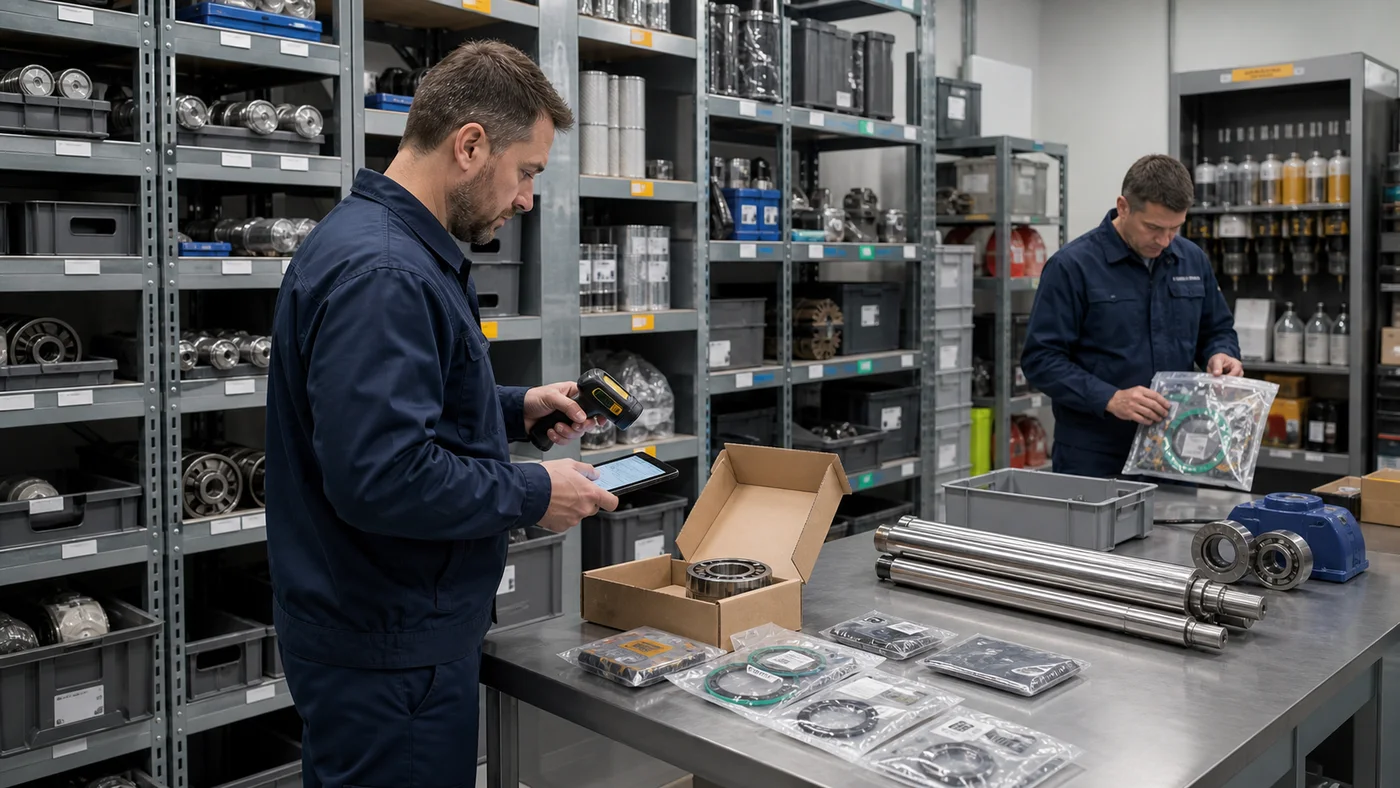
For each critical spare, define the exact part number and revision, compatible assets, minimum and maximum quantity, reorder point, approved supplier, preservation method, rotation or inspection interval, and responsible owner. Electronic controls may become obsolete even while mechanically sound equipment remains in service, so lifecycle and migration plans are also needed.
Protect spare parts during storage
Bearings, seals, belts, electronic modules, filters, lubricants, motors, and precision parts have different storage needs. Dust, humidity, vibration, ultraviolet light, ozone, temperature extremes, corrosion, poor handling, and long storage can make a new-looking spare unreliable before installation.
Keep parts sealed or covered, off the floor, and traceable. Preserve shafts and machined surfaces appropriately. Follow manufacturer recommendations for rotating stored motors or shafts where applicable, battery maintenance, desiccant, seal orientation, lubricant shelf life, and first-in-first-out or first-expire-first-out control. Quarantine damaged, opened, obsolete, or unidentified items rather than returning them to available stock.
Use work orders as technical and food-safety records
A useful work order states the failure symptom or preventive task, asset, priority, safety controls, parts, labor, measurements, findings, actions, test results, hygiene restoration, downtime, and closeout approval. “Fixed machine” is not enough to support recurrence analysis or spare planning.
Record failure codes consistently, but allow technicians to describe evidence. Attach photographs, readings, removed-part condition, and revised settings when useful. If a temporary repair is permitted, identify its risk, expiry, inspection requirement, and permanent corrective action. Temporary tape, improvised fasteners, damaged covers, or rough repairs can create cleanability and foreign-material problems.
A computerized maintenance management system can schedule work and preserve history, but data quality depends on asset hierarchy, task design, technician access, review, and disciplined closure. Do not create hundreds of low-value recurring tasks that hide overdue critical work.
Plan shutdowns as controlled projects
A major shutdown should have a frozen scope, schedule, job packages, parts verification, contractor plan, lifting plan, isolation strategy, cleaning and access sequence, quality hold points, contingency time, and restart procedure. Confirm parts physically before the line stops; a purchase order does not prove the correct component is onsite.
Sequence work to avoid recontamination. Structural, cutting, welding, or dusty work should occur before final cleaning and sensitive instrument checks. After reassembly, verify alignment, rotation direction, guards, fasteners, lubrication, utilities, instruments, interlocks, emergency stops, leak tightness, and no-load or controlled-load operation as appropriate.
Restart criteria should identify who accepts mechanical completion, electrical completion, safety restoration, sanitation release, process readiness, and product disposition. The first material through the system may need controlled collection or evaluation before commercial release.
Control contractors and specialist service providers
External technicians may know the machine but not the factory's hygiene zones, product exposure, energy sources, traffic routes, chemical rules, or release process. Prequalify contractors for competence and define site induction, permits, PPE, tools, parts, supervision, isolation coordination, contamination controls, waste removal, and documentation.
For U.S. operations covered by OSHA 1910.147, the onsite and outside employers must inform each other of their lockout or tagout procedures. Similar coordination should be built into every project even where a different local rule applies. Handover must include changed settings, replaced parts, findings, recommendations, and any unresolved risk.
Measure reliability without rewarding the wrong behavior
No single maintenance KPI proves success. Use a balanced set that can include:
- planned versus unplanned maintenance hours;
- schedule compliance and overdue critical work;
- mean time between functional failures and mean time to restore service;
- availability at the constraint or bottleneck equipment;
- repeat failures within a defined period;
- emergency work, breakdown production loss, and maintenance-related quality holds;
- critical-spare stockouts, obsolete inventory, and supplier lead-time exposure;
- condition-monitoring alerts converted into planned interventions;
- lubricant consumption anomalies and contamination findings.
High preventive-maintenance completion can coexist with repeated failures if tasks are ineffective. Low downtime can also hide deferred defects or reduced production demand. Review metrics with failure evidence, production rate, quality events, and backlog risk.
Use lifecycle planning instead of repeated emergency repair
Some assets become expensive to support because parts, software, specialist knowledge, or safety features are obsolete. Track remaining life, condition, failure trend, support horizon, energy use, capacity constraint, hygienic limitations, and upgrade dependencies. A planned replacement during a coordinated shutdown is usually easier to control than an emergency retrofit after failure.
The current ISO 55001:2024 asset management standard provides a framework for balancing asset performance, risk, and expenditure over the lifecycle. Certification is not required to use the underlying discipline: connect maintenance decisions to business objectives, risk, information, responsibilities, and continual improvement.
Documents to complete before the maintenance system goes live
- asset hierarchy, register, drawings, manuals, and installed bill of materials;
- criticality method and approved equipment rankings;
- failure-mode review and task-selection basis;
- preventive and condition-monitoring procedures with routes and baselines;
- equipment-specific energy-isolation procedures and contractor coordination rules;
- lubricant register, point maps, tools, storage, and contamination controls;
- critical-spares list, min-max levels, preservation, obsolescence, and reorder rules;
- work-order priorities, failure codes, escalation, hygienic release, and closure requirements;
- shutdown planning, restart testing, and product disposition procedures;
- staffing, competence, tools, workshop, CMMS, KPI, and lifecycle-renewal plan.
PetFactorySystem.com can coordinate maintainability, safe access, spares, utilities, sanitation handover, controls, and lifecycle requirements during factory planning and equipment procurement. To prepare a project-specific maintenance brief, send the product route, target capacity, equipment list, country, operating schedule, and expected technical-support model.
Review the related factory system
Compare the production route, equipment package, layout assumptions, capacity target, and operating requirements before confirming a factory plan.