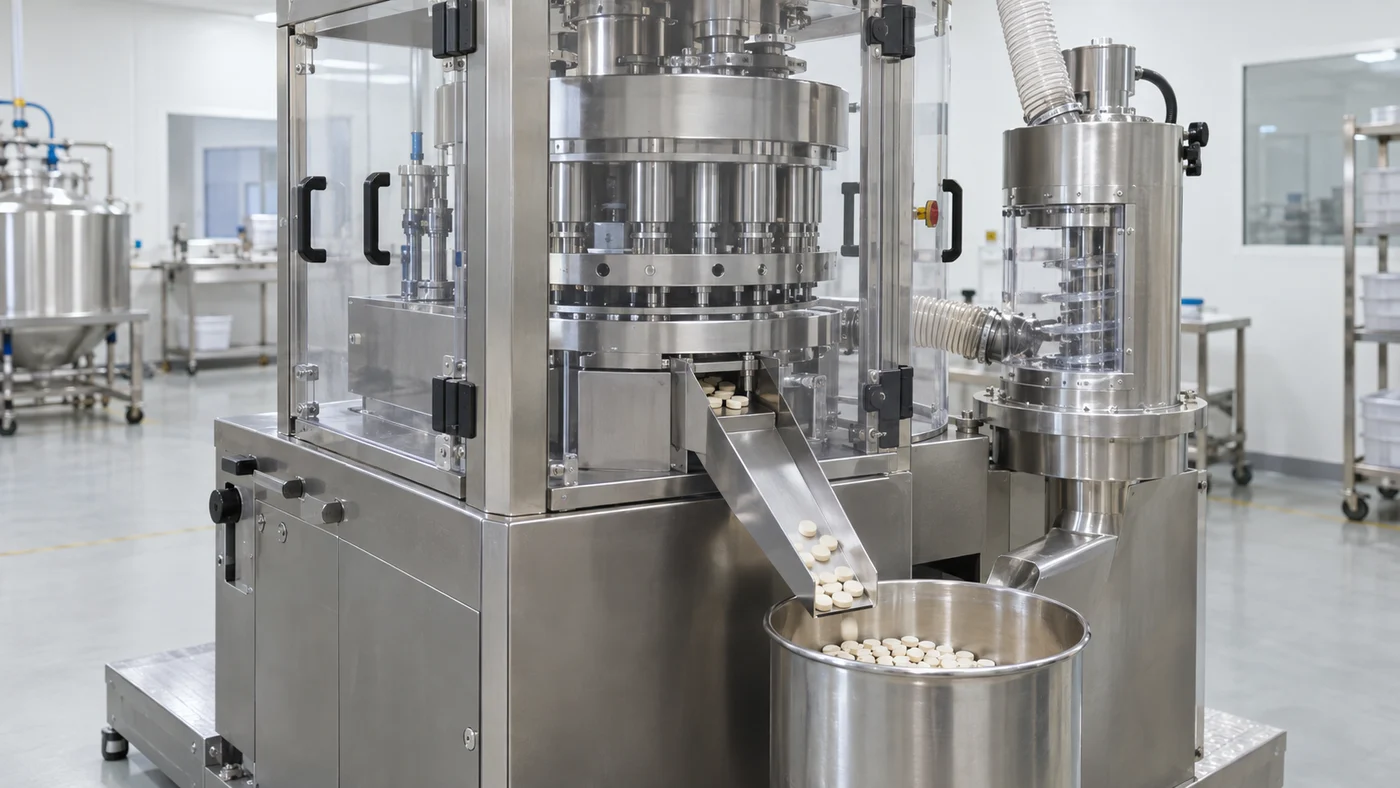
A pet supplement tablet manufacturing line must turn a formulated powder into tablets that remain consistent through compression, handling, optional coating, and final packaging. The tablet press is central to the process, but reliable production depends just as much on powder properties, blending, tooling, in-process checks, dust control, and packaging trials.
This guide covers nutritional supplement tablets for pets. It does not cover veterinary medicines, and it does not assume that one regulatory classification applies in every market. Product classification, permitted ingredients, label claims, and release requirements should be confirmed for each destination before the factory specification is finalised.
1. Start with the tablet specification, not the press speed
Define the intended tablet before selecting equipment. Record the target weight, diameter, thickness range, shape, score line if required, colour, surface finish, packaging format, and expected storage conditions. The product brief should also identify serving instructions and any practical constraints on tablet size for the intended animal group.
The formulation file should describe every ingredient, its inclusion level, approved source, particle-size range, moisture sensitivity, bulk density, flow behaviour, and known handling risks. These properties influence whether the blend feeds consistently into a die and whether it can form a robust tablet under compression. A formula that looks complete on paper may still need development work before it is ready for a production press.
Plan the line around the intended products and markets. The broader pet supplement factory system shows how tablet production fits alongside powders and soft chews, while the tablet project itself should have a dedicated process specification and acceptance plan.
2. Decide between direct compression and granulation through trials
In direct compression, weighed ingredients are blended and the resulting powder is fed to the tablet press without a preceding granulation step. This route can reduce equipment, processing time, and product transfers, but only when the formulation has suitable flow, compressibility, and content distribution. Direct compression should be treated as a formulation-dependent option, not as the default route for every supplement.
When a blend does not feed or compact reliably, a granulation route may be evaluated. Wet granulation introduces a liquid binder and normally requires controlled drying and sizing before final blending. Dry granulation compacts powder without adding liquid, then mills it into granules before lubrication and compression. Each route changes the equipment scope, cleaning work, process controls, and impact on heat- or moisture-sensitive ingredients.
Use representative ingredients in development and scale-up trials. Evaluate powder flow, segregation, tablet weight variation, compression force, ejection behaviour, hardness, friability, disintegration where relevant, and visual defects. The chosen route should be supported by results from the actual formulation or a justified representative product.
3. Control weighing, preblending, and addition order
Prepare a batch instruction that identifies the scale, target quantity, operating tolerance, material lot, verification step, and addition order for every ingredient. A scale selected for the main carrier may not be appropriate for a low-inclusion component. Where the range is wide, separate weighing stations or scales can improve control.
Low-inclusion ingredients may require a validated preblend or staged dilution before they enter the main mixer. The objective is to distribute them through a larger quantity of material without creating concentrated pockets. Lubricants and glidants may have their own addition sequence and mixing time because excessive mixing can change tablet behaviour. The correct sequence and duration must come from formulation trials rather than a universal recipe.
Mixer working volume, fill range, discharge pattern, access, and cleaning should match the planned batch sizes. Blend-uniformity sampling must be designed around the formulation and risk. The mixer selection and uniformity guide provides useful equipment questions, but tablet blends still need product-specific studies.
4. Preserve the blend between mixer and tablet press
Powder can segregate after mixing because of differences in particle size, density, or shape. Long transfer routes, repeated drops, vibration, and oversized buffer hoppers can change the mixture reaching the press. Map every interface from mixer discharge through bins, lifts, vacuum transfer, sieves, and the press feed system.
Minimise unnecessary transfers and define how each container remains identified. If an intermediate bulk container is used, confirm its discharge behaviour and cleaning method. If vacuum conveying is proposed, test whether the transport conditions affect segregation or powder condition. Any screening step should have a product-based purpose and a justified aperture rather than a single mesh size applied to all formulas.
The press feed system should deliver a stable powder supply to the dies. Compare gravity feeding and force-feeding arrangements using the actual blend. Cohesive or poorly flowing material may require a different feeder configuration, but faster agitation can also affect the powder. Feed-frame settings should therefore be included in development records and operating instructions.
5. Select the rotary press and tooling as one system
A rotary tablet press uses upper and lower punches moving through dies while the turret rotates. Powder fills the die, excess material is metered, the punches compress the dose, and the lower punch raises the tablet for take-off. Machine selection should consider tablet size and shape, required compression force, turret and station options, feeder design, tooling standard, containment, controls, and cleaning access.
Tooling determines more than the logo or tablet outline. Punch tip geometry, cup depth, edge profile, score design, and surface finish influence filling, compression, release, and tablet strength. Confirm that the proposed design is practical for the formula and animal-use context. Keep an approved tablet drawing and tooling identification record so replacement sets match the validated design.
Plan tooling storage, inspection, cleaning, polishing, and replacement. Worn or damaged punches and dies can contribute to weight variation, sticking, picking, edge damage, or poor appearance. The equipment package should include suitable change tools, lifting aids where needed, and a safe method for checking the compression zone before startup.
6. Calculate capacity using accepted tablets, not turret speed alone
For a single-tip tooling arrangement, theoretical hourly output can be estimated as the number of stations multiplied by turret revolutions per minute and 60. Multi-tip tooling changes the number of tablets produced at each station and must be calculated separately. Theoretical output is only the starting point; acceptable tablet quality and actual running time determine saleable output.
Illustrative planning example, not a production guarantee: a 25-station press operating at 30 revolutions per minute would have a theoretical rate of 45,000 tablets per hour with single-tip tooling. If trials support an assumption that 94% of tablets are accepted while the press is running, accepted output would be approximately 42,300 tablets per running hour.
If the shift plan provides six hours of actual running time after planned setup, checks, breaks, and cleaning, the illustrative accepted output is 253,800 tablets per shift. Keep the 94% acceptance assumption separate from the six-hour runtime; unplanned downtime would reduce the result further. A supplier's maximum turret speed should never be used as the factory's guaranteed daily output.
Check upstream and downstream capacity at the same time. The mixer must provide enough press-ready blend, while dedusting, inspection, coating, counting, filling, and case packing must handle accepted tablets without uncontrolled accumulation.
7. Investigate tablet defects through the process
Capping or lamination may appear as separation at the top of the tablet or into layers. Sticking leaves material on punch faces, while picking removes material around lettering or recessed features. Chipping, binding, mottling, variable weight, or excessive friability can also appear. These observations are symptoms, not proof of one universal cause.
Investigation may include formulation moisture, particle-size distribution, binder and lubricant system, powder aeration, feeder operation, fill depth, pre-compression, main compression, dwell time, turret speed, punch condition, and ejection force. Change one controlled factor at a time where practical and keep trial records. Increasing compression force alone may produce an apparently harder tablet while creating other problems.
Define an approved operating window for each product after development and scale-up. Record feeder settings, turret speed, compression settings, target weight controls, tooling set, and the checks required during a run. Operators need clear stop and escalation rules when trends move outside that window.
8. Build in-process testing around meaningful attributes
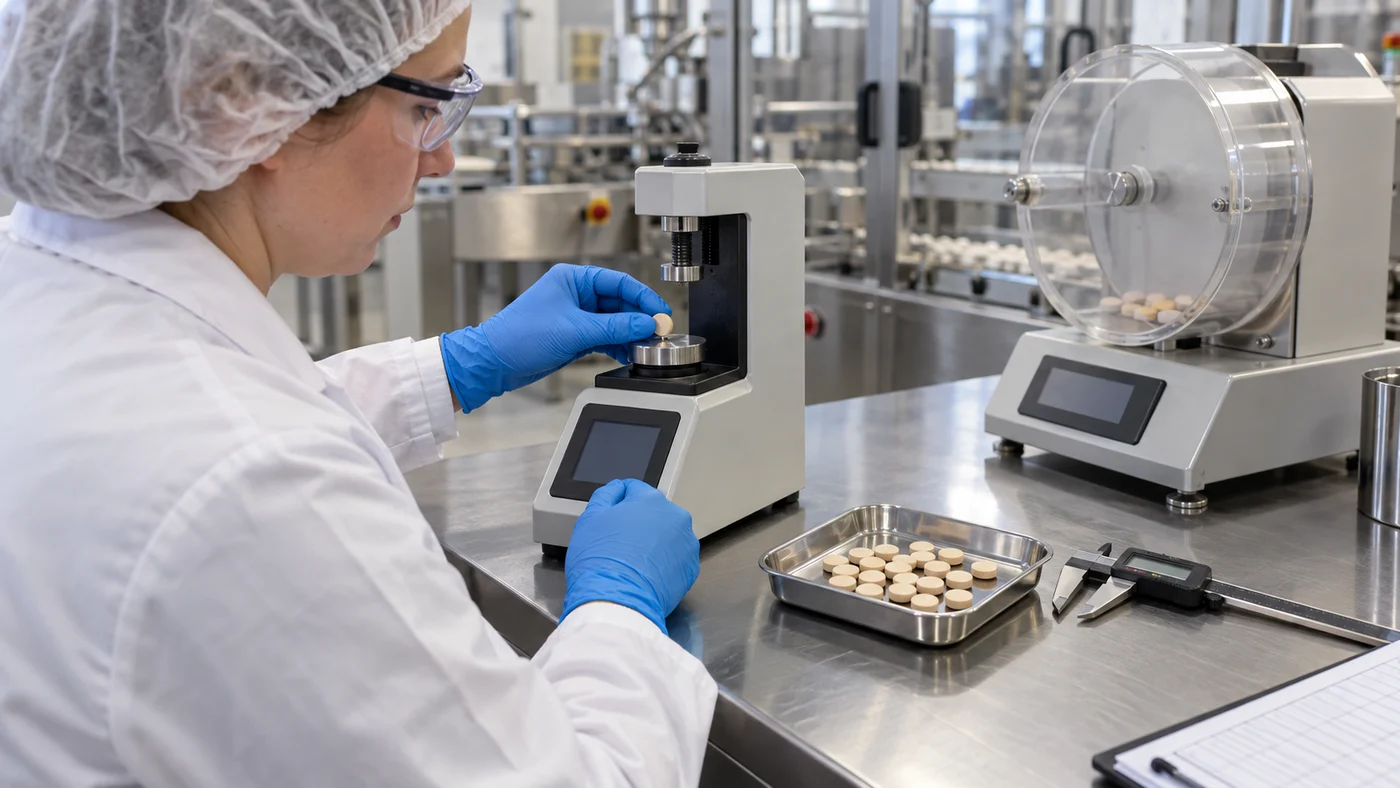
Common physical checks include individual or average weight, thickness, diameter or length, hardness or breaking force, and visual condition. Friability testing assesses resistance to abrasion and impact under a defined method. Disintegration testing may be relevant to some products, but the method and acceptance limit must match the intended product and applicable specification.
Set sampling frequency and response rules before routine manufacture begins. A tablet tester can automate several measurements, but the results still need approved limits and trend review. Record which tablets were sampled, when they were taken, and what happened when a result approached or exceeded a limit.
Physical tests do not replace chemical, microbiological, identity, or stability testing required by the product specification. Connect in-process data with the batch record and finished-product release decision. Avoid presenting a hardness value copied from another formula as a universal quality standard.
9. Plan dedusting, metal detection, and controlled rejects
Freshly compressed tablets can carry loose powder. A tablet deduster removes surface dust and elevates or transfers tablets to the next step. Its capacity, product-contact design, discharge height, access, and cleaning method should be checked with the actual tablet, especially when fragile edges or embossed faces are used.
A metal detector can be positioned after compression when justified by the site's hazard analysis and process design. Confirm aperture size, product effect, sensitivity validation method, challenge pieces, reject mechanism, reject confirmation, and access to rejected material. The detector should be tested in its installed configuration rather than selected from a sensitivity number alone.
Define how start-up tablets, in-process samples, dust, broken tablets, and detector rejects are collected, identified, reconciled, and disposed of. Rework should never be assumed. Any recovery route needs a documented product-specific decision that protects identity, quality, and traceability.
10. Use coating only when it has a defined purpose
Some pet supplement tablets are uncoated. Others may use a coating to modify appearance, reduce dusting, improve handling, manage taste or odour, or protect the product. The purpose should be stated first because it determines formulation, coating equipment, process conditions, and acceptance checks.
Coating adds a preparation and application stage, air handling, cleaning, and additional development work. Assess tablet strength before coating and confirm that the process does not create unacceptable defects or alter required performance. Any claim about taste masking or protection should be supported by product-specific evidence.
11. Match packaging to tablet stability and the market
Bottles, blister packs, and pouches create different equipment and material requirements. Bottle lines may include unscrambling, counting, filling, optional desiccant insertion where justified, capping, optional induction sealing, labelling, coding, and case packing. Blister lines require a compatible forming web, lidding material, pocket design, sealing process, inspection, and cartoning arrangement.
Provide actual tablets and packaging components for trials. Confirm count accuracy, broken-tablet handling, closure application, seal quality, coding, and line clearance. Desiccants and induction liners are not universal requirements; their use should come from stability and packaging studies.
Finished-product shelf life must be supported by the formulation in its selected pack under defined storage conditions. Packaging equipment can create a good closure, but it cannot independently establish a shelf-life claim.
12. Design dust control, cleaning, and changeover together
Identify dust-release points at bag opening, weighing, mixer charging, discharge, transfer, press feeding, compression, dedusting, and cleanup. Enclosure and extraction should reflect the actual ingredients and any identified occupational or combustible-dust risks. Collected dust must have a controlled disposition and should not automatically return to the batch.
Review access to the mixer, bins, transfer route, feeder, compression zone, deduster, detector, coater, and packaging contact parts. Decide which parts are cleaned in place and which move to a wash area. Where wet cleaning is used, drying and release before reassembly must be defined. The facility should prevent cleaned tooling and parts from becoming mixed with used items.
A changeover trial should include disassembly, cleaning, inspection, reassembly, line clearance, and restart. Record labour and elapsed time because these affect capacity. Product changeover and packaging changeover both need reconciliation of remaining material, tablets, labels, printed components, and rejects.
13. Translate the process into rooms and utilities
The layout should show people, material, waste, tooling, and cleaning flows. Provide space for receiving and hold areas, controlled weighing, preblending or granulation when used, final blending, compression, in-process testing, coating if used, packaging, finished-product hold, and support rooms. Separate unreleased from released stock through identification and procedure as well as physical planning.
Confirm electrical load, compressed air quality and demand, extraction, room environmental requirements, process water if granulation or coating uses it, drainage where applicable, and equipment heat loads. Room temperature or humidity targets should come from the products and processes rather than a generic supplement-factory value.
The pet supplement equipment overview can help organise the package, but final utility and layout schedules must use the selected machine data and real building conditions.
14. Prove performance through FAT, SAT, and product trials
Before the factory acceptance test, agree what the supplier will demonstrate and which materials will be available. Check equipment scope, controls, alarms, guarding, documentation, tooling, change parts, and cleaning access. If the actual formula cannot be used at the supplier's site, document the limitation and reserve product-performance testing for installation.
Site acceptance should verify the installed interfaces and utilities. Product trials should include representative formulas, startup, steady running, planned stops, restart, sampling, reject challenges, changeover, and cleaning. Record powder input, tablets produced, accepted output, samples, rejects, dust, residual material, runtime, downtime, and operator tasks.
Commissioning is complete only when the connected process can make an acceptable product under an approved procedure. Train production, quality, maintenance, and cleaning teams on the same equipment state and documents used for acceptance.
Information to prepare for an equipment proposal
- Tablet formulas or representative ingredient and powder-property data.
- Target tablet weight, dimensions, shape, score, appearance, and serving format.
- Direct-compression or granulation trial results, if available.
- Smallest, typical, and largest batch sizes.
- Required accepted tablets per shift and planned working pattern.
- Bottle, blister, or pouch samples and required pack counts.
- In-process tests, release tests, traceability, and reject requirements.
- Building drawings, available utilities, cleaning approach, and destination markets.
These inputs allow a supplier to compare equipment, capacity, room requirements, and commissioning work against one clear production basis. For a project review with PetFactorySystem.com, share the available information and identify any formulation work that is still pending so the proposal can separate confirmed requirements from trial-dependent decisions.
Technical references
- Fette Compacting: direct compression process describes the direct route and the importance of formulation suitability.
- GEA: tablet press and integrated line functions provides background on compression, dedusting, detection, and process integration.
- SOTAX: physical testing of tablets outlines weight, dimensions, hardness, friability, and disintegration measurements.
Review the related factory system
Compare the production route, equipment package, layout assumptions, capacity target, and operating requirements before confirming a factory plan.