Start with the product route, not the machine list
A pet food factory should not begin with a random equipment quotation. The first decision is the product route: dry kibble, baked or semi-moist treats, freeze dried treats, or a mixed project that includes several lines. Each route changes the raw material handling method, moisture target, thermal process, packaging format, utility load, factory zoning, and operator skill requirements.
For most new investors, the safest first step is to define a narrow commercial route. A factory that starts with dry dog food and dry cat food has a different process logic from a factory built around high-value freeze dried treats. Before asking for equipment, prepare the basic project scope: target market, species, product form, expected formulas, package size, annual output target, land or building status, and launch timeline.
If you are still comparing routes, use the Factory Setup Process page as the planning checklist before selecting equipment.
Define capacity in a way that matches real production
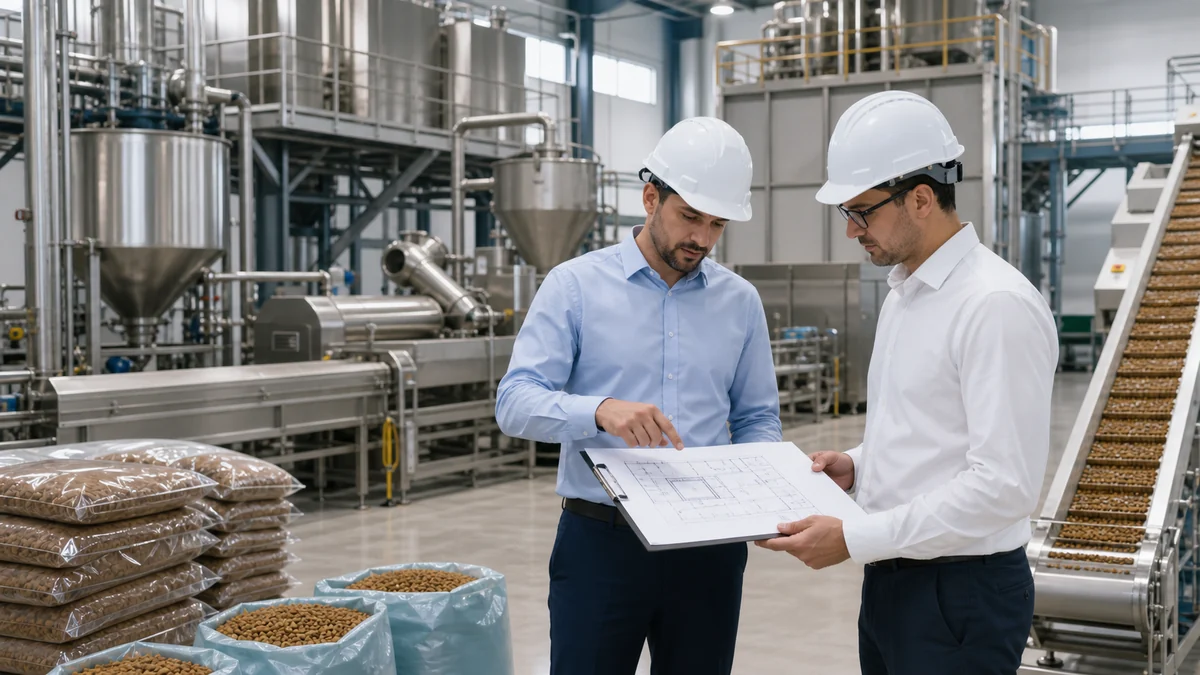
Capacity planning should be expressed by line output, operating hours, annual production days, changeover frequency, and packing speed. A line that can extrude a high hourly output may still be limited by dryer residence time, coating uniformity, cooling, packing speed, or the number of formulas scheduled in the same week.
For dry kibble, buyers should define whether they need a pilot line, a single commercial line, or a scalable factory with room for a second line. Formula complexity also matters. High-meat, high-fat, small-breed, cat food, and economy dog food formulas may require different grinding, mixing, conditioning, and coating assumptions. The Pet Food Factory System page shows how the process is treated as a complete factory system rather than a product catalog.
- Target output per hour and expected operating shifts.
- Dry dog food, dry cat food, treats, or freeze dried product route.
- Number of formulas and expected changeover frequency.
- Bag size, packaging speed, and finished goods storage model.
Build the process flow before buying equipment
A typical dry pet food factory includes raw material receiving, storage, grinding, batching, mixing, conditioning, extrusion, drying, coating, cooling, screening, packing, and warehouse flow. Each step must be sized as part of one system. If the grinder, mixer, extruder, dryer, and packing machine are selected separately, the factory may suffer from bottlenecks or unnecessary labor.
For equipment-level planning, compare the line logic on the Dry Kibble Line Equipment page. It explains why mixing, extrusion, drying, coating, cooling, and packing should be matched by output and formula range.
Plan utilities, layout, and quality control early
Pet food production is not only mechanical equipment. Steam or thermal energy, compressed air, water, power distribution, dust collection, ventilation, drainage, fire safety, operator access, raw material logistics, and finished product movement all affect the final factory design. These items are often underestimated when a buyer only compares equipment prices.
Quality control should also be designed before launch. A basic QC workflow may include incoming raw material checks, moisture testing, bulk density, kibble size control, fat coating checks, palatability sampling, packaging inspection, batch records, and retention samples. Xinji Pet Food experience is used as the manufacturing reference behind our planning logic, explained on the Factory Base page.
What to prepare before requesting a factory plan
A useful inquiry should include the product type, target capacity, country or market, available building information, preferred automation level, raw material route, packaging format, and expected launch timing. With these details, the supplier can design a process route and layout discussion instead of sending a generic machine list.
When the project scope is ready, send the details through the Project Inquiry page. The goal is not to quote a single machine, but to clarify the factory system that can be built and operated.
Common mistakes in first-time pet food factory projects
Many first-time projects fail to separate business feasibility from equipment selection. The investor may collect several machine quotations before the product route, formula range, land condition, and target market are clear. This makes the quotations difficult to compare because each supplier may assume a different capacity, automation level, packing speed, and utility scope.
Another common mistake is ignoring launch support. A factory needs installation, commissioning, trial production, operator training, raw material preparation, packaging material sourcing, and QC routines before it can produce saleable batches. A realistic plan should include the first three to six months of operating preparation, not only the equipment purchase date.
- Do not compare machine prices before confirming the product route.
- Do not ignore raw material storage, dust control, and packing logistics.
- Do not assume rated equipment output equals stable commercial output.
- Do not leave QC workflow and operator training until the final stage.
Review the related factory system
Compare the production route, equipment package, layout assumptions, capacity target, and operating requirements before confirming a factory plan.