Why a single equipment price is not the full project cost
The cost of a dry dog food production line depends on more than the extruder. A complete line may include raw material receiving, grinding, batching, mixing, conditioning, extrusion, drying, coating, cooling, screening, packing, metal detection, dust collection, utilities, installation, commissioning, training, and spare parts. Buyers who compare only extruder prices usually miss the items that decide whether the line can run continuously.
A better way to evaluate cost is to separate the project into equipment package, utility package, plant modifications, automation level, packaging system, laboratory and QC tools, installation service, and working capital for raw materials and packaging. The Pet Food Factory System page explains this as a factory system, not a single machine purchase.
Capacity and formula range drive equipment selection
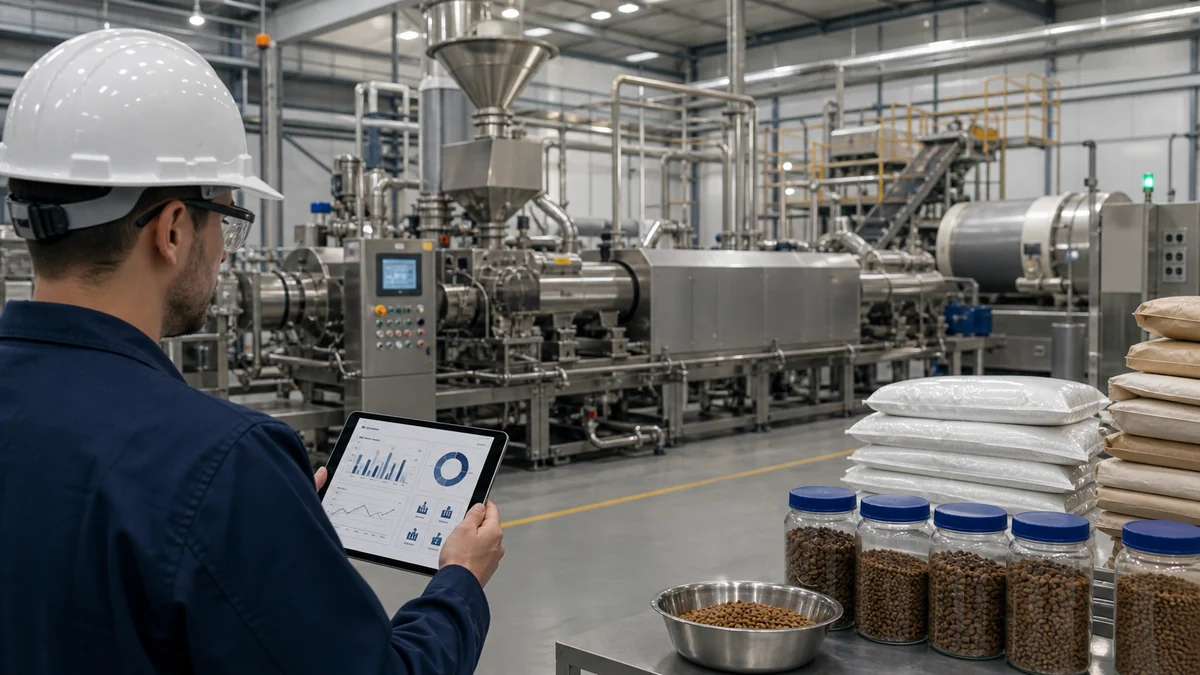
Line capacity affects nearly every part of the budget. A small commercial line may use simpler storage and manual handling. A larger factory needs stronger batching control, larger dryers, more coating capacity, higher packing speed, and a clearer material flow. Formula range also matters. High-fat, high-protein, small kibble, cat food, and economy dog food formulas create different process demands.
Before comparing cost, define the hourly output, operating days, formulas, kibble sizes, and packaging formats. If you are still mapping the production route, review Dry Kibble Line Equipment to understand the main equipment blocks.
- Grinding and batching accuracy for different raw material recipes.
- Extruder and conditioner sizing for the formula range.
- Dryer length and energy load based on moisture removal.
- Coating and cooling capacity for palatability and shelf stability.
Automation changes both CAPEX and operating discipline
Automation is not only a labor-saving choice. It affects batch consistency, data records, troubleshooting, operator skill requirements, and long-term quality control. Manual feeding and simple controls may reduce initial cost, but they can increase labor dependency and variation. Automated batching, recipe control, production data logging, and integrated packing can increase investment while improving repeatability.
For new investors, the right automation level depends on labor availability, quality expectations, number of formulas, and market positioning. A brand owner planning export products may need stronger documentation and QC than a small local plant producing a limited formula range.
Utilities and building conditions are often underestimated
Utility cost depends on the selected process. Dry kibble production may need steam or thermal energy, electric power, compressed air, ventilation, dust collection, water, drainage, and sometimes chilled or conditioned areas. The building must also support equipment height, maintenance access, raw material flow, forklift routes, packaging storage, and finished goods movement.
If the building already exists, ceiling height, floor load, drainage, power availability, and truck access may limit the line design. The Factory Setup Process page is useful for checking these assumptions before equipment confirmation.
How to request a useful cost discussion
A useful cost discussion should include target output, country, product type, formula direction, package sizes, available building information, preferred automation level, and launch timing. Without these details, any budget number is only a rough reference and may not include the items needed for operation.
Send the project information through Project Inquiry and ask for a scope-based discussion. This is more reliable than asking for a single price before the factory route is defined.
A practical way to compare budgets
When comparing budgets, request the scope in modules. A useful comparison should show what is included in raw material preparation, extrusion, drying, coating, packing, utilities, installation, electrical control, spare parts, and commissioning. If one quotation includes dust collection, packing conveyors, training, and site guidance while another only includes core machines, the lower price may not be the lower project cost.
Buyers should also separate must-have items from second-stage upgrades. For example, an initial factory may start with a single packing format but leave space for a second packing machine. It may start with a practical automation level but reserve data interfaces for future recipe management. This staged planning is often more useful than overbuilding the first line.
- Compare included equipment scope line by line.
- Ask whether installation, commissioning, and training are included.
- Check whether utilities and building preparation are excluded.
- Reserve expansion space if a second line or packing format is likely.
Review the related factory system
Compare the production route, equipment package, layout assumptions, capacity target, and operating requirements before confirming a factory plan.